


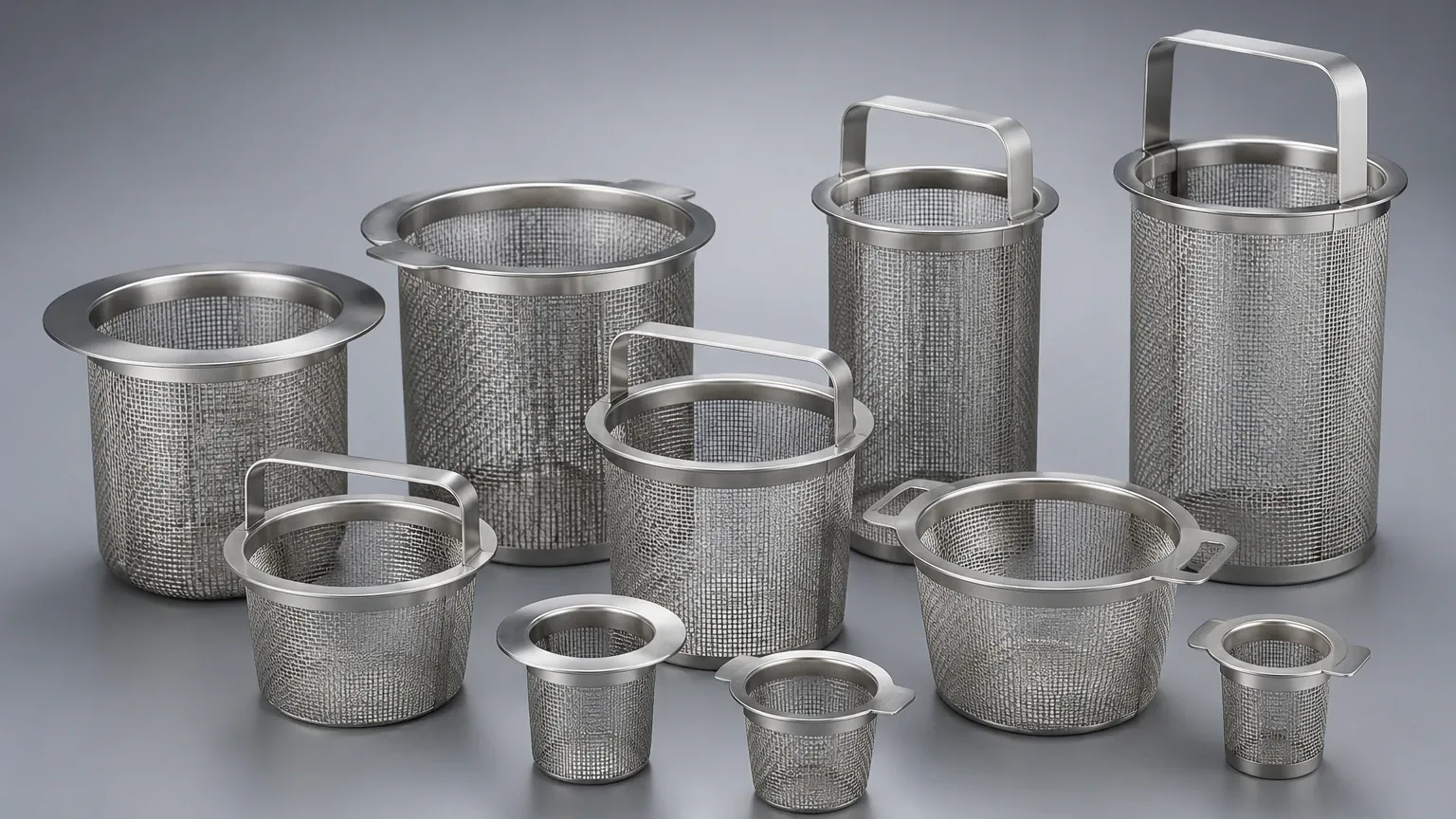
Strainer Basket Sizes
In industrial filtration and fluid handling, the selection of appropriate strainer basket sizes is a critical engineering decision that directly impacts system efficiency, equipment longevity, and maintenance frequency. Strainer baskets serve as the primary sacrificial barrier in a piping system, designed to remove unwanted solids from liquids to protect downstream components such as pumps, valves, and heat exchangers.
Choosing the correct size involves more than simply matching the pipe diameter. It requires a comprehensive understanding of flow dynamics, the physical properties of the media, and the structural limitations of the filter housing. For engineers and procurement teams, technical precision in specifying Strainers & Baskets ensures that the filtration system operates within its designed pressure parameters while providing sufficient dirt-holding capacity.
The Fundamentals of Strainer Basket Dimensions
When discussing strainer basket sizes, it is essential to distinguish between the nominal pipe size (NPS) of the strainer housing and the physical dimensions of the basket itself. While the housing is typically rated by the connection size—ranging from 1/2 inch to over 48 inches—the basket's dimensions are dictated by the internal volume of that housing.
Key Physical Parameters
1. Outside Diameter (OD): The basket must fit securely within the housing's guide or seat. An incorrect OD can lead to fluid bypass, where contaminated liquid flows around the basket rather than through the filtration media.
2. Height/Length: The length of the basket determines the total surface area available for filtration. In high-debris applications, "deep" or "high-capacity" baskets are often utilized to extend the time between cleaning cycles.
3. Flange or Ring Diameter: The top of the basket usually features a flange or a handle ring that rests on the housing ledge. This interface is critical for maintaining a seal, especially in high-pressure environments.
The Relationship Between Size and Open Area Ratio
One of the most important technical metrics in determining strainer basket sizes is the Open Area Ratio (OAR). This is the ratio of the total open area of the basket (the sum of all the holes or mesh openings) to the internal cross-sectional area of the inlet pipe.
An OAR of 6:1 or 8:1 is often preferred for industrial applications. A higher ratio means that the basket has significantly more open area than the pipe feeding it, which results in several performance benefits:
* Reduced Pressure Drop (ΔP): A larger surface area allows fluid to pass through with less resistance.
* Increased Dirt-Holding Capacity: More surface area allows the basket to collect more debris before the pressure drop reaches the terminal limit for cleaning.
* Lower Velocity: By spreading the flow over a larger area, the velocity of the fluid passing through the mesh is reduced, which minimizes the risk of particle "extruding" through the openings or damaging the mesh.
Engineering Considerations for Sizing and Mesh Selection
Selecting the right strainer basket sizes requires balancing the physical size of the basket with the size of the openings in the filtration media. These two factors work in tandem to define the performance of the strainer.
Perforation vs. Mesh Lining
Industrial baskets are typically constructed from a perforated metal substrate. For coarse filtration, the perforation size alone may be sufficient (e.g., 1/8" or 1/16" holes). However, for finer filtration, a wire mesh lining is added to the interior or exterior of the perforated basket.
When specifying mesh-lined baskets, engineers must account for the fact that the mesh reduces the effective open area. For example, a 100-mesh liner has a much smaller open area than a 20-mesh liner. To compensate for the increased resistance of fine mesh, it is often necessary to increase the physical size of the basket or use a larger strainer housing to maintain the desired OAR.
Fluid Viscosity and Flow Rate
The viscosity of the fluid is a primary driver in sizing. Highly viscous fluids, such as heavy oils or resins, encounter much higher resistance when passing through a mesh. In these cases, standard strainer basket sizes may be inadequate, and oversized baskets are required to prevent excessive pressure drop even when the basket is clean.
Customization and Manufacturing Precision
In many OEM and retrofit scenarios, standard off-the-shelf baskets do not meet the specific requirements of a unique industrial process. Manufacturers like Kaifil specialize in producing custom stainless steel filtration components that adhere to precise dimensional tolerances.
Customization options often include:
* Heavy-Duty Reinforcement: For high-pressure applications where a standard basket might collapse under the weight of collected debris.
* Specialized Handles: Including slanted handles or lift-out loops designed for specific ergonomic or overhead clearance constraints.
* Material Selection: Utilizing Grade 304 or 316L stainless steel to ensure chemical compatibility and corrosion resistance in harsh environments like chemical processing or marine applications.
* Multi-Stage Filtration: Designing baskets with concentric layers of different mesh sizes to capture a range of particle sizes in a single pass.
Risks of Incorrect Strainer Basket Sizing
Failure to accurately specify strainer basket sizes can lead to significant operational challenges and potential equipment failure.
Excessive Pressure Drop and Cavitation
If a basket is too small for the flow rate and viscosity of the fluid, the initial pressure drop will be high. As debris begins to collect, the ΔP will rise rapidly. In suction-side applications (before a pump), this can lead to cavitation, where the low pressure causes vapor bubbles to form and collapse, causing severe mechanical damage to the pump impeller and housing.
Structural Failure (Collapse)
Every strainer basket has a maximum allowable differential pressure. If a basket is undersized for the debris load, it may fill up faster than the maintenance schedule allows. The resulting pressure buildup can exceed the structural strength of the stainless steel, causing the basket to burst or collapse. This allows all collected debris to rush downstream into sensitive equipment.
Fluid Bypass
If the basket's OD or flange size is not precisely matched to the housing, fluid will take the path of least resistance. Even a small gap can allow large particles to bypass the filter, rendering the entire filtration system ineffective.
Technical Confirmation: A Checklist for Engineers
Before finalizing the procurement of Strainers & Baskets, technical teams should confirm the following data points to ensure the chosen strainer basket sizes are appropriate for the application:
1. Maximum Flow Rate: What is the peak flow the system must handle? Sizing should always be based on the maximum, not the average.
2. Particle Load: Is the fluid relatively clean, or does it contain a high concentration of solids? High loads require larger baskets or automated cleaning systems.
3. Target Particle Size: What is the smallest particle that must be removed? This determines the mesh or perforation size.
4. Allowable Clean Pressure Drop: What is the maximum ΔP the system can tolerate when the basket is clean? Usually, this is kept under 2 PSI.
5. Terminal Pressure Drop: At what ΔP will the system be shut down for cleaning? This is typically 10-15 PSI above the clean pressure.
6. Housing Compatibility: Are the ID, OD, and height measurements verified against the original manufacturer's specifications for the strainer housing?
7. Chemical Compatibility: Is the stainless steel grade (304, 316, 316L) compatible with the process fluid at operating temperatures?
Conclusion
Strainer basket sizes are a fundamental component of industrial process design. By moving beyond simple pipe-size matching and focusing on the engineering realities of Open Area Ratio, fluid velocity, and structural integrity, engineers can ensure reliable filtration performance. Whether utilizing standard dimensions or opting for custom-engineered solutions from manufacturers like Kaifil, the goal remains the same: protecting the integrity of the industrial system through precise, durable, and efficient filtration.
