


5 Wedge
In industrial filtration and separation, the selection of profile wire dimensions is a critical engineering decision that dictates the mechanical integrity, flow efficiency, and longevity of a system. Among the various specifications used by engineers, the "5 wedge" profile—referring to a profile wire with a specific width, typically 5mm, or a designated '5' series profile—represents a robust solution for heavy-duty applications. Understanding how these Wedge Wire Screens function at a granular level is essential for optimizing industrial processes in mining, water treatment, and petrochemical refining.
Wedge wire, also known as V-wire, is characterized by its triangular or wedge-shaped cross-section. This geometry is not merely aesthetic; it is a functional design intended to minimize blinding and facilitate easy cleaning. When considering a 5 wedge profile, engineers are often looking for a balance between high open area and the structural mass required to withstand significant hydraulic or mechanical loads.
Technical Engineering of Wedge Wire Profiles
The fundamental advantage of a wedge wire screen lies in its two-point contact. Unlike woven wire mesh, where particles can become wedged in the apertures, the V-shape of the wedge wire ensures that any particle passing through the narrowest point of the slot (the surface) will continue to move freely through the widening gap.
A 5 wedge profile wire provides a substantial cross-sectional area. In engineering terms, the width of the wire (5mm) and its corresponding height determine the Moment of Inertia for the individual wire strand. This is a critical factor when calculating the screen's resistance to bending under pressure. In high-pressure applications, such as deep-well sand control or large-scale diversion screens, a thicker profile like the 5 wedge is preferred over thinner 1mm or 2mm profiles because it offers superior wear life and structural stability.
The manufacturing process involves the precision resistance welding of these profile wires onto support rods. The intersection of each wire and rod is welded, creating a rigid, one-piece structure. This eliminates the risk of wire shifting, which is a common failure mode in traditional mesh screens under high-vibration or high-flow conditions.
The Relationship Between Slot Size and Open Area
When specifying a 5 wedge screen, the relationship between the wire width and the slot opening is the primary driver of filtration performance. The "Open Area" percentage is calculated using the following formula:
Open Area % = [Slot Size / (Slot Size + Wire Width)] × 100
Because a 5 wedge wire is relatively wide (5mm), achieving a high open area requires a correspondingly larger slot size. If a fine filtration (e.g., 50 microns) is required, using a 5mm wide wire would result in a very low open area, significantly increasing the pressure drop across the screen. Therefore, 5 wedge profiles are typically reserved for applications where:
1. Large Slot Sizes are Acceptable: Such as in primary water intake or heavy mineral processing where slots might range from 2mm to 10mm.
2. Structural Rigidity is Paramount: Where the screen must support the weight of a heavy catalyst bed or withstand the impact of large aggregate in a vibratory shaker.
3. High Abrasive Resistance is Required: The additional mass of the 5mm profile allows for a greater sacrificial wear layer before the structural integrity of the screen is compromised.
Material Selection and Chemical Compatibility
For industrial filtration, material selection is as important as the physical geometry of the screen. Wedge wire screens are most commonly manufactured from stainless steel due to its mechanical properties and resistance to corrosion.
* Grade 304: Suitable for general-purpose applications where cost-effectiveness is prioritized and the environment is not highly corrosive.
* Grade 316L: The industry standard for chemical processing and marine environments. The low carbon content prevents sensitization during the resistance welding process, ensuring the welds remain as corrosion-resistant as the base metal.
* Duplex Stainless Steels: For extreme environments involving high chloride concentrations or severe mechanical stress, Duplex alloys provide nearly double the yield strength of standard austenitic grades and superior resistance to stress corrosion cracking.
When deploying a 5 wedge screen in a corrosive fluid stream, engineers must account for the potential for crevice corrosion at the weld points. Proper passivation after manufacturing is a standard requirement to ensure the protective oxide layer is uniform across the entire screen assembly.
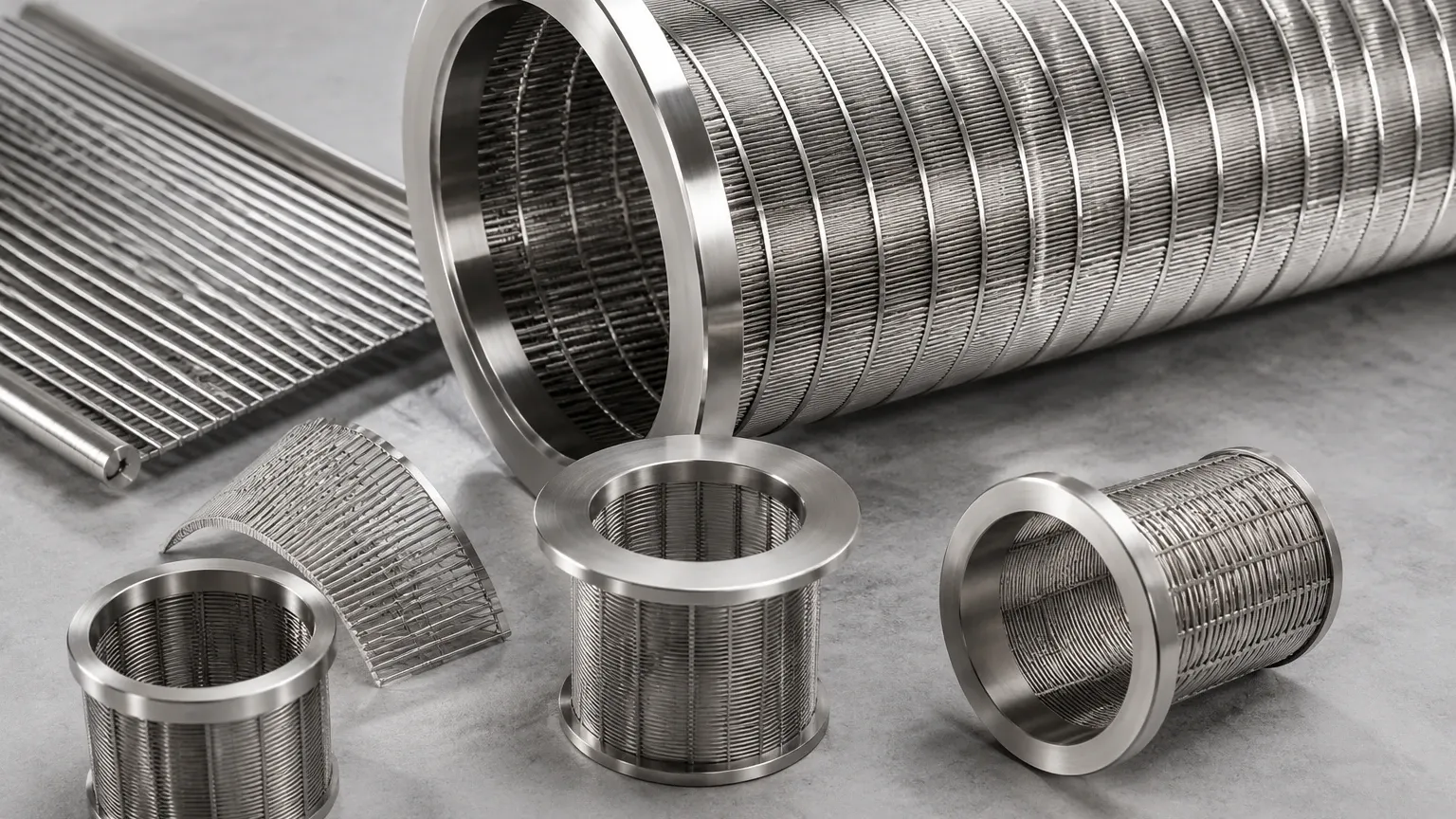
Structural Configuration: Surface Wires and Support Rods
The performance of Wedge Wire Screens is also dependent on the support rod configuration. The support rods are the skeleton of the filter, and their shape and spacing determine the collapse strength of the cylinder or the load-bearing capacity of the flat panel.
In a 5 wedge configuration, the support rods are typically spaced to match the expected load. For a cylindrical screen used in a pressurized vessel, the support rods may be circular, rectangular, or even another wedge profile oriented perpendicularly. The choice of rod shape affects the flow dynamics on the downstream side of the screen. For example, a teardrop-shaped support rod can reduce turbulence and minimize the pressure drop in high-velocity gas or liquid flows.
Engineers must also specify the orientation of the wedge wire. "Radial Internal" (wire on the inside, support rods on the outside) is common for flow-out applications, while "Radial External" (wire on the outside) is used for flow-in applications like intake screens. For 5 wedge profiles, the welding parameters must be carefully controlled to ensure full penetration without distorting the 5mm wire profile.
Application-Specific Selection Criteria
The 5 wedge profile is frequently found in specific industrial sectors where standard filtration components would fail due to mechanical fatigue or abrasive wear.
Mining and Mineral Processing
In coal and ore processing, screens are subjected to constant vibration and the impact of heavy solids. A 5mm profile provides the necessary bulk to resist the abrasive action of the slurry. These screens are often used in dewatering centrifuges and vibratory sieves where the high G-forces would cause thinner wires to snap.
Water Intake and Fish Diversion
Large-scale water intake systems for power plants or municipal treatment facilities require screens that can withstand the impact of debris and the pressure of high-volume flow. The 5 wedge profile offers the durability needed for long-term submerged service, often combined with air-burst cleaning systems that require the screen to handle sudden pressure surges.
Petrochemical Reactor Internals
In fixed-bed reactors, wedge wire screens serve as catalyst support grids. The 5 wedge profile is often chosen for its ability to support several tons of catalyst media while maintaining a precise slot opening to prevent media migration. The thermal expansion of the stainless steel must be accounted for in the design, especially in high-temperature hydroprocessing units.
Maintenance and Total Cost of Ownership (TCO)
While the initial capital expenditure for a 5 wedge screen may be higher than for thinner wire alternatives or woven mesh, the Total Cost of Ownership is often lower due to reduced downtime and longer replacement cycles.
Cleaning Efficiency
The V-shaped slot of the wedge wire is inherently easier to clean than other filter media. In automated systems, backwashing or back-pulsing is highly effective because the flow is restricted only at the surface. Once a particle is dislodged from the slot, it is immediately swept away by the reverse flow without being trapped by internal cross-wires.
Inspection and Replacement
Engineers should establish a regular inspection schedule to monitor for "wire thinning" due to abrasion. In a 5 wedge profile, the wear can be measured precisely. Once the wire width has decreased by a predetermined percentage (calculated based on the required safety factor for the application's pressure), the screen should be slated for replacement. Because the structure is welded, it does not suffer from the "fraying" associated with mesh, making it safer to handle during maintenance.
Customization Options
When ordering 5 wedge components, it is vital to confirm the exact tolerances required for the slot opening. Precision manufacturing allows for slot tolerances as tight as +/- 0.05mm, even with larger wire profiles. Customizations such as reinforced end-flanges, lifting lugs, and specialized surface coatings (like Chrome plating for extra hardness) can further extend the service life of the component.
Before finalizing a specification, technical teams should provide the manufacturer with the flow rate, fluid viscosity, particle size distribution, and maximum allowable pressure drop. This data allows for the verification of the 5 wedge profile's suitability for the specific hydraulic conditions of the project.
