


Strainer Emoji
In the digital age, symbols and icons serve as shorthand for complex objects and concepts. While a search for a "strainer emoji" might lead to various culinary icons or simplified graphics representing a colander, the gap between a digital symbol and the engineering reality of industrial fluid management is vast. For engineers and procurement professionals, the visual representation of a strainer is less about a simple icon and more about the technical specifications, material integrity, and flow dynamics of professional Strainers & Baskets.
Industrial filtration requires a level of precision that no digital icon can convey. Whether protecting high-value downstream equipment like pumps and flow meters or ensuring the purity of a chemical batch, the selection of a strainer is a critical engineering decision. This guide moves beyond the surface-level visual of a strainer to explore the technical nuances, material considerations, and performance criteria essential for industrial applications.
Understanding the Visual Representation of Filtration
The concept of the strainer emoji often brings to mind a household kitchen tool used for pasta or vegetables. In a B2B context, however, the "symbol" of a strainer represents a critical line of defense in a process piping system. While consumer-grade strainers are designed for atmospheric pressure and basic drainage, industrial strainers and baskets are engineered components designed to withstand high pressures, corrosive environments, and continuous duty cycles.
In technical drawings and P&IDs (Piping and Instrumentation Diagrams), the symbol for a strainer is standardized to ensure clarity across engineering teams. Unlike a generic emoji, these symbols indicate the type of strainer—Y-type, T-type, or basket—and its orientation within the system. For a manufacturer like Kaifil, the visual representation of a product is the starting point for a deep dive into micron ratings, mesh counts, and alloy compositions.
The Engineering Reality of Industrial Strainers & Baskets
Industrial strainers are closed-loop pressure vessels used to remove large particles from liquids or gases. Unlike fine filters, which may target sub-micron particles, strainers and baskets are typically used for "coarse" filtration, protecting equipment from debris such as scale, weld beads, or sediment.
Basket vs. Y-Strainer Designs
While the strainer emoji might suggest a simple bowl shape, industrial designs vary significantly based on the application:
1. Basket Strainers: These feature a vertical cylinder (the basket) that can hold a large volume of debris. They are preferred in applications with high flow rates or where the fluid contains a significant amount of solids. The primary advantage is the large surface area, which reduces the frequency of cleaning.
2. Y-Strainers: Named for their shape, these are compact and often used in steam or gas lines where the amount of debris is relatively low. They are easier to install in tight spaces but offer less storage capacity for captured particles than a dedicated basket design.
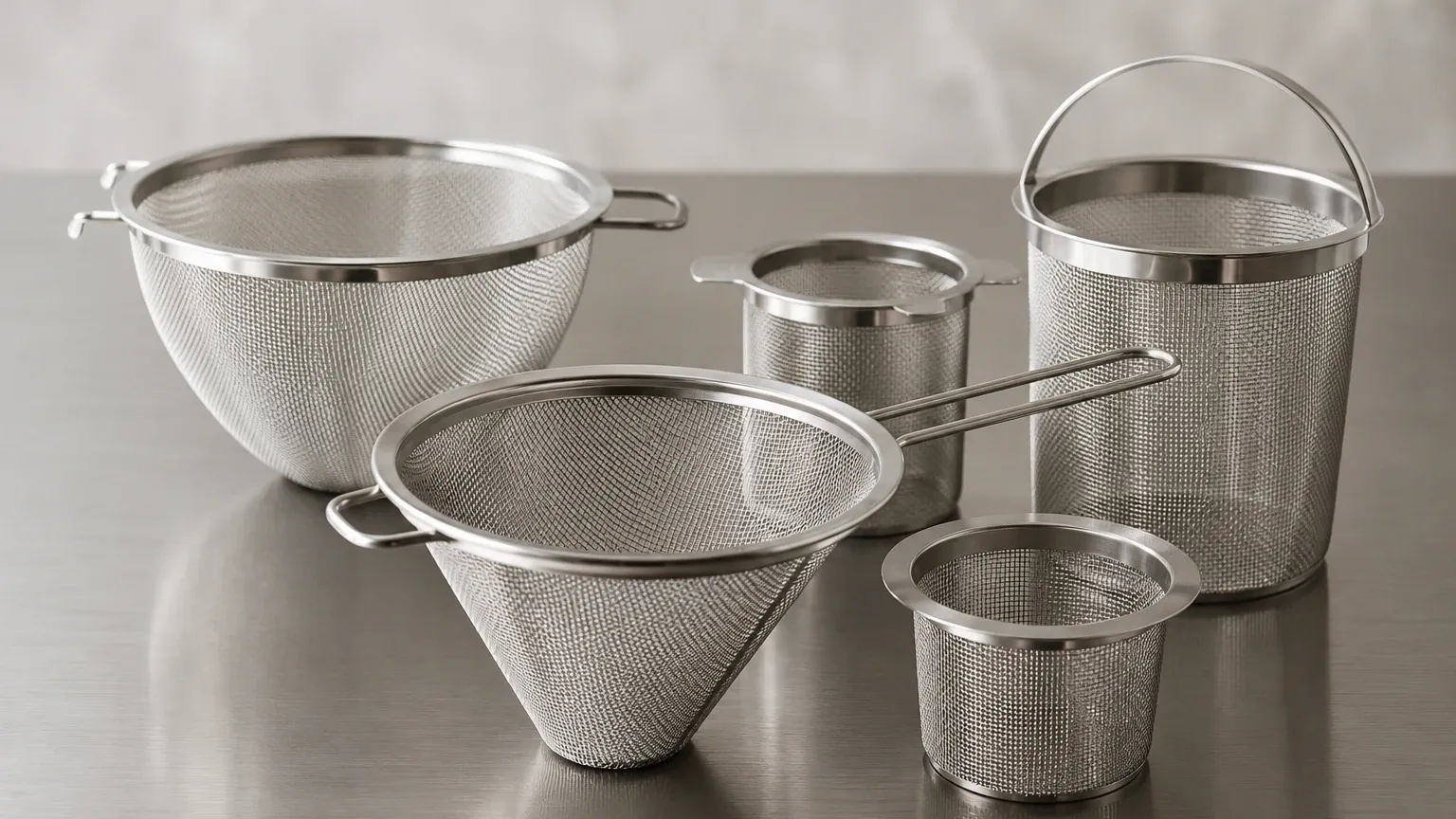
For most heavy-duty industrial processes, the basket configuration is the standard. Kaifil specializes in custom-designed baskets that utilize high-grade stainless steel wire mesh or perforated metal, ensuring that the internal component can withstand the mechanical stresses of the flow.
Key Performance Indicators (KPIs) for Industrial Filtration
When transitioning from a conceptual design to a physical installation, engineers must evaluate several technical KPIs. These factors determine whether a strainer will function efficiently or become a bottleneck in the system.
1. Pressure Drop (ΔP)
Every component added to a piping system introduces resistance to flow, resulting in a pressure drop. An ideal strainer design maximizes the "Open Area Ratio" (OAR). The OAR is the ratio of the total open area of the mesh or perforations to the cross-sectional area of the inlet pipe. A high OAR (typically 4:1 or higher) ensures that the pressure drop remains low even as the basket begins to fill with debris.
2. Micron Rating and Mesh Count
The "fineness" of the filtration is determined by the mesh count (the number of openings per linear inch) or the micron rating (the size of the smallest particle the mesh will capture). In industrial Strainers & Baskets, it is common to use a multi-layered approach: a heavy-duty perforated metal basket for structural strength, lined with a fine stainless steel wire mesh for precise particle retention.
3. Flow Velocity
Flow velocity impacts both the efficiency of the filtration and the wear on the strainer element. High velocities can lead to erosion of the mesh or cause particles to be forced through the openings. Engineering teams must calculate the optimal velocity to ensure laminar flow through the strainer body, minimizing turbulence and potential cavitation.
Material Selection: Why Stainless Steel is the Industrial Standard
While a digital strainer emoji is agnostic of material, the physical reality of chemical processing or food production demands specific alloys. Kaifil focuses on stainless steel due to its superior mechanical properties and resistance to environmental degradation.
* Grade 304 Stainless Steel: The most common industrial grade, offering excellent corrosion resistance for water treatment and general industrial applications. It is cost-effective and provides high structural integrity.
* Grade 316/316L Stainless Steel: Contains molybdenum, which provides enhanced resistance to chlorides and pitting. This is the preferred material for marine environments, pharmaceutical processing, and chemical plants where aggressive fluids are present.
* Specialty Alloys: For extreme environments involving high temperatures or highly acidic media, custom baskets can be fabricated from materials like Monel, Hastelloy, or Duplex stainless steel.
Material selection also impacts the cleaning process. Stainless steel components can be ultrasonically cleaned or chemically passivated, extending the lifecycle of the basket and reducing the total cost of ownership (TCO).
Customization: Moving Beyond Standard Off-the-Shelf Solutions
One of the limitations of standard parts—and the simplified view suggested by a generic icon—is that they rarely fit the unique constraints of a specialized industrial plant. Customization is often required to meet specific spatial or performance needs.
OEM and Bespoke Fabrication
Kaifil provides extensive OEM capabilities for customers requiring unique strainer geometries. Customization options include:
* Flange Configurations: Adapting to ANSI, DIN, or JIS standards to ensure seamless integration into existing piping.
* Reinforced Structures: Adding internal supports or outer shrouds to baskets to prevent collapse under high differential pressure (ΔP).
* Handle and Lifting Lug Designs: For large-scale baskets, ease of removal is critical for maintenance safety. Custom handles and lifting points are engineered based on the weight and accessibility of the strainer housing.
By working closely with engineering teams, manufacturers can develop filtration components that are optimized for the specific viscosity, temperature, and particle load of the process fluid.
Maintenance and Operational Longevity
A strainer is only as effective as its maintenance protocol. In a B2B environment, downtime is costly. Therefore, the design of Strainers & Baskets must facilitate rapid servicing.
Monitoring Differential Pressure
In sophisticated systems, differential pressure gauges are installed across the strainer. When the ΔP reaches a predetermined limit, it signals that the basket is full and requires cleaning. Ignoring this signal can lead to basket failure, where the structural integrity of the mesh is compromised by the force of the fluid, potentially sending debris downstream and defeating the purpose of the strainer.
Cleaning and Replacement Cycles
Unlike disposable filter cartridges, stainless steel baskets are designed to be cleaned and reused. The cleaning method depends on the nature of the contaminant. For non-adhesive particles, a simple high-pressure water wash may suffice. For resins or biological materials, thermal cleaning or chemical baths may be necessary. Understanding the expected replacement cycle—which is influenced by the abrasiveness of the particles and the frequency of cleaning—is essential for accurate MRO (Maintenance, Repair, and Operations) budgeting.
Conclusion: The Path to Optimized Filtration
While the "strainer emoji" serves as a simple visual cue in casual communication, the professional world of fluid processing demands a much more rigorous approach. Selecting the right Strainers & Baskets involves a deep understanding of fluid mechanics, material science, and the specific requirements of the application.
By focusing on high-quality materials like 304 and 316 stainless steel, and prioritizing engineering factors such as the Open Area Ratio and structural reinforcement, Kaifil ensures that industrial filtration systems remain reliable and efficient. For engineers and purchasing managers, the goal is to move past the simplified icons and invest in filtration solutions that provide long-term protection for their critical infrastructure. Whether you are designing a new chemical plant or upgrading a food processing line, the technical details of the strainer basket will always be more important than its digital representation.
