


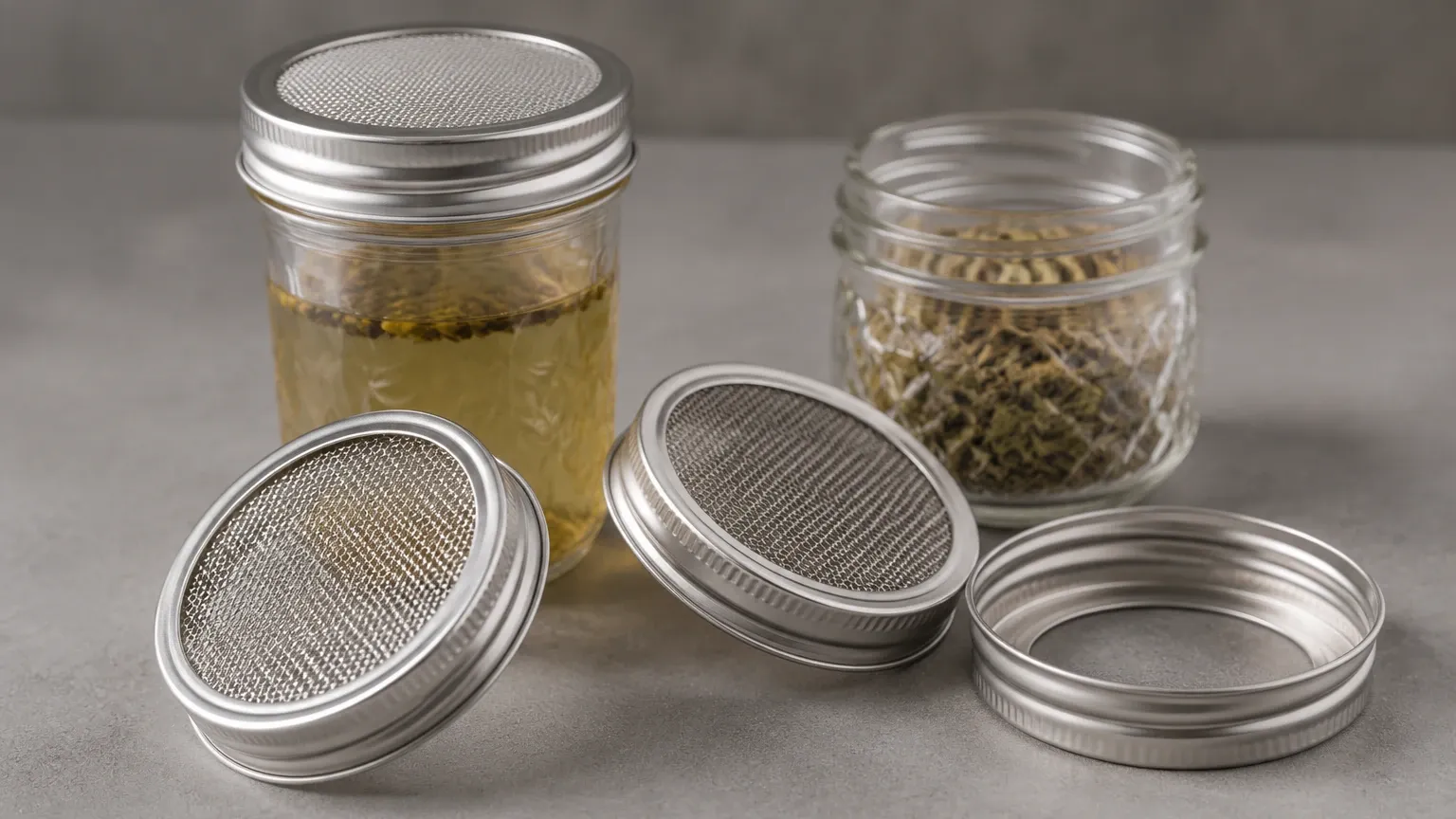
Strainer Lid for Mason Jar
In industrial research, laboratory testing, and small-batch chemical processing, the requirement for precise liquid-solid separation often necessitates the use of standardized containers paired with high-performance filtration components. The strainer lid for mason jar has evolved from a simple consumer tool into a specialized engineering component used for bench-top filtration, seed sprouting in controlled environments, and cold-extraction processes in pilot plants.
When evaluating these components from a B2B perspective, the focus shifts from basic utility to material integrity, mesh precision, and long-term durability. For engineers and procurement specialists, selecting the right filtration interface requires an understanding of how these small-scale strainers integrate into broader Strainers & Baskets systems and the technical specifications that define their performance.
Technical Specifications of Industrial-Grade Mesh Lids
An industrial-grade strainer lid for mason jar is defined by its construction materials and the precision of its wire mesh. Unlike standard consumer versions, industrial variants are typically manufactured using high-grade stainless steel (SS304 or SS316) to ensure chemical compatibility and resistance to corrosion.
Material Selection: 304 vs. 316 Stainless Steel
* Type 304 Stainless Steel: This is the standard for most food and beverage applications. It offers excellent corrosion resistance to most oxidizing acids and is highly durable for repeated sterilization cycles.
* Type 316 Stainless Steel: In environments involving high salinity, chlorides, or aggressive chemicals (common in pharmaceutical and chemical processing), 316 stainless steel is preferred. The addition of molybdenum enhances its resistance to pitting and crevice corrosion.
Mesh Count and Micron Ratings
The performance of a strainer lid for mason jar is primarily determined by its micron rating. The "mesh count" refers to the number of openings per linear inch. For industrial applications, these are often categorized as:
1. Coarse Filtration (20–40 Mesh): Used for large particle separation, such as botanical extractions or primary debris removal.
2. Medium Filtration (60–100 Mesh): Ideal for general laboratory straining and fine sediment removal.
3. Fine Filtration (150–400+ Mesh): Utilized for precision applications where microscopic particles must be retained, often found in specialized chemical synthesis or fine-powder recovery.
Engineering Considerations for Strainers & Baskets
While the strainer lid for mason jar serves small-scale needs, it shares the same engineering principles as larger industrial Strainers & Baskets. Understanding these principles helps technical teams scale their processes from the lab to the production floor.
Flow Rate and Open Area
The "open area" percentage of a mesh filter determines the flow rate and the pressure drop across the filter medium. A higher open area allows for faster processing but may compromise the structural integrity of the mesh if not supported correctly. Engineers must calculate the required flow velocity to ensure that the strainer does not become a bottleneck in the fluid system.
Structural Integrity and Reinforcement
In larger industrial baskets, the wire mesh is often supported by a perforated metal backing to withstand high differential pressures. For a strainer lid for mason jar, structural integrity is maintained through precision welding or mechanical crimping of the mesh into the lid frame. This ensures that the mesh remains taut and does not bypass fluid around the edges, even under vacuum-assisted filtration or pressurized pouring.
Applications in Professional Environments
The utility of a strainer lid for mason jar extends across several professional sectors where small-volume filtration is a daily requirement.
Pharmaceutical and Laboratory Research
In R&D labs, mason jars are frequently used as inexpensive, inert glass vessels for chemical reactions or solvent storage. A stainless steel strainer lid allows researchers to perform in-situ filtration, separating catalysts or precipitated solids without transferring the contents to a separate filtration assembly, thereby reducing the risk of contamination.
Food and Beverage Pilot Testing
Before scaling up to large-scale production, food scientists use small-scale vessels to test infusion rates, cold brew extraction profiles, and fermentation processes. The ability to swap different micron-rated lids on a standard jar allows for rapid prototyping of filtration stages.
Botanical and Essential Oil Extraction
Small-batch extraction often requires the separation of organic matter from solvents. A high-quality mesh lid provides a reliable method for primary separation, ensuring that the resulting liquid is free of large particulates before entering secondary, finer filtration stages.
Selection Criteria for Purchasing Teams
When sourcing filtration components, purchasing teams must look beyond the initial price and consider the total cost of ownership, which includes durability, ease of cleaning, and compliance with industry standards.
Compliance and Certification
For applications in the food, beverage, or pharmaceutical industries, it is essential that the materials used in the strainer lid for mason jar are FDA-compliant or meet equivalent international standards. This includes not only the stainless steel mesh but also any gaskets or seals used to prevent leaks. Silicone gaskets are generally preferred for their high-temperature resistance and food-grade safety.
Manufacturing Precision
Precision manufacturing ensures that the mesh is consistently woven and that the lid fits securely on standard wide-mouth or regular-mouth jars. Inconsistent weaving can lead to "hot spots" where larger particles pass through, compromising the quality of the filtrate. OEM manufacturers like Kaifil emphasize quality control to ensure that every component meets the specified micron rating.
Customization and OEM Solutions
In many industrial scenarios, off-the-shelf products do not meet the specific requirements of a unique process. Customization is a critical service provided by specialized manufacturers.
Custom Mesh Configurations
While standard mesh sizes are common, some processes require non-standard micron ratings or specific weave patterns (such as Dutch weave for higher strength or twill weave for finer filtration). Custom OEM manufacturing allows for the production of lids tailored to these exact needs.
Integration with Industrial Systems
Beyond the jar lid, industrial filtration often requires larger components like basket strainers for pipeline protection. Manufacturers who specialize in both small-scale lids and large-scale industrial baskets can provide a cohesive filtration strategy. This ensures that the materials and filtration logic remain consistent as a project moves from the laboratory (using a strainer lid for mason jar) to full-scale industrial production (using heavy-duty Strainers & Baskets).
Maintenance and Longevity of Stainless Steel Filters
One of the primary advantages of stainless steel filtration components is their reusability. However, maintaining their performance requires proper cleaning protocols.
1. Ultrasonic Cleaning: For fine mesh lids (100 mesh and above), ultrasonic cleaning is the most effective way to remove trapped particles from the wire intersections without damaging the mesh.
2. Chemical Cleaning: Depending on the residue, compatible solvents or caustic solutions can be used to dissolve organic buildup. The corrosion resistance of 316 stainless steel is particularly beneficial here.
3. Sterilization: Stainless steel lids can be autoclaved or steam-sterilized, making them ideal for applications requiring high levels of hygiene, such as sprouting or pharmaceutical sampling.
Conclusion: Selecting the Right Filtration Partner
Whether a facility requires a specialized strainer lid for mason jar for bench-top testing or a suite of custom-engineered Strainers & Baskets for a large-scale processing plant, the fundamental requirements remain the same: material quality, filtration accuracy, and structural reliability.
By focusing on technical specifications—such as alloy type, mesh count, and manufacturing tolerances—engineers can ensure that their filtration processes are efficient and repeatable. Partnering with a manufacturer that understands the nuances of industrial filtration allows for the development of customized solutions that meet the rigorous demands of modern industry, ensuring that every stage of the process, from the smallest jar to the largest pipeline, is optimized for performance.
