


Strainer Net
In industrial fluid handling systems, the integrity of downstream equipment—such as pumps, valves, and heat exchangers—depends heavily on the efficiency of primary filtration components. The strainer net serves as the critical functional element within industrial Strainers & Baskets, acting as a physical barrier that captures solid contaminants while allowing the process fluid to pass through with minimal resistance. For engineers and procurement professionals, selecting the appropriate strainer net involves a complex evaluation of material science, fluid dynamics, and mechanical durability.
Industrial strainer nets are typically constructed from high-quality stainless steel wire mesh or perforated metal. Unlike disposable filter cartridges, these components are designed for longevity and cleanability, making them a cost-effective solution for high-volume or high-viscosity applications. Understanding the technical nuances of mesh selection, support structures, and flow characteristics is essential for optimizing system performance and reducing total cost of ownership.
Technical Specifications of Industrial Strainer Nets
The performance of a strainer net is defined by its ability to retain specific particle sizes while maintaining structural integrity under pressure. Technical specifications generally revolve around three core metrics: mesh count, micron rating, and open area percentage.
Mesh Count and Micron Rating
Mesh count refers to the number of openings per linear inch of the wire cloth. A higher mesh count indicates a finer weave capable of capturing smaller particles. However, for engineering purposes, the micron rating (the size of the smallest particle the net will reliably trap) is often the more critical metric. For example, a 100-mesh strainer net typically provides a filtration accuracy of approximately 140 to 150 microns. In industrial settings, these ratings must be balanced against the viscosity of the fluid; higher viscosity fluids generally require a coarser strainer net to prevent excessive pressure drops.
Open Area Percentage
The "open area" is the ratio of the total area of the holes to the total area of the strainer net. This is a vital calculation for hydraulic efficiency. A higher open area results in a lower initial pressure drop across the strainer, which reduces the workload on pumps and extends the interval between cleaning cycles. Engineers typically aim for a strainer-to-pipe area ratio of at least 4:1 to ensure that even as the net begins to load with debris, the system flow remains within acceptable parameters.
Material Selection for Demanding Environments
Material compatibility is a primary concern in B2B procurement, particularly in industries involving corrosive chemicals or high-temperature processes. Kaifil specializes in manufacturing strainer nets from materials that withstand rigorous industrial cleaning and harsh operating conditions.
1. Stainless Steel 304: The industry standard for general-purpose applications. It offers excellent durability and corrosion resistance for water treatment, oil filtration, and non-acidic chemical processing.
2. Stainless Steel 316L: Containing molybdenum, 316L provides superior resistance to chlorides and pitting. It is the preferred choice for marine environments, pharmaceutical production, and food and beverage applications where hygienic standards are paramount.
3. Specialty Alloys: For extreme environments involving high concentrations of acids or temperatures exceeding 500°C, alloys such as Monel or Hastelloy may be utilized to ensure the strainer net does not degrade or contaminate the process stream.
Structural Design and Weave Types
A strainer net is rarely a standalone piece of mesh. In high-pressure applications, the fine mesh is often bonded to or supported by a heavier perforated metal basket. This configuration provides the mechanical strength necessary to resist "bursting" or deformation when the strainer becomes clogged and differential pressure increases.
Weave Patterns
The method of weaving the wire significantly impacts the strainer net's performance:
* Plain Weave: The most common and cost-effective, offering a straightforward square opening for general straining.
* Dutch Weave: Uses heavier wires in one direction and finer wires in the other, resulting in a dense, strong mesh with high filtration precision. This is ideal for high-pressure applications where fine particle retention is required.
* Twilled Weave: Allows for a heavier wire diameter in a given mesh count, increasing the mechanical strength of the net without sacrificing filtration accuracy.
Engineering Considerations: Flow and Pressure Drop
When integrating a strainer net into an industrial system, engineers must account for the Clean Pressure Drop (CPD). Every filtration element introduces resistance. If the strainer net is too fine for the application, the CPD will be high, leading to cavitation in pumps and increased energy consumption.
Furthermore, the "dirt-holding capacity" must be considered. A well-designed strainer net should provide sufficient surface area to collect a significant volume of solids before reaching the terminal pressure drop (the point at which cleaning is required). This is often achieved by using pleated designs or deep-well baskets that increase the effective filtration area without increasing the overall footprint of the strainer housing.
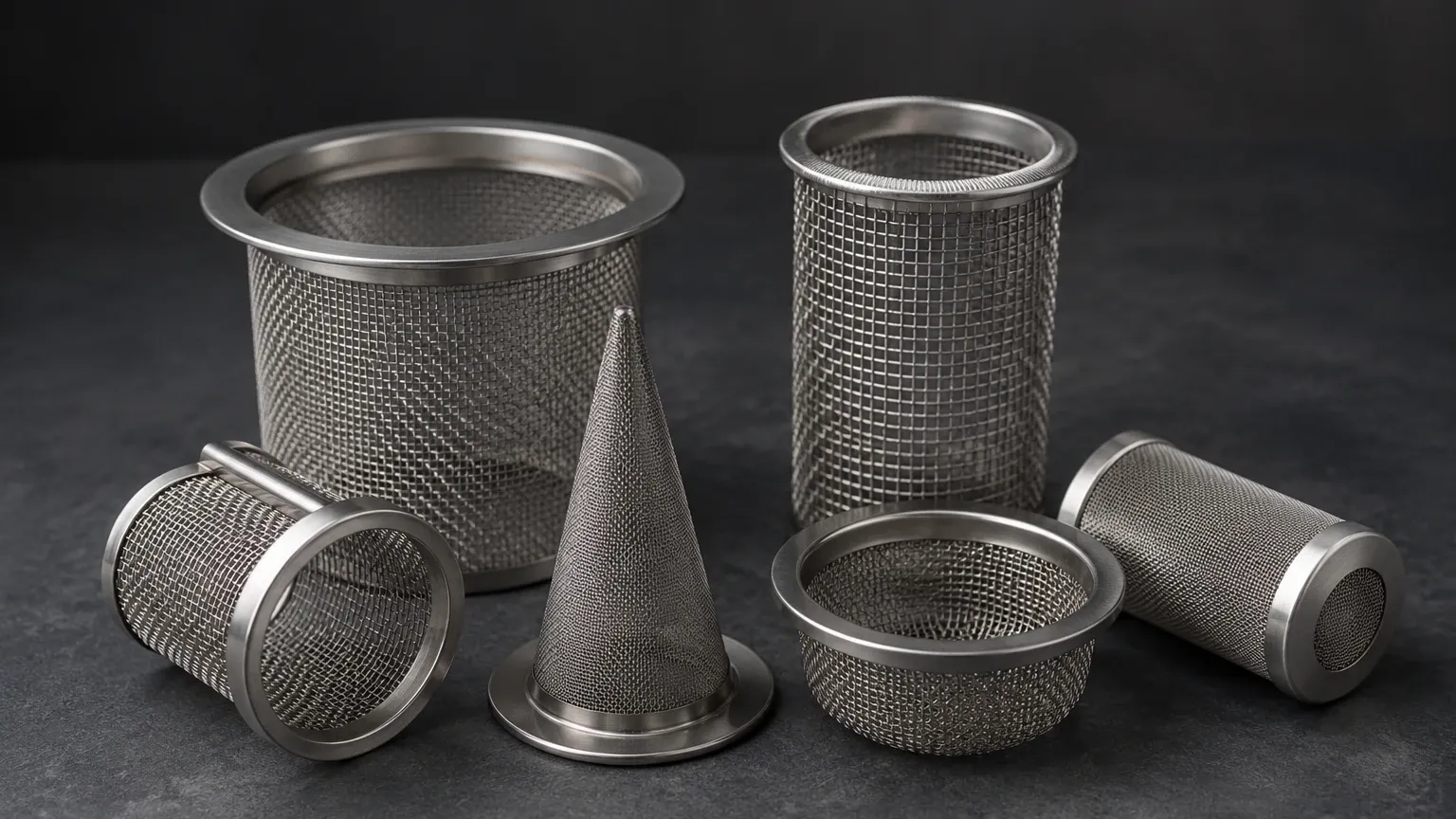
Common Applications for Strainer Nets
Strainer nets are utilized across a broad spectrum of industries, each with specific requirements for filtration accuracy and material safety.
Chemical and Petrochemical Processing
In these sectors, strainer nets protect expensive catalysts and prevent debris from entering sensitive reactors. The nets must be resistant to a wide range of pH levels and high operating pressures. Custom stainless steel solutions are often required to meet the specific chemical compatibility needs of the facility.
Food and Beverage Industry
Strainer nets in this industry must adhere to strict sanitary standards. They are used to remove pulp from juices, seeds from preserves, or clumps from dairy products. These nets are typically made from SS316L and feature smooth, polished surfaces to prevent bacterial growth and facilitate easy cleaning (Clean-in-Place or CIP processes).
Water Treatment and Irrigation
For municipal and industrial water treatment, strainer nets act as pre-filters to protect membrane systems (like Reverse Osmosis) from large particulates. In irrigation, they prevent sand and organic matter from clogging spray nozzles and emitters.
Maintenance, Cleaning, and Longevity
One of the primary advantages of a stainless steel strainer net is its reusability. Unlike synthetic fabric filters, metal nets can be cleaned and returned to service multiple times, significantly reducing waste and operational costs.
Cleaning Methods
* Manual Cleaning: For coarse strainers, a simple pressure wash or manual scrubbing with a soft brush is often sufficient.
* Ultrasonic Cleaning: For fine mesh or Dutch weave nets, ultrasonic baths are highly effective at removing microscopic particles trapped deep within the weave.
* Backwashing: In automated systems, the flow is reversed to flush contaminants off the surface of the strainer net and out through a blow-down valve.
Regular inspection is crucial. Engineers should look for signs of "wire migration" (shifting of the weave) or mechanical fatigue, especially in systems subject to frequent pressure surges. A damaged strainer net can allow bypass, leading to catastrophic failure of downstream components.
Selecting the Right Strainer Net for Your Project
To ensure optimal performance, purchasing teams and engineers should confirm several factors before finalizing a custom strainer net order:
* Particle Characterization: What is the size, shape, and concentration of the solids being removed?
* Operating Conditions: What are the maximum temperature and pressure? Is the flow continuous or pulsating?
* Fluid Properties: What is the viscosity and chemical composition of the fluid?
* Housing Compatibility: Does the net require a specific flange, handle, or gasket configuration to fit the existing Strainers & Baskets assembly?
Kaifil provides comprehensive OEM and customization services, allowing clients to specify every aspect of the strainer net, from the micron rating to the structural reinforcement. By working closely with a manufacturer that understands the complexities of industrial filtration, companies can ensure they receive a product that balances filtration precision with long-term durability.
In conclusion, the strainer net is a foundational component of industrial fluid management. Its selection should not be treated as a commodity purchase but as a technical decision that impacts the efficiency, safety, and maintenance schedule of the entire plant. By focusing on high-quality materials, precise engineering, and application-specific designs, industrial operators can achieve reliable and cost-effective filtration performance.
