


Strainer Valve
In industrial fluid handling systems, the integrity of downstream equipment—such as pumps, flow meters, control valves, and heat exchangers—is paramount to operational uptime. A strainer valve serves as the primary mechanical defense against debris, scale, and particulate matter. Unlike standard filtration systems designed for sub-micron removal, a strainer valve is typically integrated directly into the piping infrastructure to provide coarse to medium filtration, ensuring that solid contaminants do not cause mechanical failure or erosion.
Selecting the correct strainer valve requires a deep understanding of fluid dynamics, material compatibility, and the specific mechanical requirements of the application. For engineers and procurement teams, the decision involves more than just matching pipe sizes; it requires an evaluation of pressure drop, filtration surface area, and maintenance accessibility.
The Role of the Strainer Valve in Industrial Systems
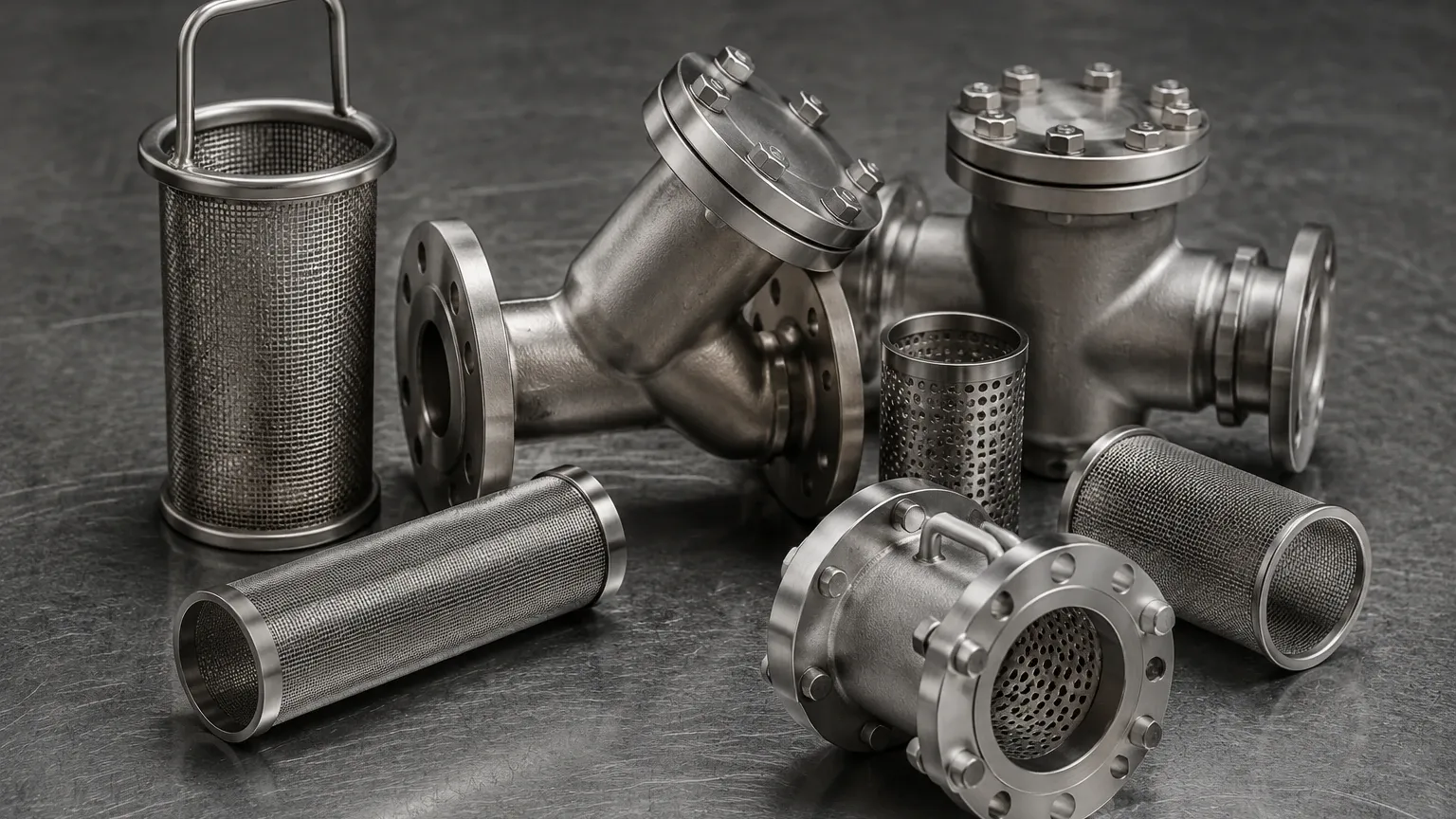
A strainer valve is essentially a closed vessel with a cleanable screen element designed to remove and retain foreign particles from flowing liquids or gases. While the term is often used interchangeably with "filter," in a B2B industrial context, a strainer is distinguished by its ability to handle larger volumes of solids and its typically lower pressure drop across the element.
In systems where Strainers & Baskets are deployed, the goal is often protection rather than purification. For instance, in a cooling water loop, a strainer valve prevents pipe scale or biological growth from entering a high-precision heat exchanger. In chemical processing, it ensures that undissolved catalysts or raw material fragments do not damage pump impellers.
Core Configurations: Y-Type vs. Basket Strainers
The geometry of a strainer valve significantly impacts its performance and suitability for specific environments. The two most common configurations are the Y-strainer and the basket (or T-type) strainer.
Y-Strainer Valves
Named for its "Y" shape, this configuration is optimized for high-pressure applications where the amount of material to be removed is relatively small. The compact design allows for installation in both horizontal and vertical pipelines, provided the "leg" of the Y points downward to collect debris via gravity. Y-strainers are frequently used in steam, gas, or high-pressure liquid lines where space is at a premium.
Basket Strainer Valves
Basket strainers feature a vertical cylinder that houses a removable basket-shaped element. These are typically used in horizontal lines and offer a significantly larger holding capacity for debris compared to Y-types. Because the basket can be lifted out from the top, maintenance is often simpler. These are the preferred choice for liquid applications with higher solids loading, as they provide a larger open area ratio, which translates to a lower pressure drop and longer intervals between cleaning.
Engineering Considerations: The Open Area Ratio (OAR)
One of the most critical technical metrics for an engineer selecting a strainer valve is the Open Area Ratio (OAR). The OAR is the relationship between the total area of the holes in the internal screen and the cross-sectional area of the inlet pipe.
* Low OAR (under 2:1): Results in rapid clogging and high pressure drops, which can lead to pump cavitation or system throttling.
* High OAR (4:1 to 6:1): Preferred for industrial applications. A higher ratio ensures that even as the screen begins to collect debris, the fluid velocity through the remaining open holes does not increase to the point of causing excessive turbulence or pressure loss.
Kaifil specializes in customizing these internal components to ensure that the OAR meets the specific flow requirements of a project, balancing filtration efficiency with system energy consumption.
Material Selection and Corrosion Resistance
Industrial environments often involve corrosive fluids, extreme temperatures, or strict hygiene requirements. The choice of material for both the valve body and the internal mesh is a primary factor in the component's lifespan.
Stainless Steel (304 and 316L)
Stainless steel is the industry standard for high-performance strainer valves. Grade 304 provides excellent durability for general industrial use, while Grade 316L is essential for pharmaceutical, food and beverage, and chemical applications due to its superior resistance to pitting and chloride-induced corrosion.
Specialized Alloys
For highly aggressive chemical environments or seawater applications, exotic alloys like Monel or Duplex stainless steel may be required. Ensuring that the strainer element is made from the same or a more noble material than the housing prevents galvanic corrosion, which can lead to premature structural failure of the mesh.
Filtration Accuracy: Mesh vs. Micron
When specifying a strainer valve, engineers must define the required filtration accuracy. This is typically expressed in mesh size or microns.
1. Mesh Size: Refers to the number of openings per linear inch. A higher mesh number indicates a finer screen. For example, a 20-mesh screen has larger openings than a 100-mesh screen.
2. Micron Rating: Defines the actual size of the particles that the screen can intercept. 1000 microns equals 1 millimeter.
It is a common mistake to specify a mesh that is too fine for the application. While a finer mesh removes more particulate, it also increases the frequency of maintenance and the initial pressure drop. The rule of professional engineering is to select a mesh size that is just fine enough to protect the most sensitive downstream component, but no finer.
Operational Maintenance and the Blow-Off Valve
A strainer valve is not a "fit and forget" component. Its effectiveness depends on regular cleaning. Many Y-strainers are equipped with a blow-off port in the cap. By installing a blow-off valve on this port, operators can flush out accumulated debris without shutting down the system or dismantling the strainer.
However, for basket strainers or when dealing with sticky or fibrous contaminants, manual cleaning of the basket is necessary. In these cases, installing differential pressure gauges upstream and downstream of the strainer is a best practice. When the pressure differential (ΔP) reaches a predetermined limit (usually 5-10 psi), it signals that the element requires cleaning.
Customization and OEM Requirements
Many industrial projects involve non-standard piping or unique fluid characteristics that off-the-shelf components cannot accommodate. This is where custom manufacturing becomes essential. Customization options for a strainer valve include:
* Custom Flange Connections: Matching specific international standards (ANSI, DIN, JIS) or proprietary equipment interfaces.
* Reinforced Baskets: For high-viscosity fluids or high-flow applications where the pressure might otherwise collapse a standard mesh screen.
* Magnetic Inserts: Used to capture fine ferrous particles that might pass through a standard mesh, providing an extra layer of protection for precision bearings and seals.
As a professional manufacturer, Kaifil works closely with engineering teams to develop these customized solutions, ensuring that every strainer valve is optimized for the specific pressures, temperatures, and flow rates of the intended environment.
Risk Mitigation in Procurement
When purchasing strainer valves for large-scale industrial projects, there are several risks that procurement teams must mitigate:
* Incompatible Materials: Failure to verify the compatibility of gaskets and seals with the process fluid can lead to leaks and environmental hazards.
* Inadequate Pressure Ratings: The valve body must be rated for the maximum surge pressure of the system, not just the operating pressure.
* Poor Weld Quality: In custom-fabricated strainers, the integrity of the mesh-to-frame welds is critical. Poor welding can lead to "bypass," where contaminants leak through gaps in the assembly, rendering the strainer useless.
To ensure quality, it is vital to confirm that the manufacturer follows rigorous quality control protocols and can provide material certifications (MTRs) for all pressure-retaining components.
Conclusion
The strainer valve is a fundamental component in maintaining the health and efficiency of industrial piping systems. By understanding the nuances of configuration, material science, and flow dynamics, engineers can select a solution that minimizes downtime and protects expensive downstream assets. Whether utilizing a standard Y-strainer for steam lines or a custom-engineered basket strainer for a chemical refinery, the focus must remain on technical precision and long-term durability. For those managing complex filtration requirements, partnering with an experienced manufacturer like Kaifil ensures that these critical components are designed and built to meet the most demanding industrial standards.
