


Strainer vs Sieve
In the realm of industrial fluid handling and material processing, the terms "strainer" and "sieve" are frequently used interchangeably. However, for engineers, plant managers, and procurement specialists, understanding the technical distinctions in the strainer vs sieve debate is essential for optimizing process efficiency and protecting downstream equipment. While both components utilize a porous medium—typically stainless steel wire mesh or perforated metal—to separate solids from fluids or to grade particles by size, their mechanical designs, operational environments, and primary objectives differ significantly.
Selecting the wrong component can lead to premature equipment failure, excessive pressure drops, or contaminated end-products. This guide examines the engineering nuances between these two filtration tools, focusing on their application within industrial systems such as Strainers & Baskets and specialized separation units.
Defining the Core Functions: Strainer vs Sieve in Industrial Processes
To differentiate between a strainer and a sieve, one must first look at the primary intent of the operation.
What is an Industrial Strainer?
An industrial strainer is a closed-system component integrated directly into a piping circuit. Its primary role is to protect expensive downstream equipment—such as pumps, valves, flow meters, and spray nozzles—from damage caused by debris, scale, or foreign particles. Strainers are designed for continuous or semi-continuous liquid flow. Because they are part of a pressurized system, they must be constructed to withstand specific line pressures and temperature fluctuations. In most cases, a strainer is intended to remove a small amount of relatively large solids from a large volume of liquid.
What is an Industrial Sieve?
A sieve is primarily a classification or grading tool. It is often used in batch processing or at the discharge point of a production line to ensure that solid particles meet a specific size distribution. While sieves can be used for liquid-solid separation, they are more commonly associated with dry bulk solids or slurries where the goal is to categorize the material rather than simply "cleaning" the fluid. A sieve typically operates under gravity or mechanical vibration rather than high-line pressure. In the context of strainer vs sieve, the sieve is often the tool used to define the quality of the product itself, whereas the strainer is a protective measure for the infrastructure.
Technical Specifications: Mesh Size, Micron Rating, and Flow Dynamics
When evaluating the performance of filtration components, engineers must look beyond simple terminology and focus on the technical metrics that govern particle retention and flow resistance.
Mesh Count and Micron Rating
Both strainers and sieves utilize wire mesh, but the way these are specified can vary. Mesh count refers to the number of openings per linear inch. A higher mesh count indicates smaller openings. However, the wire diameter also plays a role in determining the actual "clear opening" or micron rating.
In a strainer vs sieve comparison, strainers often utilize coarser mesh or perforated plate for primary filtration, sometimes lined with a finer mesh for secondary retention. Sieves, especially those used in laboratory or pharmaceutical settings, require extremely precise mesh tolerances to ensure repeatable grading. For industrial Strainers & Baskets, the focus is often on the "open area ratio," which is the ratio of the total area of the holes to the total area of the mesh or plate. A higher open area results in a lower initial pressure drop (Delta P).
Pressure Drop and Flow Rate
Because strainers are inline components, the pressure drop across the unit is a critical engineering constraint. As solids accumulate in a strainer basket, the available open area decreases, leading to an increase in differential pressure. If the pressure drop exceeds the design limit, it can cause the mesh to collapse or starve downstream pumps. Sieves, being mostly open-to-atmosphere or gravity-fed, do not face the same internal pressure constraints but must manage "blinding" or "pegging," where particles become lodged in the openings and stop the flow of material.
Structural Integrity: Strainers & Baskets vs Laboratory Sieves
The physical construction of these components reflects their different operating environments.
Industrial Strainer Construction
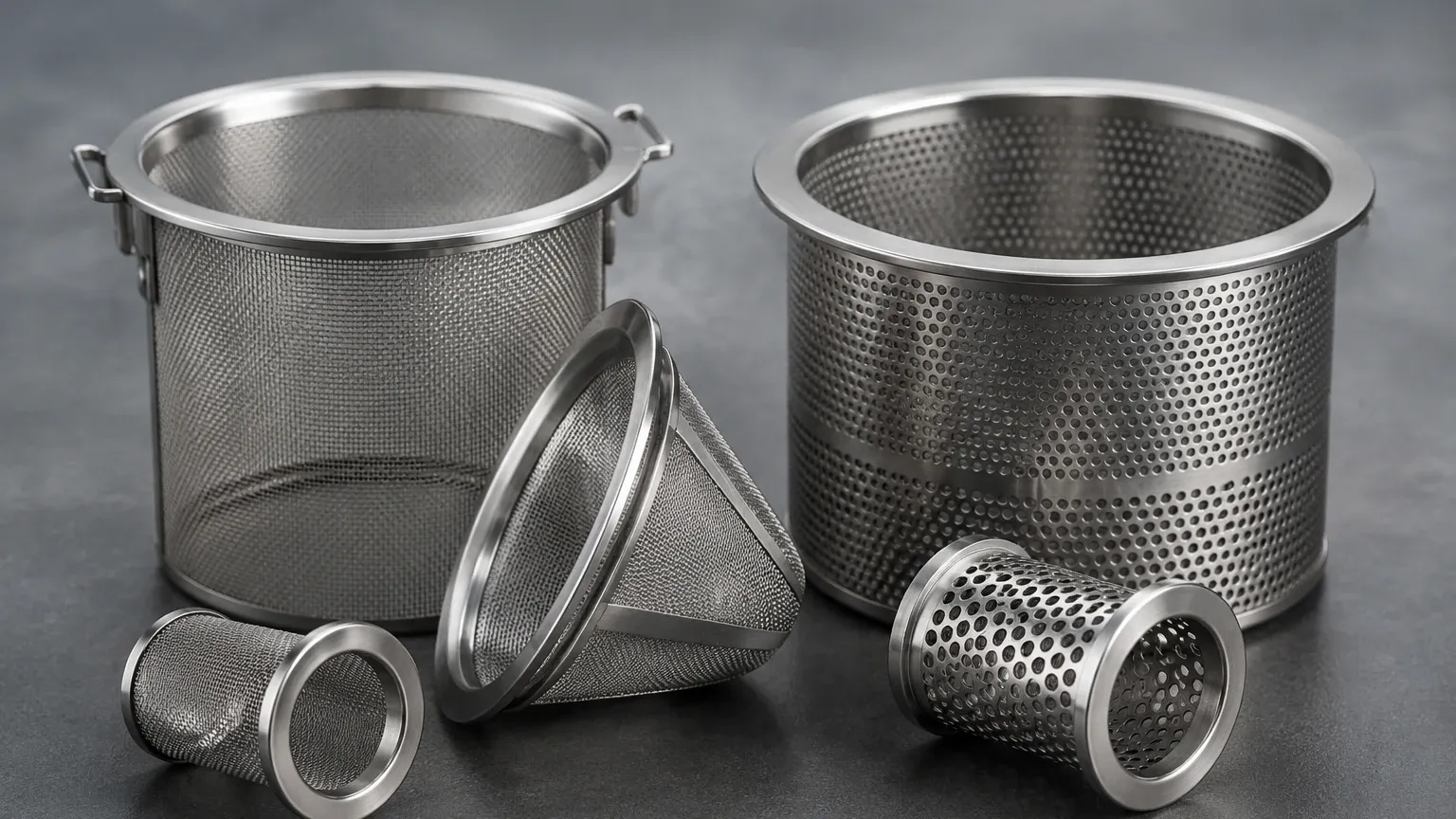
Industrial strainers, such as Y-strainers, T-strainers, and basket strainers, feature robust housings made of cast iron, carbon steel, or stainless steel. The internal element—the basket—is the heart of the system. These baskets are often reinforced with heavy-duty perforated metal backups to support the finer wire mesh lining. This reinforcement is necessary to prevent deformation under the force of high-velocity fluid flow. Custom manufacturers like Kaifil specialize in engineering these reinforced components to meet specific PSI requirements.
Sieve Construction
Sieves are generally lighter in construction. A standard test sieve consists of a shallow metal frame with a tightly tensioned mesh bottom. In industrial vibratory sieves, the frames are larger and designed to withstand the stresses of high-frequency oscillation, but they rarely need to contain the high static pressures found in a chemical processing pipeline. The focus here is on the tension of the mesh; a loose mesh in a sieve will lead to inaccurate grading and rapid mechanical fatigue.
Operational Environment: Pressure, Temperature, and Chemical Compatibility
When deciding between a strainer vs sieve approach, the environmental conditions of the process take precedence.
1. Pressure: If the process requires the fluid to remain under pressure (e.g., a hydraulic line or a cooling water loop), a strainer is the only viable option. Sieves cannot be easily integrated into high-pressure piping without specialized, expensive enclosures.
2. Temperature: Both components can be manufactured from 304 or 316L stainless steel to handle high temperatures. However, the thermal expansion of the strainer housing and the internal basket must be synchronized to prevent bypass—where fluid flows around the filter element rather than through it.
3. Chemical Compatibility: In industries like chemical processing or food and beverage, the material of construction is paramount. Stainless steel is the standard due to its corrosion resistance and ease of sterilization. For highly corrosive environments, specialized alloys or coatings may be required for both strainers and sieves.
Selection Criteria for Engineering and Procurement Teams
To make an informed decision, procurement teams should collaborate with engineering to answer the following questions before sourcing Strainers & Baskets:
* What is the target particle size? Determine the minimum particle size that must be removed to protect downstream equipment or meet product specs.
* What is the solids loading? If the fluid contains a high percentage of solids, a simplex basket strainer may require too frequent cleaning. A duplex strainer (which allows for cleaning without shutting down the line) or a continuous self-cleaning sieve might be more appropriate.
* What is the allowable pressure drop? Calculate the maximum Delta P the system can tolerate when the filter is 50% clogged.
* Is the process batch or continuous? Sieves are often preferred for batch-end quality control, while strainers are essential for continuous flow protection.
In the strainer vs sieve analysis, consider the "dirt holding capacity." A larger basket volume allows for longer run times between maintenance cycles, reducing the total cost of ownership (TCO) by minimizing labor and downtime.
Maintenance, Cleaning, and Longevity Considerations
The longevity of a filtration component is directly tied to its maintenance regimen.
Cleaning Strainers
Strainers are typically cleaned by removing the basket and washing it manually or using high-pressure air/water. In some applications, ultrasonic cleaning is used to remove fine particles trapped deep within the mesh weaves (such as Dutch weave). Because strainers protect critical equipment, they often feature differential pressure gauges that alert operators when cleaning is required.
Cleaning Sieves
Sieves used for dry powders are often cleaned using brushes or ultrasonic baths. In automated systems, "ball trays" or "sliders" are placed beneath the mesh; as the sieve vibrates, these elements bounce against the mesh to dislodge trapped particles.
For both components, the choice of weave type—plain, twill, or Dutch—impacts how easily the element can be cleaned. A plain weave is the easiest to clean but offers less structural strength than a twill or Dutch weave, which are often used in high-pressure Strainers & Baskets.
Conclusion: Choosing the Right Solution for Your Application
While the strainer vs sieve distinction may seem academic, the practical implications for industrial performance are significant. A strainer is your primary line of defense for mechanical systems, designed to handle pressure and protect infrastructure. A sieve is your primary tool for quality assurance, designed to classify and grade materials to meet strict production standards.
For engineers looking to optimize their filtration systems, working with a manufacturer that understands these nuances is vital. Customization—whether it involves specific mesh linings, reinforced basket structures, or unique alloy selections—ensures that the filtration component performs reliably under the specific stresses of your industry. By focusing on technical parameters like micron ratings, open area ratios, and pressure tolerances, you can select a solution that balances performance with durability.
When evaluating your next project, consider the specific demands of your fluid or solid material. Whether you require high-capacity Strainers & Baskets for a chemical plant or precision mesh for a grading sieve, the right choice will ultimately lead to reduced maintenance costs and higher product purity.
