


Strainer vs Colander vs Sieve
In the realm of industrial mechanical separation, the terminology used to describe filtration components can often overlap with everyday consumer language. For engineers and procurement specialists, understanding the technical nuances of strainer vs colander vs sieve is essential for selecting the correct equipment for fluid handling, material processing, and equipment protection. While these terms are often used interchangeably in domestic settings, their industrial counterparts—specifically Strainers & Baskets—are engineered to meet rigorous standards for pressure, temperature, and filtration precision.
This guide examines the engineering distinctions between these three separation tools, their specific applications in industrial environments, and the critical factors that dictate their selection in professional manufacturing and processing sectors.
Defining the Industrial Strainer
An industrial strainer is a closed-system component designed to remove unwanted solids from a flowing liquid or gas stream. Unlike domestic versions, industrial strainers are built to withstand significant internal pressures and are integrated directly into piping systems. Their primary function is "protection filtration"—ensuring that downstream equipment such as pumps, valves, meters, and heat exchangers are not damaged by debris.
Technical Characteristics of Strainers
* Pressure Rating: Industrial strainers are designed to operate under high-pressure conditions, often categorized by ANSI or DIN pressure classes.
* Media Type: They typically utilize perforated metal plates or high-strength stainless steel wire mesh. In many cases, a perforated basket serves as the structural support for a finer mesh liner.
* Configuration: Common designs include Y-strainers (for compact spaces), T-strainers (for high-flow applications), and Simplex or Duplex basket strainers.
* Flow Direction: Fluid enters the strainer, passes through the media where particles are trapped, and exits through the outlet. The debris is retained within the basket or the "leg" of the Y-strainer for later removal.
In the context of strainer vs colander vs sieve, the strainer is the only one designed for continuous, pressurized fluid flow within a sealed pipeline.
The Industrial "Colander": Coarse Drainage Baskets
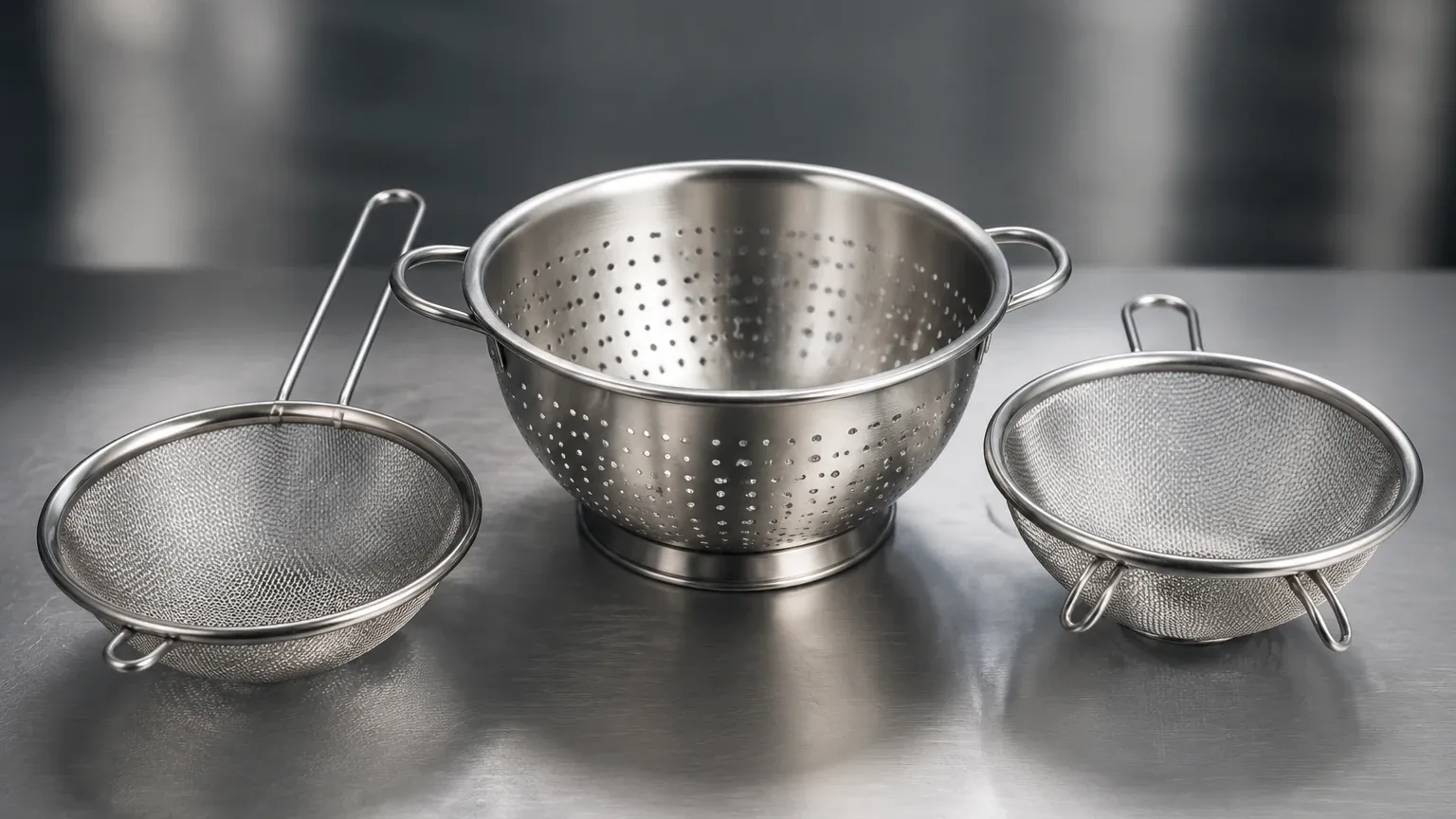
While the term "colander" is rarely used in heavy industrial engineering, the concept exists in the form of coarse drainage baskets or washing vessels. In a culinary sense, a colander is a bowl-shaped tool with large perforations used to drain liquid from solids. In an industrial B2B context, this translates to gravity-fed separation or batch processing tools.
Industrial Equivalents and Applications
* Batch Washing: Used in food and beverage processing or chemical parts cleaning where bulk solids need to be submerged and then drained.
* Gravity Drainage: Employed in open-tank systems where liquid needs to be separated from large solids without the need for a pressurized seal.
* Hole Size: Industrial "colanders" or drainage baskets usually feature much larger perforations (often 3mm to 10mm or larger) compared to fine strainers or sieves.
When comparing a strainer vs colander vs sieve, the colander equivalent is the least precise and is generally reserved for bulk separation where the goal is simply to remove the majority of the liquid from a solid mass under atmospheric pressure.
The Sieve: Precision Particle Sizing
A sieve is a specialized separation tool used primarily for dry material grading or particle size analysis. While strainers focus on protecting equipment from debris in a fluid stream, sieves are designed to categorize solids based on their dimensions.
Engineering Focus of Sieving
* Particle Distribution: Sieves are used to ensure that a batch of powder or granulate meets specific size requirements. This is critical in the pharmaceutical and chemical industries.
* Wire Mesh Precision: Industrial sieves utilize highly tensioned, precision-woven wire mesh. The aperture size is strictly controlled to meet standards such as ASTM E11 or ISO 3310.
* Operation: Unlike strainers, which are often static components in a pipe, sieves are frequently used in conjunction with mechanical shakers or vibratory equipment to facilitate the passage of undersized particles through the mesh.
In the strainer vs colander vs sieve comparison, the sieve is the most precise tool for dry separation, whereas the strainer is the standard for liquid-solid separation in active flow systems.
Technical Comparison: Strainer vs Colander vs Sieve
To better understand which component is required for a specific application, it is helpful to compare them across several engineering parameters:
| Feature | Industrial Strainer | Industrial Colander (Drainage Basket) | Industrial Sieve |
| :— | :— | :— | :— |
| Primary State of Matter | Liquid or Gas | Solid-Liquid Slurry | Dry Solids / Powders |
| Operating Pressure | High (Pressurized) | Atmospheric (Gravity) | Atmospheric / Vibratory |
| Precision Level | High (Micron-rated) | Low (Coarse) | Extremely High (Graded) |
| Installation Type | Inline (Piping) | Batch / Tank-based | Benchtop or Vibratory Deck |
| Primary Goal | Equipment Protection | Bulk Drainage | Particle Sizing |
Selection Criteria for Industrial Strainers and Baskets
When moving beyond the basic definitions of strainer vs colander vs sieve, engineers must evaluate specific performance metrics to ensure the longevity and efficiency of their filtration system. For those sourcing Strainers & Baskets, the following criteria are paramount:
1. Micron Rating and Open Area Ratio
The micron rating determines the smallest particle the strainer will capture. However, a finer mesh increases resistance to flow. Engineers must balance filtration efficiency with the "Open Area Ratio" (OAR). A higher OAR allows for a lower pressure drop and longer intervals between cleanings. Typically, an industrial strainer should have an open area at least 4 to 6 times the cross-sectional area of the inlet pipe.
2. Material Compatibility
Stainless steel (304 or 316L) is the industry standard due to its corrosion resistance and durability. In chemical processing or pharmaceutical applications, 316L is often preferred for its superior resistance to pitting and crevice corrosion. For highly aggressive environments, specialized alloys like Hastelloy or Monel may be required.
3. Pressure Drop (Delta P)
Every filtration component introduces a pressure drop into the system. It is vital to calculate the clean pressure drop and determine the maximum allowable pressure drop before the basket must be cleaned. Exceeding the maximum Delta P can lead to basket collapse or bypass, where contaminants forced through the media damage downstream components.
4. Maintenance and Cleaning Cycles
Unlike disposable filters, industrial strainers and baskets are designed to be cleaned and reused. The ease of access to the basket is a major design consideration. For systems that cannot be shut down, a duplex strainer—which features two chambers and a diverter valve—allows for cleaning one basket while the other remains in service.
Common Risks in Improper Selection
Choosing the wrong type of separation tool—such as using a coarse drainage basket (colander type) when a precision strainer is required—can lead to significant operational failures. Common risks include:
* Downstream Contamination: If the mesh is too coarse, small particles can pass through and cause abrasive wear on pump impellers or clog precision nozzles.
* Structural Failure: Using a sieve mesh without proper structural support in a high-pressure line will result in the mesh tearing or collapsing.
* Flow Restriction: Using a sieve with an inappropriately fine mesh for a high-viscosity liquid will cause an immediate and dangerous spike in system pressure.
Custom Engineering Solutions with Kaifil
In many industrial scenarios, standard off-the-shelf solutions do not meet the unique requirements of a specific process. This is where custom manufacturing becomes essential. Kaifil specializes in the design and production of high-performance stainless steel filtration components, including custom-engineered Strainers & Baskets.
By working closely with global customers, Kaifil provides expertise in material selection, filtration accuracy, and structural design. Whether the application involves food-grade stainless steel for sanitary processing or heavy-duty perforated metal for industrial water treatment, custom solutions ensure that the separation tool is perfectly matched to the flow rate, pressure, and particle size requirements of the system.
Conclusion
Understanding the distinction between a strainer vs colander vs sieve is more than a matter of semantics; it is a fundamental requirement for sound engineering. While the colander serves for bulk drainage and the sieve for precision dry grading, the industrial strainer remains the workhorse of liquid and gas process protection. By focusing on technical specifications such as micron ratings, material compatibility, and pressure drop, procurement teams and engineers can select the most effective filtration components to optimize performance and protect their capital equipment investments.
