


Strainer Y Type Dimensions
In industrial piping systems, the Y-strainer is a critical component designed to protect downstream equipment—such as pumps, valves, and meters—from damage caused by debris, scale, and other solid particulates. While the functional purpose of the device is straightforward, the engineering specifications, particularly the strainer y type dimensions, are complex and vital for successful integration. Selecting the correct dimensions is not merely a matter of matching pipe size; it involves accounting for pressure ratings, flow dynamics, maintenance clearances, and material expansion.
For engineers and procurement professionals, understanding the nuances of these dimensions ensures that the Strainers & Baskets integrated into a system will perform reliably without causing excessive pressure drops or installation conflicts. This guide provides a technical overview of the dimensional parameters, standardization, and selection criteria for Y-type strainers in industrial applications.
Core Dimensional Parameters of Y-Strainers
When reviewing a manufacturer's technical data sheet, several key dimensions define the physical envelope of a Y-strainer. These dimensions are standardized to ensure interchangeability between different brands, provided they adhere to the same engineering codes.
Face-to-Face (L)
The face-to-face dimension is the overall length of the strainer from one end connection to the other. For flanged strainers, this is measured from the outer face of the inlet flange to the outer face of the outlet flange. For threaded or socket-weld strainers, it is the end-to-end length. This is the most critical dimension for piping layout design and retrofitting, as it determines the "gap" required in the pipeline.
Center-to-Top and Center-to-Bottom (H)
Because the "leg" of a Y-strainer extends at an angle (typically 45 degrees), the vertical clearance is essential. The center-to-bottom dimension measures the distance from the centerline of the pipe to the lowest point of the strainer cap or blow-off connection. This dimension determines how much space is needed below the pipe for the strainer to fit and, more importantly, how much room is required to remove the internal screen for cleaning.
Blow-off / Drain Size (D)
The blow-off connection is located at the bottom of the strainer cap. Its dimension is usually specified in NPT (National Pipe Thread) or as a flanged connection. This size is critical for sizing the blow-down valve that allows for the flushing of accumulated debris without dismantling the entire unit.
Flange Thickness and Diameter
For flanged units, the thickness and outside diameter of the flange must comply with standards such as ASME B16.5. These dimensions change significantly based on the pressure class (e.g., Class 150 vs. Class 600), even if the nominal pipe size (NPS) remains the same.
The Impact of Pressure Ratings on Strainer Y Type Dimensions
One of the most common points of confusion in procurement is the variation in dimensions across different pressure classes. A 4-inch Y-strainer rated for Class 150 will have different physical dimensions than a 4-inch Y-strainer rated for Class 300 or Class 600.
Wall Thickness
As the pressure rating increases, the wall thickness of the strainer body must increase to withstand the internal stress. This often results in a larger outer diameter (OD) for the main body casting, even if the internal flow path remains consistent with the pipe's internal diameter (ID).
Flange Dimensions
In flanged systems, the strainer y type dimensions are heavily influenced by the flange rating. Higher-pressure flanges are thicker and have larger bolt circle diameters. For example, an ASME Class 150 flange for a 2-inch pipe has a 4.75-inch bolt circle, while a Class 300 flange for the same pipe size has a 5.00-inch bolt circle. These differences must be accounted for in the overall layout and when calculating the weight of the component for support structures.
Weight Considerations
Because higher pressure ratings require more material (thicker walls and heavier flanges), the weight of the strainer increases significantly. This is a critical "dimension" for structural engineers who must design pipe hangers and supports to prevent sagging or mechanical failure at the connection points.
Engineering Standards and Compliance
To ensure safety and compatibility, industrial Y-strainers are manufactured according to established international standards. These standards dictate the minimum strainer y type dimensions and testing requirements.
* ASME B16.34: This standard covers valves and includes requirements for pressure-temperature ratings, dimensions, and wall thicknesses that are often applied to strainer bodies.
* ASME B16.5: This governs the dimensions of pipe flanges and flanged fittings. Any flanged Y-strainer must adhere to these dimensions to ensure it can be bolted into a standard piping system.
* ASME B16.11: This standard applies to forged steel fittings, including socket-welding and threaded types, which are common for smaller-diameter Y-strainers (typically 2 inches and below).
* API 598: While primarily a valve testing standard, it is frequently used to define the leakage and pressure testing protocols for high-performance strainers.
By adhering to these standards, manufacturers like Kaifil ensure that their Strainers & Baskets can be integrated into global industrial projects with predictable fitment and performance.
Clearance Requirements for Maintenance and Screen Removal
A frequent oversight in piping design is failing to account for the clearance required to service the strainer. The "H" dimension (center-to-bottom) only tells you where the strainer ends; it does not tell you how much room you need to pull the screen out.
The Removal Path
The internal screen of a Y-strainer is a cylindrical or conical component that sits inside the angled leg. To remove it for cleaning or replacement, the operator must unscrew the cap and slide the screen out along the same 45-degree axis.
Calculating Service Clearance
As a rule of thumb, the service clearance should be at least equal to the length of the screen itself, plus an additional 2 to 4 inches for hand tools and handling. If a strainer is installed in a tight space or near the floor, it may be impossible to remove the screen without cutting the pipe. In such cases, engineers must specify "compact" designs or consider alternative strainer types, such as basket strainers, which allow for top-entry removal.
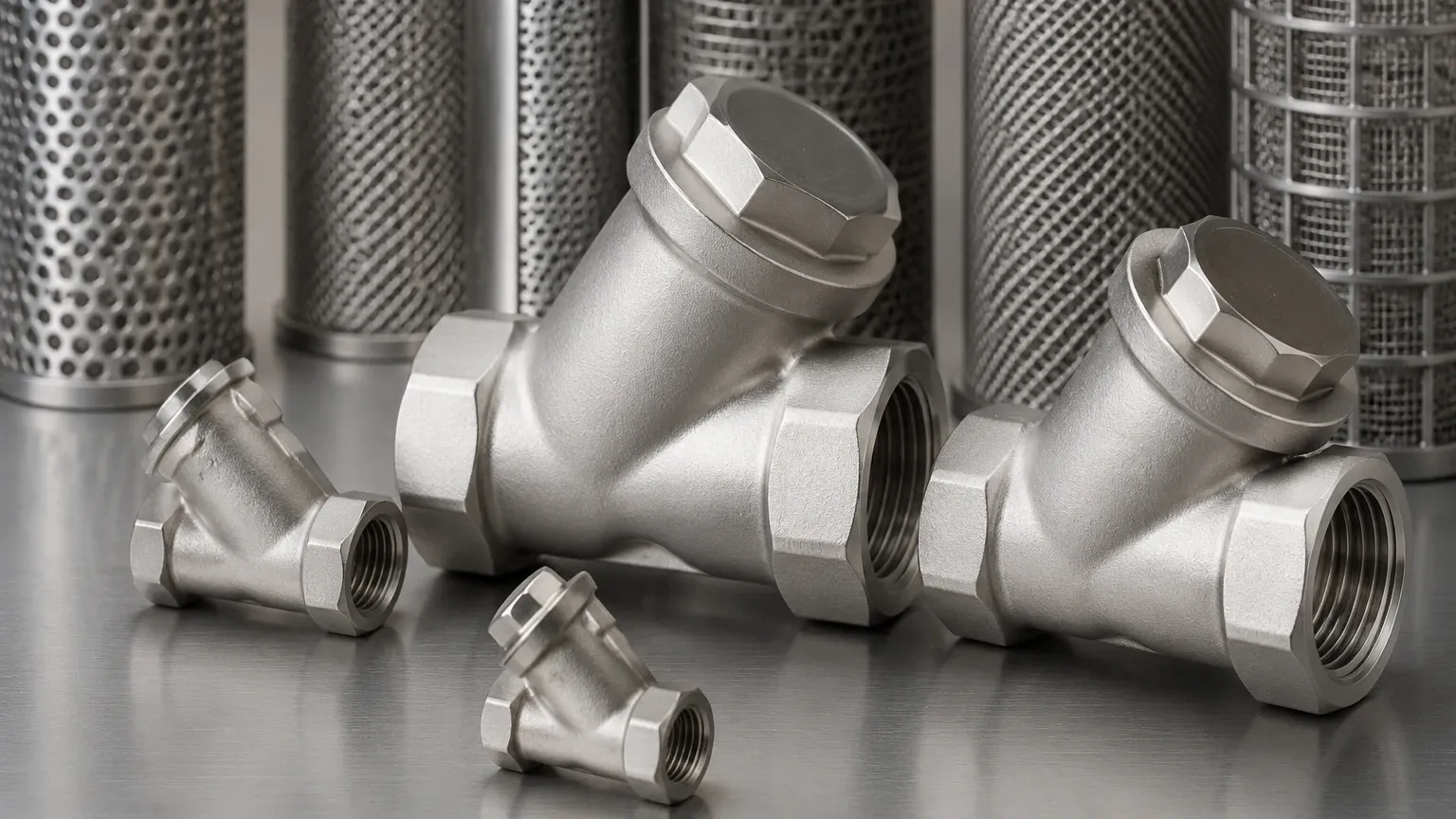
Material Selection and Dimensional Stability
The material used to construct the Y-strainer—whether it is 304 stainless steel, 316 stainless steel, carbon steel, or a specialty alloy—affects the strainer y type dimensions in subtle but important ways.
Thermal Expansion
In high-temperature applications, such as steam lines or chemical processing, the strainer body will expand. Stainless steel has a higher coefficient of thermal expansion than carbon steel. If the face-to-face dimension is tight, thermal expansion can exert significant stress on the piping flanges and bolts. Engineers must calculate these changes when designing the piping run.
Casting vs. Fabrication
Standard Y-strainers are typically cast. However, for large diameters or unique pressure requirements, strainers may be fabricated from pipe and plate. Fabricated strainers often have different external dimensions than cast ones, even if they share the same nominal pipe size. It is essential to verify whether the dimensions provided are for a cast or fabricated unit during the procurement phase.
Flow Efficiency and Internal Dimensions
The external strainer y type dimensions are often a reflection of the internal volume. A larger body typically allows for a larger screen surface area, which has several benefits:
1. Lower Pressure Drop (ΔP): A larger screen area reduces the velocity of the fluid as it passes through the mesh, resulting in a lower initial pressure drop.
2. Increased Dirt Holding Capacity: More surface area means the strainer can accumulate more debris before reaching the maximum allowable pressure drop, thereby extending the maintenance interval.
3. Reduced Turbulence: A well-proportioned internal chamber minimizes turbulence, which can otherwise lead to erosion of the strainer body or the screen itself.
When evaluating Strainers & Baskets, engineers should look for the "Open Area Ratio." This is the ratio of the total open area of the screen to the internal cross-sectional area of the inlet pipe. A higher ratio usually implies a larger physical body dimension but superior flow performance.
Customization and OEM Considerations
In many industrial settings, standard off-the-shelf dimensions may not be suitable. This is particularly true in OEM (Original Equipment Manufacturer) applications where a strainer must fit within a pre-designed skid or a compact machine housing.
Kaifil specializes in custom stainless steel filtration solutions, providing the flexibility to adjust strainer y type dimensions to meet specific spatial constraints. Customization options may include:
* Shortened Face-to-Face Lengths: For applications where space is at a premium.
* Modified Blow-off Orientations: To facilitate easier drainage in crowded piping layouts.
* High-Capacity Bodies: Increasing the "leg" length to accommodate a larger screen for high-solids applications without changing the pipe size.
* Specialized End Connections: Combining different connection types (e.g., a flanged inlet with a threaded outlet) to eliminate the need for additional adapters.
Checklist for Confirming Strainer Y Type Dimensions
Before finalizing a purchase or completing a piping design, the following technical details should be confirmed with the manufacturer:
1. Nominal Pipe Size (NPS): Ensure the inlet/outlet matches the system piping.
2. Pressure Class: Confirm if it is Class 150, 300, 600, or a specific PN rating (e.g., PN16, PN40).
3. End Connection Type: Flanged (Raised Face or Flat Face), Threaded (NPT or BSP), Socket Weld, or Butt Weld.
4. Face-to-Face Dimension: Verify against the available gap in the piping layout.
5. Clearance Height: Ensure there is sufficient room below or to the side for screen removal.
6. Drain Size: Confirm the blow-off connection size for valve integration.
7. Material Grade: Ensure the body and screen materials are compatible with the process fluid and temperature.
By focusing on these technical boundaries, engineering teams can ensure that their filtration components provide maximum protection with minimal operational disruption. Whether utilizing standard designs or seeking customized solutions, the precision of strainer y type dimensions remains a cornerstone of efficient industrial fluid handling.
