


Strainers Basket
In industrial fluid handling systems, the protection of downstream equipment—such as pumps, valves, flow meters, and heat exchangers—is a critical engineering priority. A strainers basket serves as the primary line of defense, capturing solid contaminants from liquid or gas streams. Unlike simple Y-strainers intended for low-debris applications, basket strainers are designed for systems requiring high flow rates and higher dirt-holding capacities.
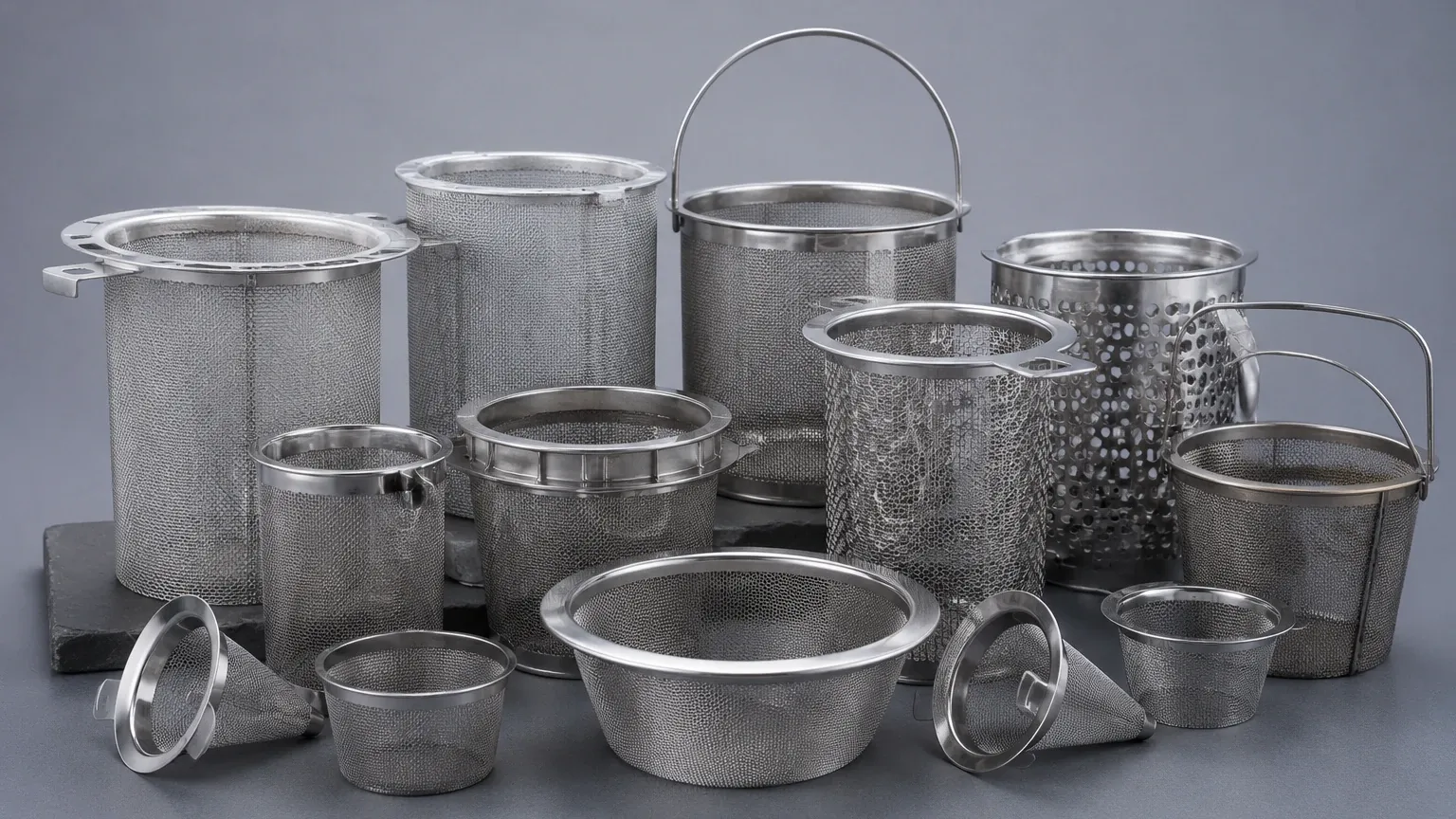
As a specialized manufacturer, Kaifil provides custom stainless steel Strainers & Baskets engineered to meet the rigorous demands of chemical processing, food and beverage production, and hydraulic systems. Selecting the correct basket configuration requires a deep understanding of fluid dynamics, material compatibility, and mechanical stress factors. This guide explores the technical considerations essential for engineers and procurement teams when specifying industrial filtration components.
Engineering Fundamentals of Basket Strainers
The primary function of a strainers basket is to remove oversized particles while maintaining a manageable pressure drop across the system. The efficiency of this process is governed by several engineering variables that must be calculated during the design phase.
Open Area Ratio (OAR)
The Open Area Ratio is the relationship between the total area of the openings in the basket and the internal cross-sectional area of the inlet pipe. A common industry standard is an OAR of 4:1 or 6:1. A higher OAR ensures that even as the basket begins to fill with debris, the flow is not significantly restricted. If the OAR is too low, the velocity of the fluid through the remaining open holes increases, which can lead to accelerated wear on the mesh or perforation and a rapid increase in differential pressure.
Differential Pressure ($ΔP$)
Differential pressure is the difference in pressure between the inlet and outlet of the strainer. For a clean strainers basket, the initial $ΔP$ should be kept as low as possible—typically below 2 PSI (0.14 bar). As the basket captures solids, the $ΔP$ increases. Engineers must specify the maximum allowable pressure drop before the system requires a cleaning cycle. Exceeding this limit can result in basket collapse or "blow-by," where the pressure forces contaminants through the filter media.
Fluid Viscosity and Flow Velocity
Fluid viscosity significantly impacts filtration performance. High-viscosity fluids, such as heavy oils or syrups, require larger open areas and potentially lower flow velocities to prevent excessive pressure buildup. When designing a custom filtration solution, the flow velocity (typically measured in feet per second) must be balanced against the particle size to be captured to ensure the structural integrity of the basket remains uncompromised.
Material Selection for Industrial Environments
The longevity of a strainers basket is largely determined by its material composition. In industrial settings, stainless steel is the preferred choice due to its mechanical strength and resistance to environmental degradation.
Grade 304 vs. 316L Stainless Steel
* Grade 304: This is the standard industrial grade, offering excellent durability and good corrosion resistance for most water treatment and general industrial applications. It is cost-effective but may be susceptible to chloride-induced pitting in marine or highly acidic environments.
* Grade 316L: Containing molybdenum, 316L provides superior resistance to chlorides and chemicals. The "L" denotes low carbon content, which minimizes carbide precipitation during welding, making it the preferred choice for pharmaceutical and chemical processing where weld integrity is paramount.
Specialized Alloys
For extreme environments involving highly corrosive acids or high temperatures, Kaifil can manufacture baskets using specialized alloys such as Monel, Hastelloy, or Duplex stainless steel. These materials are selected when standard grades cannot withstand the chemical reactivity of the process fluid.
Customization Options for Specific Applications
Every industrial process has unique requirements, making "off-the-shelf" solutions often inadequate. Customization of the strainers basket allows for optimization of both filtration precision and ease of maintenance.
Perforated Metal vs. Wire Mesh
* Perforated Baskets: These are typically used for coarse filtration (large particles). They provide high structural strength and are often used as a support "cage" for finer mesh linings. The hole size and pattern (staggered vs. straight) affect the OAR and the strength of the basket.
* Wire Mesh Linings: For finer filtration requirements, stainless steel wire mesh is layered inside or outside a perforated support. Mesh can be specified by mesh count (the number of wires per inch) or by micron rating. Multi-layer sintered mesh may be used for high-pressure applications where the mesh must remain rigid under significant stress.
Handle and Lifting Configurations
In large-scale industrial systems, the weight of a debris-filled basket can be substantial. Custom handle designs—such as T-handles, folding handles, or heavy-duty lifting lugs—are essential for operator safety and efficient maintenance. The handle design must not interfere with the sealing mechanism of the strainer housing cover.
Sealing and Gasket Interfaces
To prevent fluid bypass, the basket must seat perfectly within the strainer body. Custom-machined rings or flanges are often integrated into the top of the basket. Depending on the chemical compatibility and temperature, gaskets made of Viton, EPDM, or PTFE may be utilized to ensure a leak-proof seal between the basket and the housing seat.
Performance Evaluation and Quality Standards
To ensure reliability in demanding environments, industrial filters must undergo rigorous testing and quality control. Engineers should confirm that their suppliers adhere to recognized manufacturing standards.
1. Filtration Accuracy Verification: Using bubble point testing or glass bead challenges to verify that the micron rating of the mesh meets the specified requirements.
2. Structural Integrity Testing: Assessing the burst pressure and collapse pressure of the basket. This is particularly important in hydraulic systems where pressure spikes are common.
3. Weld Quality Inspection: For pharmaceutical and food-grade applications, welds must be smooth and free of pits or crevices (sanitary finish) to prevent bacterial growth and ensure ease of cleaning.
Maintenance and Operational Longevity
The total cost of ownership (TCO) for a strainers basket is influenced by how easily it can be maintained and how long it lasts before requiring replacement. A well-designed basket should be easy to remove, clean, and reinstall.
Cleaning Protocols
Depending on the nature of the contaminants, cleaning methods may include:
* Manual Pressure Washing: Effective for large, non-adhesive particles.
* Ultrasonic Cleaning: Necessary for fine mesh baskets where particles are lodged deep within the wire intersections.
* Chemical Cleaning/Solvents: Used when the debris consists of resins, oils, or biological matter that cannot be removed mechanically.
Signs of Wear and Replacement Cycles
Regular inspection is required to identify signs of mechanical fatigue. Engineers should look for:
* Wire Fraying: In mesh baskets, broken wires can contaminate the downstream flow.
* Deformation: A "bowed" or distorted basket indicates that the differential pressure has exceeded the design limits.
* Corrosion Pitting: Even stainless steel can corrode if the process chemistry changes or if the material was not correctly specified for the application.
Strategic Procurement: Total Cost of Ownership
When purchasing a Strainers & Baskets solution, the initial purchase price is only one component of the value equation. Technical professionals must consider the following to optimize their investment:
* Durability: A cheaper, thinner basket may fail prematurely, leading to expensive downtime and potential damage to high-value downstream equipment.
* Customization vs. Standardization: While standard baskets have lower lead times, a customized design that perfectly fits the housing and the specific debris profile will reduce maintenance frequency and improve filtration efficiency.
* OEM Compatibility: For equipment manufacturers (OEMs), sourcing baskets that meet exact dimensional tolerances is vital for the performance of their branded machinery.
Kaifil’s expertise in manufacturing custom stainless steel filtration components ensures that each strainers basket is built to the specific mechanical and chemical requirements of the application. By focusing on precision engineering and high-quality materials, we help industrial operators achieve reliable, long-term filtration performance.
Conclusion: Selecting the Right Partner
Selecting an industrial strainer basket is a technical decision that impacts the safety and efficiency of the entire fluid system. Engineers must balance the need for fine filtration against the realities of pressure drop and structural durability. By confirming flow rates, particle sizes, and chemical environments before purchase, and by partnering with a manufacturer capable of providing custom engineering support, purchasing teams can ensure they receive a filtration solution that minimizes risk and maximizes operational uptime.
