


Strainers Job
In industrial fluid management, the term "strainers job" refers to the critical mechanical process of removing unwanted solids from liquid or gas streams. While often overshadowed by high-precision secondary filtration, the primary straining phase is the first line of defense for expensive downstream equipment. Without a properly specified strainer, pumps, valves, nozzles, and heat exchangers are susceptible to erosion, clogging, and catastrophic mechanical failure.
For engineers and procurement teams, understanding the technical nuances of the strainers job is essential for maintaining system uptime and reducing the total cost of ownership (TCO). This guide explores the engineering principles, material considerations, and operational strategies required to optimize the performance of Strainers & Baskets in demanding industrial environments.
Understanding the Primary Function of Industrial Strainers
The fundamental strainers job is to provide coarse filtration, typically removing particles larger than 40 microns, although some high-precision baskets can reach finer levels. Unlike filters, which are often disposable and designed for fine particulate removal, strainers are generally permanent components intended for high-flow applications where the solid loading might be significant.
Protection of Downstream Assets
The most vital aspect of the strainers job is the protection of rotating equipment. In hydraulic systems or chemical processing lines, even small amounts of debris—such as pipe scale, weld slag, or foreign contaminants—can lead to pump cavitation or seal damage. By intercepting these particles, a strainer ensures that the fluid entering a pump or a control valve meets the required cleanliness standards for that specific component.
Maintaining Process Continuity
In continuous manufacturing processes, such as those found in food and beverage or pharmaceutical production, the strainers job includes ensuring that the flow remains uninterrupted. This is achieved through the selection of appropriate housing designs, such as duplex strainers, which allow for the cleaning of one basket while the other remains in operation, preventing system shutdowns.
Engineering Considerations for Strainer Design and Selection
Selecting the right equipment for the strainers job requires a deep dive into the physics of the application. An incorrectly sized strainer can lead to excessive pressure drops, reduced flow rates, and increased energy consumption by the system's pumps.
Pressure Drop and Flow Dynamics
The pressure drop, or Delta P (ΔP), is the difference in pressure between the inlet and the outlet of the strainer. Every strainer creates some resistance to flow. However, as the basket collects debris, the ΔP increases. Engineers must calculate the "clean pressure drop" and establish a "dirty pressure drop" limit at which the strainer must be cleaned. A general rule of thumb in the industry is to size the strainer so that the initial pressure drop does not exceed 2 PSI at the maximum design flow rate.
The Open Area Ratio (OAR)
The efficiency of the strainers job is largely determined by the Open Area Ratio. This is the ratio of the total open area of the holes in the strainer element to the internal cross-sectional area of the inlet pipe. For most industrial applications, an OAR of 4:1 or 6:1 is recommended. A higher OAR allows for longer intervals between cleanings and reduces the velocity of the fluid passing through the mesh, which minimizes the risk of particle "breakthrough."
Viscosity and Specific Gravity
The viscosity of the fluid significantly impacts the strainers job. High-viscosity fluids, such as heavy oils or syrups, require larger straining areas and coarser mesh to prevent excessive pressure buildup. If the fluid is highly viscous, the flow velocity must be reduced, which often necessitates a larger strainer housing than the pipe size would otherwise suggest.
Types of Strainers and Baskets for Specific Applications
Different industrial layouts and fluid types require specific strainer configurations to perform the strainers job effectively. Choosing between a Y-type, Simplex, or Duplex configuration depends on the system's tolerance for downtime and the nature of the contaminants.
Y-Strainers
Y-strainers are typically used in steam, air, or gas lines where the amount of debris is minimal. They are compact and can be installed horizontally or vertically. However, their dirt-holding capacity is lower than that of basket-type strainers, making them less suitable for liquids with high solid concentrations.
Simplex Basket Strainers
For liquid applications where the flow can be temporarily stopped, a simplex basket strainer is the standard choice. The basket design allows for a much larger dirt-holding capacity than a Y-strainer. These are commonly used in batch processing where the strainer can be cleaned between cycles.
Duplex (Twin) Basket Strainers
In industries where the process cannot be stopped—such as power generation or continuous chemical synthesis—the strainers job is handled by duplex strainers. These units consist of two separate strainer chambers connected by a diverter valve. When one basket is full, the flow is switched to the clean chamber, allowing the operator to service the dirty basket without interrupting the process.
Material Science in Strainer Manufacturing
The durability of the strainers job depends heavily on material compatibility. Industrial environments often involve corrosive chemicals, high temperatures, and abrasive solids that can quickly degrade inferior materials.
Stainless Steel 304 and 316L
Stainless steel is the gold standard for industrial Strainers & Baskets. Type 304 provides excellent general-purpose corrosion resistance, while Type 316L (low carbon) is preferred for environments involving chlorides or high-acidity fluids, such as in marine or chemical processing applications. The use of 316L also prevents intergranular corrosion after welding, ensuring the structural integrity of the basket.
Specialty Alloys and Coatings
For extreme conditions, such as those involving phosphoric acid or high-temperature steam, specialty alloys like Monel, Hastelloy, or Titanium may be required. In some water treatment applications, epoxy coatings or rubber linings are applied to carbon steel housings to provide a cost-effective balance between structural strength and corrosion resistance.
Operational Performance and Maintenance Cycles
The effectiveness of the strainers job is not just a matter of design but also of diligent maintenance. A strainer that is ignored becomes a liability, potentially collapsing under high differential pressure and sending a "slug" of concentrated debris downstream.
Monitoring Differential Pressure
The most reliable way to manage the strainers job is through differential pressure monitoring. Installing gauges on the inlet and outlet allows operators to see exactly when the basket is reaching its capacity. Many modern systems use differential pressure switches that trigger an alarm or automatically switch chambers in a duplex system when the ΔP reaches a pre-set limit (e.g., 10-15 PSI).
Cleaning and Inspection Protocols
When cleaning a strainer basket, it is not enough to simply rinse it. Maintenance teams should inspect the mesh for signs of fatigue, broken wires, or "blinded" areas where particles have become permanently lodged. In high-pressure systems, the structural welds of the basket should be checked for stress cracks. Using ultrasonic cleaning tanks can help remove fine particles from the wire mesh that manual brushing might miss.
Replacement Cycles
While stainless steel baskets are designed for long-term use, they are ultimately wear items. The lifespan of a basket depends on the abrasiveness of the solids and the frequency of cleaning. Keeping spare baskets on-site is a critical part of the strainers job, ensuring that a damaged element does not lead to extended system downtime.
Customization and OEM Solutions for Demanding Environments
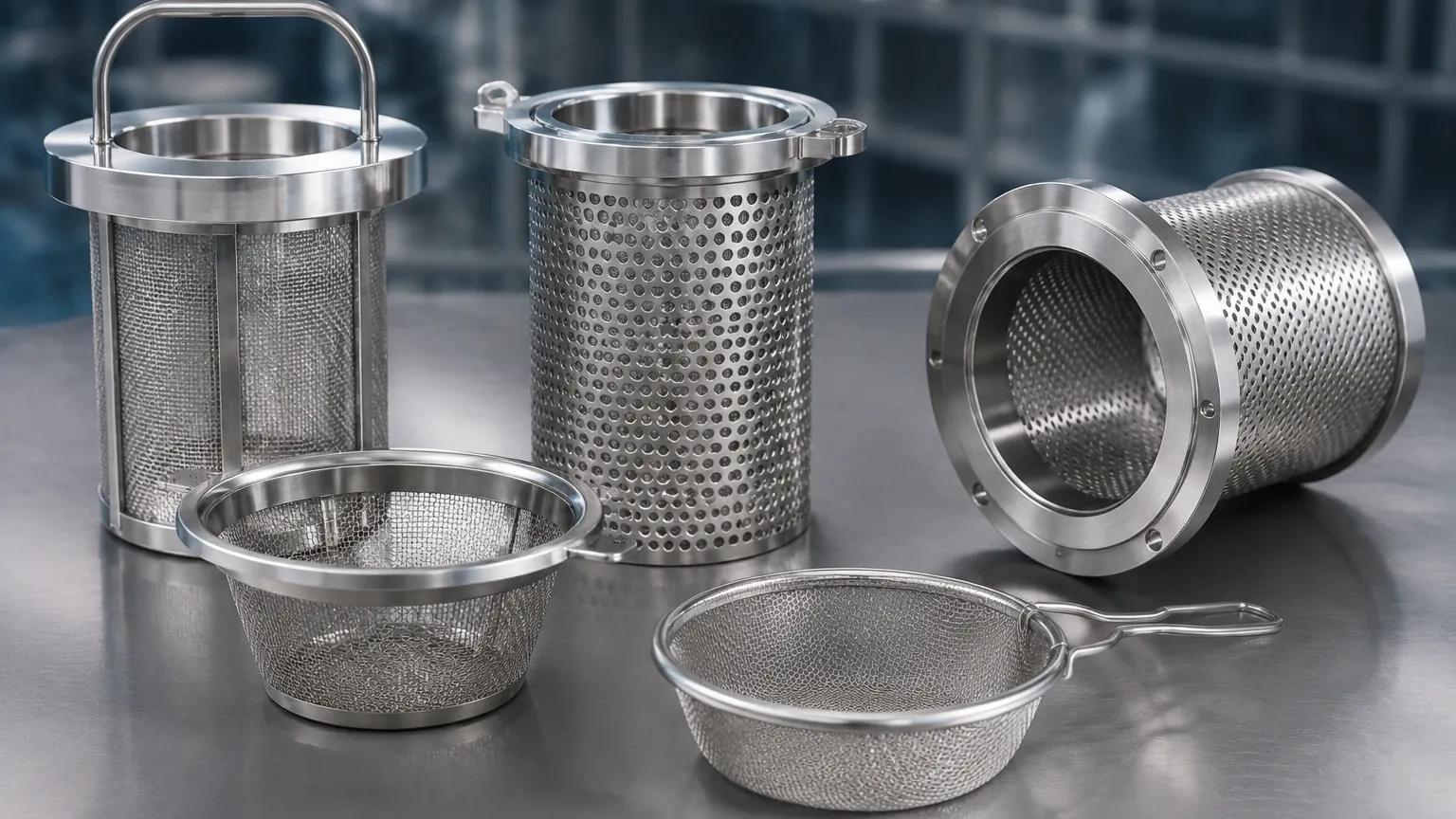
Off-the-shelf strainers often fail to meet the specific requirements of complex industrial systems. This is where custom-engineered Strainers & Baskets become necessary. Customization allows engineers to tailor the filtration surface area, the structural reinforcement, and the connection types to fit existing infrastructure.
Tailored Micron Ratings
In many cases, a standard perforation (e.g., 1/8") is too coarse, while a standard mesh (e.g., 100 mesh) is too fine. Custom manufacturers can combine perforated metal backups with fine wire mesh linings to create a basket that offers both high structural strength and precise filtration accuracy. This hybrid approach is common in hydraulic oil systems and pharmaceutical ingredient processing.
Structural Reinforcement for High-Pressure Differentials
In high-flow applications, the force exerted on a clogged basket can be immense. Custom strainers can be designed with internal bridges, reinforced longitudinal seams, and heavier-gauge perforated metal to prevent basket collapse. This ensures that even if the maintenance schedule is missed, the strainer will not fail and damage the downstream pump.
Specialized Geometry and Connections
Space constraints in existing plants often require unique strainer geometries. Custom OEM solutions include offset nozzles, tangential inlets, or extra-large housings designed to fit into tight footprints while maintaining the required OAR. Furthermore, custom flange ratings (ANSI, DIN, or JIS) ensure that the strainer integrates seamlessly into the global piping standards used at the facility.
Conclusion: Optimizing the Strainers Job for Your Facility
Executing the strainers job effectively requires a balance of engineering theory and practical operational knowledge. By focusing on the correct material selection, calculating accurate pressure drops, and implementing a robust maintenance strategy, industrial facilities can significantly improve their equipment reliability and process efficiency.
When evaluating a supplier for your filtration needs, it is essential to confirm their capabilities in material traceability, welding certifications, and custom design. A high-quality strainer is an investment in the longevity of your entire fluid system. For those looking to upgrade their current infrastructure or design a new process line, reviewing professional options for Strainers & Baskets is the first step toward achieving a reliable and cost-effective filtration solution.
