


Strainers Meaning in Hindi
In the global landscape of industrial manufacturing and fluid handling, technical terminology often requires clear cross-cultural understanding to ensure precision in procurement and engineering. For professionals operating within or sourcing from the Indian market, understanding the strainers meaning in hindi is a foundational step in aligning technical specifications with local operational contexts. While the linguistic translation provides a starting point, the engineering reality of industrial Strainers & Baskets involves complex material science, flow dynamics, and mechanical design.
At its core, the term "strainer" in Hindi is most commonly translated as *chhalni* (छलनी), which refers to a device used for separating solid particles from liquids. However, in a B2B and industrial engineering environment, the English term "strainer" is widely adopted as the standard nomenclature in technical drawings, purchase orders, and safety manuals. This article explores the technical nuances of industrial strainers, their applications, and the critical factors engineers must consider when selecting these components for demanding industrial environments.
Understanding the Industrial Context of Strainers
When discussing the strainers meaning in hindi in a professional capacity, it is essential to distinguish between domestic sieves and industrial-grade filtration components. In the Indian industrial sector—ranging from chemical processing plants in Gujarat to pharmaceutical hubs in Hyderabad—the term *industrial strainer* is often transliterated or referred to as a mechanical device for "ashuddhi nikaalna" (removing impurities).
An industrial strainer is a closed vessel with a cleanable screen element designed to remove and retain foreign particles down to a specific micron size. Unlike filters, which often remove much smaller particles (sub-micron levels) and frequently require disposable media, strainers are typically used for coarser filtration and are designed for longevity and reuse. They protect downstream equipment such as pumps, valves, and meters from damage caused by scale, rust, or debris.
For an engineer, the "meaning" of a strainer is defined by its performance parameters: its pressure rating, its material compatibility, and its ability to maintain flow efficiency while protecting the integrity of the piping system.
Engineering Differences: Strainers vs. Filters
In many technical discussions, the terms "strainer" and "filter" are used interchangeably, but in high-precision manufacturing, the distinction is vital. Understanding this distinction is as important as knowing the strainers meaning in hindi for clear communication between design teams and suppliers.
1. Particle Size: Strainers are generally used to remove larger particles that are visible to the naked eye. They are often rated by mesh size or perforation diameter. Filters, conversely, handle microscopic contaminants and are rated in microns.
2. Pressure Drop: Because strainers use coarser media (like stainless steel wire mesh), they typically exhibit a lower initial pressure drop compared to fine filters. This makes them ideal for high-volume intake lines.
3. Maintenance: Strainers are designed for easy cleaning. Many industrial baskets can be removed, washed, and reinstalled without the need for replacement parts, which is a significant factor in reducing the total cost of ownership (TCO).
4. Placement: Strainers are usually installed on the suction side of pumps to prevent mechanical damage, whereas filters are often placed on the discharge side to ensure the purity of the final product.
Types of Industrial Strainers and Baskets
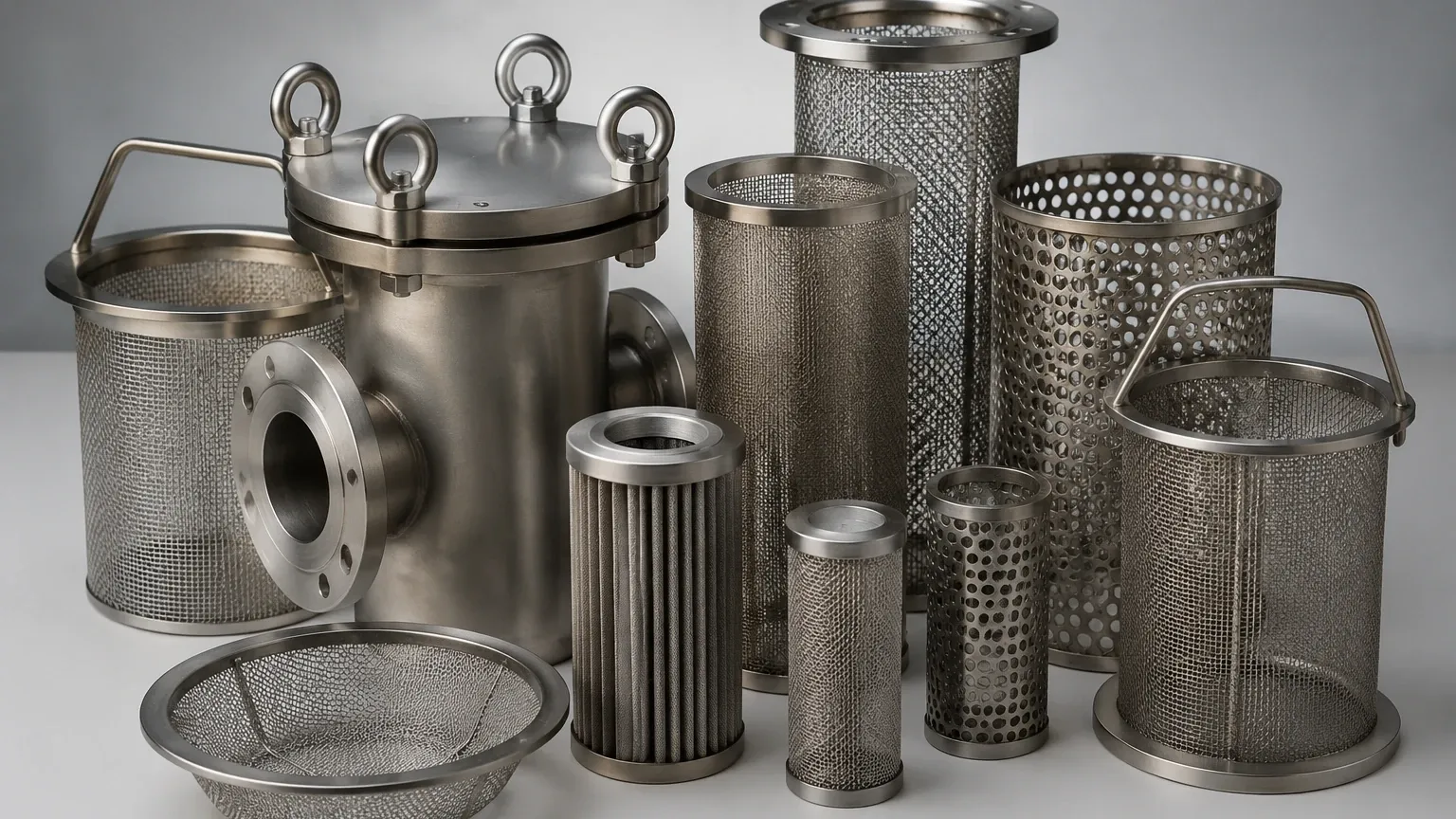
To provide comprehensive solutions, manufacturers like Kaifil produce various configurations of Strainers & Baskets tailored to specific flow patterns and debris loads. Choosing the right type depends on the orientation of the piping and the frequency of cleaning required.
Y-Strainers
Named for their shape, Y-strainers are the most common choice for pressurized lines, whether liquid or gas. They are compact and can be installed horizontally or vertically. In the context of the Indian market, these are frequently used in steam applications and small-diameter water lines. Their primary advantage is the ability to be cleaned without removing the entire unit from the piping, often via a blow-off valve.
Simplex Basket Strainers
Basket strainers feature a larger surface area than Y-strainers, allowing for a greater holding capacity for solids. This results in longer intervals between cleaning cycles. These are typically used in horizontal pipelines where high flow rates are required. The "basket" design allows for the easy capture of heavy debris, making them essential in cooling water systems and chemical processing.
Duplex Basket Strainers
For operations that cannot afford downtime, duplex strainers are the standard. These consist of two separate strainer chambers connected by a diverting valve. When one basket becomes clogged, the flow is diverted to the second chamber, allowing the first to be cleaned without interrupting the process. This is a critical requirement in continuous flow industries like oil refining and power generation.
Material Selection and Durability Factors
In industrial filtration, the material of construction determines the lifespan and reliability of the component. When engineers search for the strainers meaning in hindi, they are often looking for solutions that can withstand the harsh environmental conditions found in various regional climates.
Kaifil specializes in stainless steel solutions, primarily utilizing Grade 304 and Grade 316.
* Stainless Steel 304: Offers excellent resistance to a wide range of atmospheric environments and many corrosive media. It is the standard choice for food and beverage applications due to its hygiene properties.
* Stainless Steel 316: Contains molybdenum, which provides superior corrosion resistance, particularly against chlorides and industrial solvents. This is the preferred material for pharmaceutical and marine applications.
* Specialty Alloys: For highly acidic or high-temperature environments, strainers may be fabricated from Monel, Hastelloy, or Duplex stainless steel to ensure structural integrity over long-term exposure.
Beyond the housing, the internal mesh or perforated metal must be selected based on the mechanical stress it will face. A high-quality strainer basket must resist "collapsing" under the pressure of a clogged screen, necessitating reinforced frames and precision welding.
Key Selection Criteria for Procurement and Engineering
Selecting the right Strainers & Baskets involves more than just matching pipe sizes. Procurement teams and engineers must evaluate several technical variables to ensure the component performs as expected in the field.
1. Open Area Ratio (OAR)
The Open Area Ratio is the relationship between the internal cross-sectional area of the pipe and the total open area of the holes in the strainer element. A common industry standard is a 4:1 ratio. A higher OAR means the strainer can accumulate more debris before the pressure drop becomes unacceptable, thereby reducing maintenance frequency.
2. Mesh vs. Perforation
Strainers can use perforated plate (for large debris) or wire mesh (for finer particles). In many cases, a "lined" basket is used, where a fine wire mesh is supported by a heavy-duty perforated metal cylinder. This provides both the filtration accuracy of mesh and the structural strength of a plate.
3. Connection Types
Depending on the system pressure and the need for frequent removal, strainers may feature flanged, threaded, or socket-weld connections. Flanged connections are generally preferred in industrial settings for their ease of installation and leak-proof sealing in high-pressure environments.
4. Seal and Gasket Compatibility
The choice of O-rings or gaskets (EPDM, Viton, PTFE) is just as important as the metal itself. If the seal fails due to chemical incompatibility, the entire filtration process is compromised, leading to bypass or external leaks.
Maintenance and Replacement Cycles in Industrial Applications
A common question for engineers is when to clean or replace a strainer. While the strainers meaning in hindi might imply a simple cleaning process, industrial maintenance requires a data-driven approach.
Most modern systems utilize differential pressure (DP) gauges. A clean strainer will show a specific pressure drop (e.g., 2 psi). As debris accumulates, the pressure drop increases. Manufacturers generally recommend cleaning the basket once the DP reaches a predetermined limit (often 10-15 psi above the clean drop).
Neglecting maintenance can lead to:
* Pump Cavitation: If a suction-side strainer is clogged, the pump may starve for fluid, leading to catastrophic mechanical failure.
* Element Collapse: Excessive pressure can tear the wire mesh or crush the basket, allowing all captured debris to rush downstream.
* Process Contamination: In food or pharma applications, stagnant debris in a strainer can become a breeding ground for bacteria if not cleaned regularly.
Customization plays a large role here. Kaifil works with clients to design baskets that are not only durable but also optimized for the specific cleaning protocols of their facility, whether that involves ultrasonic cleaning, backwashing, or manual scrubbing.
Conclusion: Sourcing Reliable Filtration Solutions
Understanding the strainers meaning in hindi is a helpful bridge for communication, but the success of an industrial operation relies on the technical integrity of the hardware. For engineers and purchasing managers, the goal is to source Strainers & Baskets that offer the perfect balance of filtration accuracy, structural strength, and cost-efficiency.
By focusing on high-quality materials like stainless steel and adhering to rigorous engineering standards, Kaifil provides the global industrial market with filtration components that protect vital infrastructure. Whether you are designing a new chemical processing line or upgrading a water treatment facility, selecting a manufacturer with OEM capabilities and deep technical expertise ensures that your "chhalni" is more than just a sieve—it is a precision-engineered safeguard for your entire process.
When evaluating your next filtration project, consider the total lifecycle of the product. A well-specified strainer reduces downtime, protects expensive downstream equipment, and ensures the consistency of your output, providing value that far exceeds the initial purchase price.
