


Strainers Meaning in Tamil
In the landscape of industrial fluid handling and process engineering, clear communication regarding equipment specifications is vital for operational success. For engineering teams and procurement professionals operating in or collaborating with Tamil-speaking regions, understanding the technical nuances of "strainers meaning in tamil" is more than a linguistic exercise—it is a prerequisite for ensuring equipment compatibility and safety. In Tamil, the word for strainer is primarily translated as வடிகட்டி (Vadikatti), though in specific industrial contexts involving sieving or coarse separation, the term சல்லடை (Salladai) may also be employed.
However, in a professional B2B environment, a simple translation is insufficient. Engineers must distinguish between domestic-scale straining and the heavy-duty performance of industrial Strainers & Baskets. This guide explores the technical definitions, engineering considerations, and selection criteria for industrial strainers, bridging the gap between localized terminology and global manufacturing standards.
Defining the Industrial Strainer: Beyond the Translation
While the general "strainers meaning in tamil" refers to any device that separates solids from liquids, the industrial definition is more precise. An industrial strainer is a closed-vessel component designed to remove large particles from a process fluid (liquid or gas) to protect downstream equipment such as pumps, valves, flow meters, and heat exchangers. Unlike a filter, which typically removes microscopic particles (measured in microns), a strainer is generally used for coarser separation, often measured in mesh sizes or millimeters.
In Tamil-speaking industrial hubs—such as the manufacturing corridors of Chennai, Coimbatore, and Tiruppur—engineers often use the English technical term "strainer" in documentation, but the functional description provided to site technicians often relies on the term *Vadikatti*. Understanding the relationship between these terms ensures that the technical requirements for flow rate, pressure drop, and material integrity are accurately communicated across the supply chain.
The Engineering Distinction: Straining vs. Filtration
One of the most common points of confusion in industrial procurement is the distinction between a strainer and a filter. In technical terms, the difference lies in the size of the particles being removed and the longevity of the media.
1. Particle Size: Strainers are designed to remove larger debris (typically 40 microns and above) that could cause mechanical damage. Filters are used for finer clarification.
2. Pressure Drop: Because strainers handle larger particles, they are designed to operate with a lower initial pressure drop (ΔP) compared to fine filters.
3. Cleanability: Industrial strainers are almost always designed for repeated cleaning and reuse. The internal element, often a stainless steel basket or mesh, is removed, washed, and reinstalled.
For a procurement officer looking for "strainers meaning in tamil," it is essential to specify whether the application requires a coarse *Vadikatti* for pump protection or a high-precision filter for pharmaceutical-grade clarification.
Types of Industrial Strainers and Baskets
Selecting the correct configuration is critical for system efficiency. The most common designs used in chemical processing, water treatment, and hydraulic systems include:
Y-Strainers
Named for their shape, Y-strainers are typically used in pressurized lines, either for liquid or gas. They are preferred in applications where the amount of material to be removed is relatively small. Their compact design makes them ideal for installations where space is limited.
Simplex Basket Strainers
These feature a top-loading basket that can be easily removed for cleaning. They are used in batch processes where the flow can be temporarily shut down to service the strainer. The basket design allows for a larger surface area, which results in a higher dirt-holding capacity compared to Y-strainers.
Duplex Strainers
For continuous flow operations where the process cannot be stopped, duplex strainers are the industry standard. They consist of two separate strainer chambers connected by a valve. When one basket becomes clogged, the flow is diverted to the second chamber, allowing the first to be cleaned without interrupting the process.
Custom Fabricated Baskets
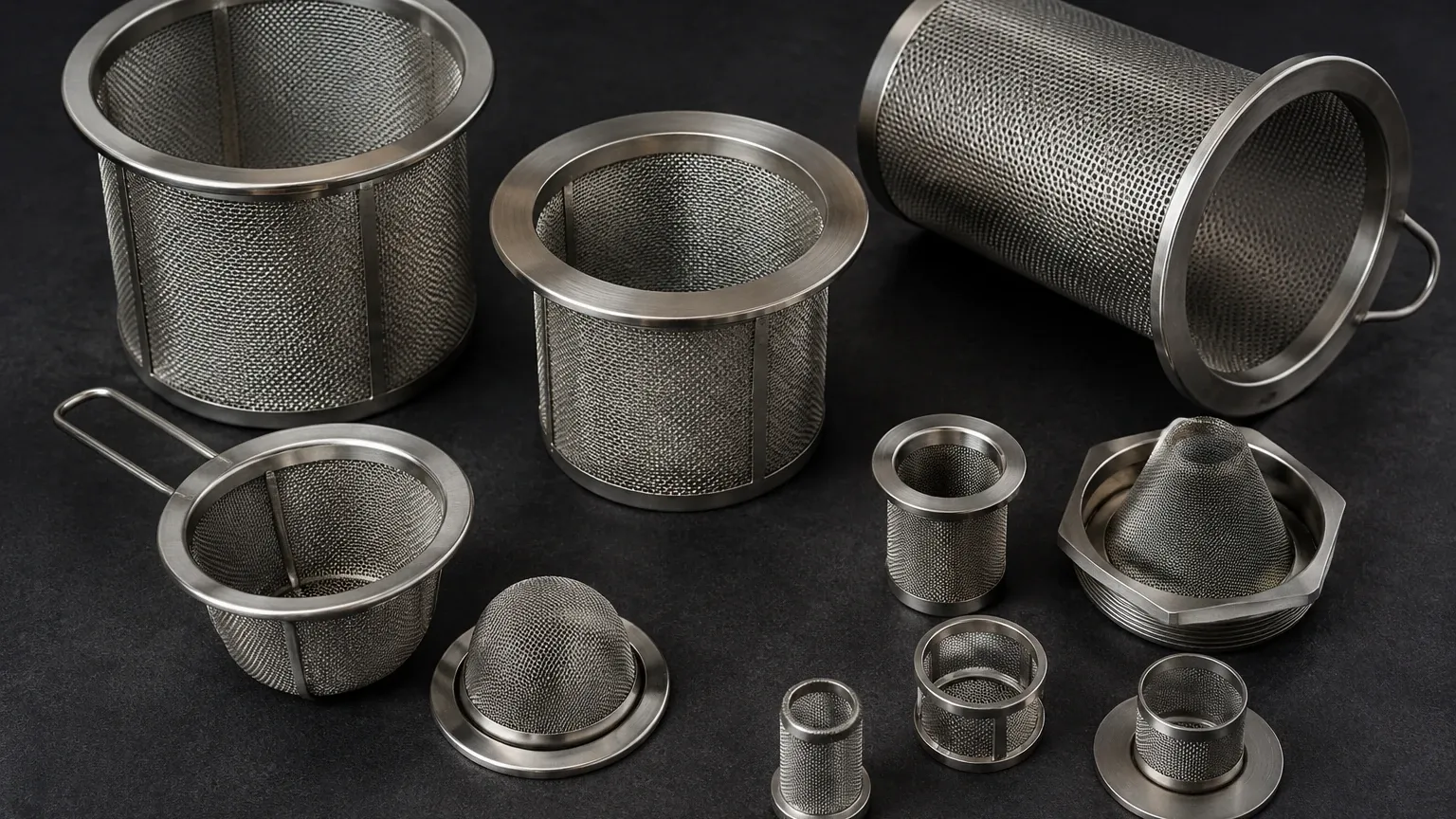
In many OEM applications, standard off-the-shelf solutions do not meet specific flow requirements or chemical compatibility needs. Custom-designed Strainers & Baskets can be manufactured with specific perforation patterns, mesh linings, and handle configurations to fit existing housings.
Technical Considerations for Selection
When specifying a strainer, engineers must look beyond the basic "strainers meaning in tamil" and focus on quantitative data. The following factors are non-negotiable for reliable performance:
1. Material Compatibility
The choice of material is dictated by the process fluid. Stainless steel (Grade 304 or 316L) is the gold standard for industrial applications due to its corrosion resistance and durability. In the pharmaceutical and food and beverage industries, 316L stainless steel is required to prevent contamination and withstand rigorous Clean-in-Place (CIP) protocols.
2. Mesh and Perforation Size
The "open area ratio" is a critical engineering metric. It represents the ratio between the total area of the holes in the strainer element and the cross-sectional area of the inlet pipe. A high open area ratio (typically 4:1 or higher) ensures that the strainer does not cause excessive pressure drop as it begins to collect debris.
3. Pressure and Temperature Ratings
Strainers must be rated for the maximum operating pressure and temperature of the system. Failure to account for pressure spikes can lead to the collapse of the strainer basket, allowing debris to bypass the unit and damage expensive downstream components.
4. Viscosity of the Fluid
Highly viscous fluids, such as oils or syrups, require larger perforations and more surface area to maintain flow rates. If the viscosity is high, the pressure drop across the strainer will increase significantly, necessitating a larger vessel size than would be required for water-like fluids.
The Role of Stainless Steel in Durable Straining
In the context of "strainers meaning in tamil," the durability of the *Vadikatti* is often linked to the quality of the metal used. Stainless steel wire mesh and perforated sheets are the primary components of high-performance strainers. Unlike carbon steel, which can rust and introduce particulates into the fluid stream, stainless steel maintains its structural integrity in harsh environments.
For industries such as chemical processing or marine applications, the use of specialized alloys or high-grade stainless steel is essential. This prevents pitting and crevice corrosion, which can lead to premature failure of the straining element.
Maintenance and Total Cost of Ownership (TCO)
While the initial purchase price of a strainer is an important factor, the Total Cost of Ownership (TCO) is a more accurate measure of value. This includes maintenance labor, replacement part costs, and the cost of process downtime.
* Cleaning Cycles: A well-designed strainer should have a clear indicator, such as a differential pressure gauge, to signal when cleaning is required. Over-cleaning leads to unnecessary labor costs, while under-cleaning can cause basket rupture.
* Replacement Parts: Using high-quality, precision-manufactured baskets ensures a proper fit within the housing. Poorly fitted baskets allow "bypass," where fluid flows around the edges of the strainer rather than through it, defeating the purpose of the installation.
* Customization: For many facilities, investing in a customized strainer basket that is specifically engineered for their unique debris type and flow rate can significantly extend the time between cleaning cycles, thereby reducing operational costs.
Conclusion for Engineers and Procurement Teams
Understanding the linguistic context of "strainers meaning in tamil" helps in localizing technical requirements and ensuring that site-level staff understand the importance of the *Vadikatti* in the process chain. However, the engineering success of a project depends on the rigorous application of filtration principles—selecting the right material, the correct mesh size, and the appropriate configuration for the flow conditions.
For those seeking reliable, high-performance Strainers & Baskets, the focus should remain on technical excellence and manufacturing precision. Whether protecting a simple water pump or a complex chemical reactor, the quality of the strainer is the first line of defense in maintaining system uptime and protecting capital investments. By combining localized understanding with global engineering standards, businesses can achieve optimized filtration performance that meets both technical and budgetary requirements.
