


Strainers Metal
In industrial fluid handling systems, the integrity of downstream equipment such as pumps, valves, meters, and spray nozzles depends heavily on the effective removal of solid contaminants. Industrial strainers metal components serve as the primary line of defense, utilizing perforated metal or woven wire mesh to intercept debris while allowing the process fluid to pass through with minimal resistance. Unlike fine filtration systems that may target sub-micron particles, metal strainers are typically designed for coarser separation, focusing on protecting mechanical assets from damage, clogging, or erosion.
Selecting the appropriate Strainers & Baskets requires a deep understanding of fluid dynamics, material science, and the specific mechanical stresses of the application. For engineers and procurement teams, the choice is not merely about size, but about the synergy between the strainer’s structural design and the operational environment.
The Role of Metal Strainers in Industrial Process Protection
Metal strainers are stationary mechanical devices used to remove unwanted solids from liquid, gas, or steam lines. In a B2B industrial context, these components are essential for maintaining the "health" of a piping system. The primary function of strainers metal is to prevent large particles—such as pipe scale, weld beads, or extrinsic debris—from entering sensitive equipment.
From an engineering perspective, a strainer is often distinguished from a filter by its service life and maintenance requirements. While filters are often disposable or require frequent replacement of media, metal strainers are typically permanent components designed for repeated cleaning. The use of stainless steel and other robust alloys ensures that these components can withstand high pressures, extreme temperatures, and corrosive fluids that would compromise polymer-based filtration media.
Material Selection: Stainless Steel Grades and Chemical Compatibility
The performance of a metal strainer is fundamentally limited by its material composition. In most industrial settings, stainless steel is the standard due to its mechanical strength and resistance to oxidation. However, the specific grade of stainless steel must be matched to the chemical profile of the process fluid.
Type 304 Stainless Steel
Type 304 is the most common material for industrial strainers. It provides excellent strength and good corrosion resistance for water treatment, food processing, and general industrial applications. It is cost-effective but may be susceptible to pitting in high-chloride environments.
Type 316 and 316L Stainless Steel
For more demanding environments, such as chemical processing or marine applications, Type 316 stainless steel is preferred. The addition of molybdenum enhances its resistance to chlorides and acetic acid. Type 316L (low carbon) is often specified for components requiring extensive welding, as it minimizes carbide precipitation that can lead to intergranular corrosion.
Specialty Alloys
In highly specialized sectors, such as petrochemical or pharmaceutical manufacturing, standard stainless steels may not suffice. Alloys like Monel, Hastelloy, or Duplex stainless steel are utilized when the process involves highly acidic or alkaline solutions, or when the system operates at temperatures exceeding the safe limits of austenitic stainless steels.
Comparing Structural Designs: Baskets, Y-Strainers, and Conical Inserts
The geometry of a strainer dictates its flow efficiency and ease of maintenance. When evaluating Strainers & Baskets, engineers must choose a configuration that fits the physical constraints of the piping layout and the expected solids loading.
Basket Strainers
Basket strainers are characterized by a vertical cylinder or "basket" that holds the debris. These are typically used in horizontal pipelines where high flow rates and high solids loading are expected. The primary advantage of the basket design is its large holding capacity and the fact that the basket can be serviced without draining the entire line if a duplex configuration is used. For heavy-duty applications, the basket is often reinforced with a perforated metal support to prevent the mesh from collapsing under pressure.
Y-Strainers
Named for their shape, Y-strainers are more compact and are often used in pressurized lines, both horizontal and vertical. They are ideal for applications with low solids loading. While they have a smaller holding capacity than basket strainers, they are easier to integrate into tight spaces. Y-strainers can also be equipped with a "blow-down" valve, allowing the debris to be flushed out without stopping the process flow.
Temporary and Conical Strainers
Often referred to as "witch's hats," conical strainers are typically used during the startup phase of a new plant to capture construction debris. While they are cost-effective, they are not intended for long-term use as they can be difficult to clean and may cause significant pressure drops if they become heavily loaded.
Engineering Specifications: Mesh Size, Open Area, and Pressure Drop
The technical efficiency of strainers metal is defined by two main factors: the filtration rating and the impact on system pressure.
Mesh vs. Perforation
Strainers can be constructed from perforated metal or woven wire mesh. Perforated metal is used for coarser straining (typically 1/32" to 1/4" holes), providing high structural integrity. Wire mesh is used for finer applications, often down to 40 microns. In many high-performance designs, a fine wire mesh is sintered or mechanically fastened to a perforated metal backing to combine fine filtration with structural durability.
Open Area Ratio (OAR)
One of the most critical metrics for a strainer is the Open Area Ratio. This is the ratio of the total area of the holes in the strainer element to the cross-sectional area of the inlet pipe. A common industry standard is an OAR of 4:1. An OAR of 4:1 means the strainer has four times the flow area of the pipe, which ensures that even as the strainer begins to clog, the pressure drop (Delta P) remains within acceptable limits. A low OAR leads to high velocity through the mesh, which can cause particle bypass or mechanical failure of the element.
Pressure Drop (Delta P)
Every strainer introduces a restriction to the flow. Engineers must calculate the clean pressure drop to ensure the pump has sufficient head to overcome it. As debris accumulates, the pressure drop increases. Monitoring the differential pressure across the strainer is the most reliable way to determine when cleaning is required.
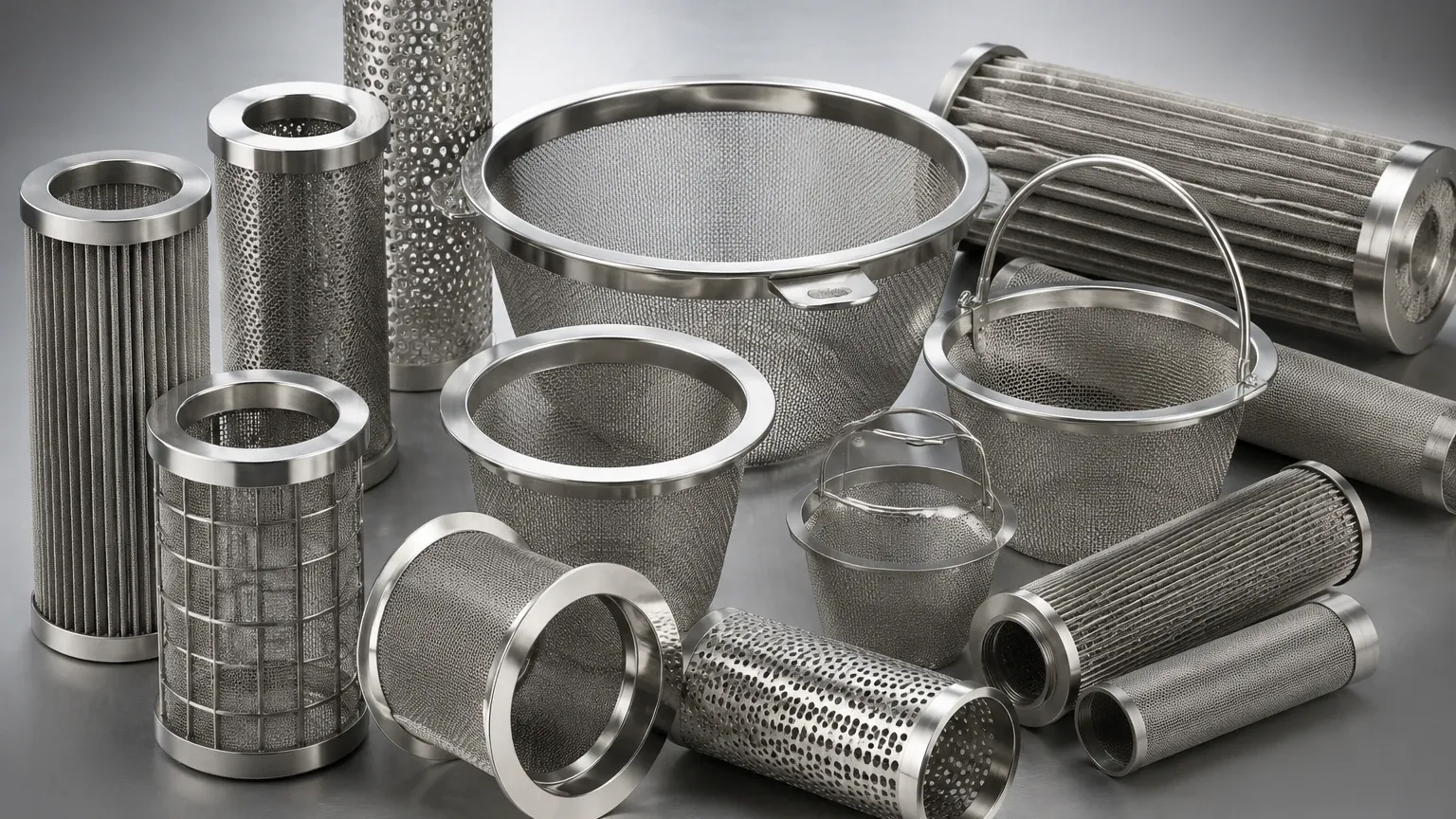
Manufacturing Techniques for Precision Metal Strainers
Quality manufacturing is what separates a reliable industrial strainer from a component prone to failure. At the manufacturing level, several processes are employed to ensure longevity:
* Welding Integrity: TIG (Tungsten Inert Gas) and resistance welding are used to join the mesh and perforated sections. High-quality welds prevent bypass and ensure the basket can withstand the stresses of high-pressure cleaning.
* Surface Treatment: Passivation is a critical post-manufacturing process for stainless steel strainers. It removes free iron from the surface and enhances the protective chromium oxide layer, which is vital for preventing corrosion in chemical and food-grade applications.
* Customization: Many industrial applications require non-standard dimensions or unique flange configurations (such as ANSI, DIN, or JIS standards). Custom-engineered strainers allow for direct retrofitting into existing systems without the need for costly piping modifications.
Maintenance, Cleaning, and Operational Best Practices
The total cost of ownership for strainers metal is largely influenced by maintenance efficiency. A strainer that is difficult to clean will lead to longer downtimes and higher labor costs.
1. Scheduled Inspection: While differential pressure gauges are the primary indicator for cleaning, regular visual inspections are necessary to check for signs of erosion or mechanical fatigue in the mesh.
2. Cleaning Protocols: For manual basket strainers, the element should be cleaned using a soft brush or high-pressure water/steam. Abrasive tools should be avoided as they can damage the fine wires of the mesh, altering the filtration rating.
3. Gasket and Seal Replacement: Every time a strainer is opened for cleaning, the gaskets or O-rings should be inspected. Using high-quality seal materials like EPDM, Viton, or PTFE ensures a leak-proof seal upon reassembly.
Selecting the Right Strainer for Specific Industry Applications
Different industries have varying priorities when it comes to metal strainers.
* Chemical Processing: Priority is placed on material compatibility and the ability to handle hazardous fluids safely. Bolted covers are often preferred over quick-opening covers for added safety.
* Food and Beverage: Sanitary strainers must feature smooth surface finishes (often electropolished) and be free of crevices where bacteria can grow. These must comply with stringent hygienic standards.
* Hydraulic Systems: In high-pressure hydraulic lines, strainers must be exceptionally robust to handle high-velocity pulses without deforming.
* Water Treatment: Large-scale basket strainers are used to protect membranes and UV systems from suspended solids. Here, the focus is on high flow capacity and corrosion resistance against treated water chemicals.
When sourcing industrial filtration components, it is essential to work with a manufacturer that understands these nuances. For technical specifications and custom design options, engineers can Review product options and application support to find a solution that aligns with their specific flow rates, pressure requirements, and material needs.
Conclusion
Metal strainers are a fundamental component of industrial infrastructure. By carefully considering material grades, structural designs like baskets or Y-strainers, and critical engineering metrics like the Open Area Ratio, facilities can significantly reduce equipment wear and unplanned downtime. Investing in high-quality, precision-manufactured strainers metal ensures that the entire fluid system operates at peak efficiency, protecting both the process integrity and the bottom line.
