


Strainer Meaning in Malayalam
In the global landscape of industrial procurement and engineering, clear communication regarding technical components is vital for ensuring system integrity and operational efficiency. For professionals operating in regions where Malayalam is spoken, or for those coordinating with engineering teams in South India, understanding the specific terminology used for filtration components is a foundational step. While the linguistic strainer meaning in malayalam is primarily associated with the word "അരിപ്പ" (arippa), the technical application of Strainers & Baskets in industrial environments involves a complex set of engineering parameters that go far beyond simple household definitions.
Industrial strainers are specialized closed vessels with cleanable screen elements designed to remove foreign particles from flowing liquids or gases. Unlike standard filters, which often handle microscopic particulates and are frequently disposed of after use, strainers are typically designed to capture larger debris and are intended for repeated cleaning and reuse. This article examines the technical nuances of these components, their engineering specifications, and the critical factors purchasing teams must consider when selecting high-performance filtration solutions.
Technical Definitions: Strainer Meaning in Malayalam and Industrial Contexts
To bridge the gap between general terminology and industrial application, one must look at how the word is used in different contexts. In a general sense, the strainer meaning in malayalam (arippa) refers to any device that separates solids from liquids. However, in a B2B or industrial engineering context, this term must be qualified by the specific function the device performs within a piping system.
In industrial fluid dynamics, a strainer is defined as a coarse filter. Its primary purpose is to protect downstream equipment—such as pumps, valves, meters, and heat exchangers—from damage caused by scale, rust, weld beads, or other solid contaminants. When discussing these components with technical teams, it is essential to specify the mechanical design, such as Y-type, T-type, or basket-type, as the generic term "arippa" does not convey the pressure ratings or flow characteristics required for heavy-duty applications.
For engineers, the distinction between a "filter" and a "strainer" is often based on the size of the particles being removed. Strainers generally handle particles that are visible to the naked eye (typically 40 microns or larger), whereas filters are used for much finer separation. Understanding this distinction ensures that when a request for a "strainer" is made, the resulting component is capable of handling the expected debris load without causing excessive pressure drops.
Engineering Considerations for Strainers & Baskets
When selecting Strainers & Baskets, engineers must evaluate several key performance indicators to ensure the component survives the rigors of the application. The choice of a strainer is rarely a matter of simple sizing; it requires a deep dive into the fluid properties and system requirements.
Open Area Ratio (OAR)
One of the most critical engineering metrics is the Open Area Ratio. This is the ratio of the total open area of the strainer screen to the internal cross-sectional area of the inlet pipe. A high OAR (typically 4:1 or higher) is desirable because it allows for a longer period of operation before the debris buildup causes a significant pressure drop. A low OAR will result in frequent cleaning cycles and potential cavitation in suction-side applications.
Pressure Drop (Delta P)
Every strainer introduces a degree of resistance to the flow. Engineers must calculate the clean pressure drop to ensure the system's pump capacity is sufficient. As the basket or screen collects debris, the pressure drop increases. If the pressure drop exceeds the design limit, it can lead to mechanical failure of the screen or damage to the pump. Monitoring this differential pressure is the standard method for determining when maintenance is required.
Micron vs. Mesh Rating
The filtration accuracy of a strainer is defined by its mesh or micron rating. Mesh refers to the number of openings per linear inch, while micron refers to the actual size of the opening in micrometers. In industrial procurement, it is safer to specify the micron rating, as the wire diameter can vary between different mesh manufacturers, affecting the actual opening size.
Types of Industrial Strainers and Their Applications
The physical configuration of the strainer body dictates its suitability for specific piping layouts and maintenance schedules. The two most common designs used in industrial settings are Y-strainers and basket strainers.
Y-Strainers
Y-strainers are named for their shape and are typically used in applications where the amount of material to be removed is relatively small. They are compact and can be installed in either horizontal or vertical pipelines. Because they are designed to handle high pressures, they are frequently found in steam, gas, and high-pressure liquid lines. However, their dirt-holding capacity is lower than that of basket designs.
Basket Strainers (Simplex and Duplex)
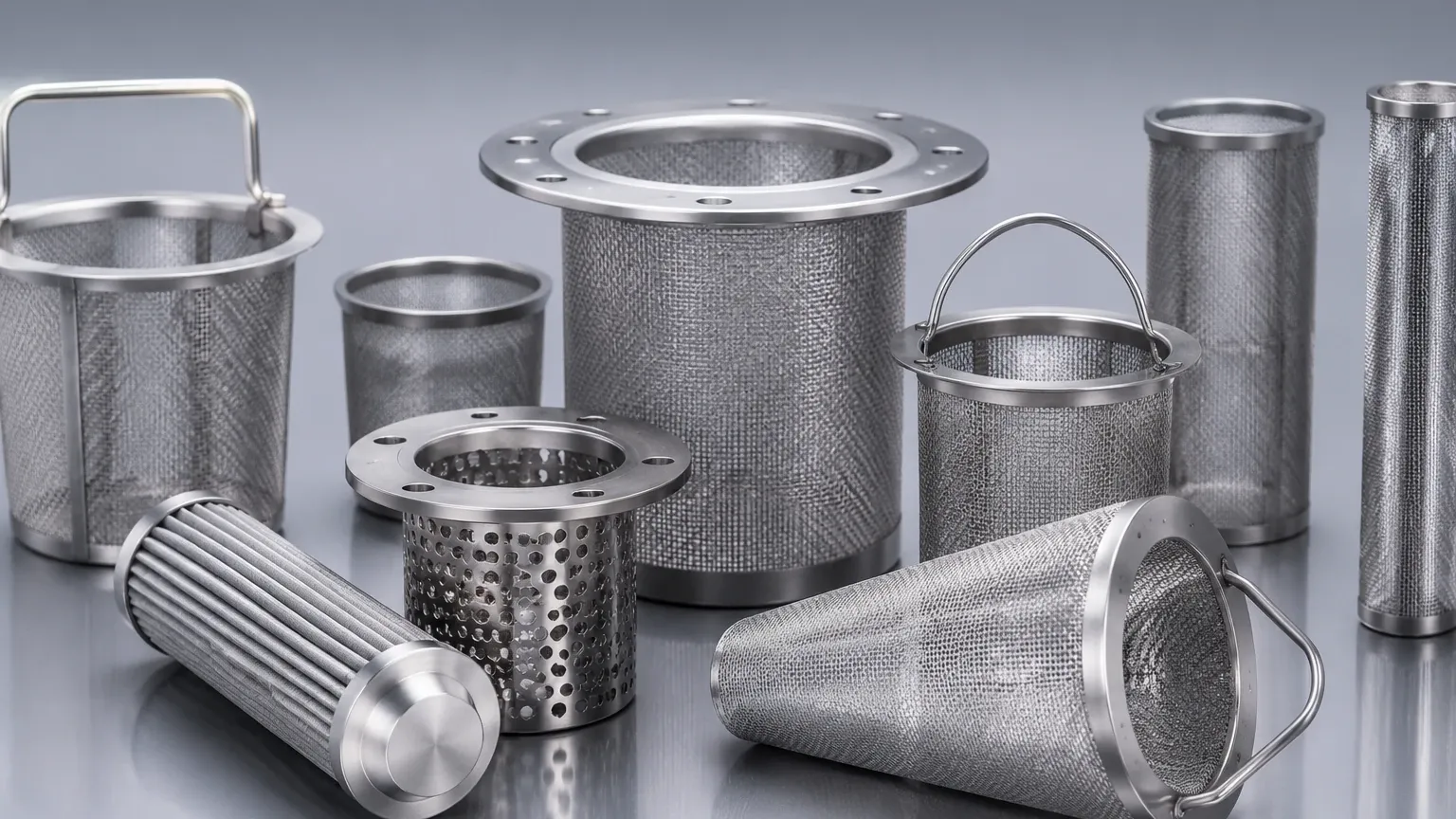
Basket strainers feature a vertical cylinder that houses a removable basket. This design offers a much larger surface area for debris collection compared to Y-strainers.
- Simplex Basket Strainers: These are used in systems where the flow can be intermittently stopped to clean the basket. They are common in batch processing and cooling water systems.
- Duplex Basket Strainers: Also known as twin-basket strainers, these consist of two separate strainer chambers connected by a valve. This allows the flow to be diverted to one chamber while the other is being cleaned, ensuring continuous operation. This is critical for 24/7 chemical processing or oil lubrication systems where downtime is not an option.
Material Selection and Durability
The longevity of Strainers & Baskets is heavily dependent on the materials used in their construction. In demanding industrial environments, stainless steel is the gold standard due to its mechanical strength and chemical resistance.
Stainless Steel 304 vs. 316L
Stainless steel 304 is suitable for most general-purpose applications, providing excellent resistance to atmospheric corrosion. However, in environments involving chlorides, acids, or high-salinity water, Type 316L stainless steel is preferred. The addition of molybdenum in 316L enhances its resistance to pitting and crevice corrosion, which is essential for pharmaceutical and chemical processing plants.
Perforated Metal vs. Wire Mesh
The internal basket or screen can be constructed from perforated metal or a combination of perforated metal and fine wire mesh. Perforated metal provides the structural integrity needed to withstand high-pressure differentials, while the wire mesh liner provides the fine filtration required for specific processes. Choosing the right gauge and hole pattern is vital to prevent the "blinding" of the screen, where particles become wedged in the openings.
Maintenance and Total Cost of Ownership (TCO)
For purchasing teams, the initial cost of a strainer is only one part of the total cost of ownership. A poorly designed strainer may be cheaper upfront but can lead to significant costs in terms of labor for cleaning, lost production time, and potential damage to downstream components.
Cleaning Cycles and Accessibility
In many industrial settings in Kerala and other regions, labor costs and operational uptime are scrutinized. A strainer that is difficult to open or requires specialized tools for maintenance will inevitably lead to longer downtime. Quick-opening covers and tool-free designs are highly valued in modern plant management. Furthermore, the strainer meaning in malayalam context often implies a manual process of cleaning (അരിപ്പ വൃത്തിയാക്കൽ), so ensuring that the basket is robust enough to withstand repeated handling and scrubbing is a key quality requirement.
Replacement Schedules
While the bodies of industrial strainers can last for decades, the internal baskets are wear parts. Factors such as erosion from high-velocity particles, corrosion, and mechanical stress from pressure surges will eventually necessitate replacement. Keeping a stock of precision-manufactured replacement baskets is essential for risk mitigation in any industrial facility.
Customization and OEM Solutions in Filtration
Standard off-the-shelf strainers do not always meet the unique requirements of specialized industries. Customization is often necessary when dealing with non-standard pipe sizes, extreme temperatures, or specific chemical compatibilities.
Professional manufacturers like Kaifil specialize in providing tailored filtration solutions. Customization options may include:
- Custom Mesh Sizes: Tailoring the filtration level to the exact particle distribution of the process fluid.
- Specialized Coatings: Applying PTFE or other coatings to enhance chemical resistance or reduce particle adhesion.
- Structural Reinforcements: Adding internal supports to baskets to prevent collapse under high-pressure differential scenarios.
- Specific Connection Types: Providing flanged, threaded, or socket-weld connections that match existing infrastructure.
By working closely with an OEM manufacturer, engineers can ensure that the Strainers & Baskets they install are optimized for their specific flow rates and fluid viscosities, rather than settling for a "one-size-fits-all" component.
Conclusion: Making Informed Procurement Decisions
Understanding the strainer meaning in malayalam is a helpful starting point for regional communication, but successful industrial filtration requires a rigorous focus on technical specifications and material science. Whether a facility is processing food and beverages, managing hydraulic fluids, or treating industrial wastewater, the choice of strainer directly impacts the reliability of the entire system.
When evaluating suppliers, purchasing teams should prioritize manufacturers who demonstrate deep technical expertise in stainless steel fabrication and fluid dynamics. A high-quality strainer should offer a balance of high open-area ratios, robust mechanical construction, and ease of maintenance. By focusing on these factual engineering boundaries, companies can reduce their total cost of ownership and ensure their downstream equipment remains protected from the damaging effects of particulate contamination.
