


Strainers Pasta
In the industrial food processing sector, particularly within large-scale pasta manufacturing, the efficiency of liquid-solid separation is a critical factor in maintaining product quality and operational throughput. Industrial strainers pasta applications involve more than just simple drainage; they require precision-engineered components capable of withstanding high temperatures, corrosive cleaning agents, and the mechanical stresses of continuous production cycles. For engineers and procurement specialists, selecting the right filtration hardware is essential to ensure that starch-heavy process water is managed effectively and that the final product meets strict consistency standards.
Customized Strainers & Baskets serve as the backbone of these systems, providing the structural integrity and filtration accuracy needed to handle diverse pasta shapes and sizes while facilitating rapid water removal. This article explores the technical considerations, material requirements, and engineering principles behind industrial straining solutions in the pasta industry.
The Role of Industrial Strainers in Pasta Production
Pasta manufacturing involves several stages where liquid-solid separation is mandatory. From the initial blanching or cooking phase to the subsequent cooling and rinsing stages, the ability to quickly and cleanly separate the pasta from the process water determines the texture and quality of the final product. In high-volume environments, standard consumer-grade equipment is insufficient. Industrial-grade strainers pasta solutions must be integrated into automated lines to manage the flow of both the product and the byproduct.
Starch Management and Water Recycling
During the cooking process, pasta releases significant amounts of starch into the water. This starch-laden water can become viscous, potentially clogging standard filters. Engineering a strainer for this environment requires a balance between fine filtration (to capture small pasta fragments) and high flow rates (to prevent water backup). Effective straining also allows for the pre-treatment of process water before it enters recycling or waste treatment systems, reducing the load on downstream filtration units.
Batch vs. Continuous Processing
In batch processing, large baskets are often used to lift pasta out of boiling water or cooling baths. These baskets must be designed with reinforced frames to support the weight of several hundred kilograms of wet pasta. Conversely, in continuous flow systems, inline strainers or rotating drum screens are more common. Understanding the mechanical load and the frequency of use is the first step in specifying the correct strainer configuration.
Engineering Considerations for Material Selection
Material choice is perhaps the most critical technical decision when sourcing strainers for food-grade applications. Stainless steel is the industry standard due to its non-reactive properties and durability.
Stainless Steel 304 vs. 316L
While SS304 is suitable for many food applications, SS316L is often preferred for industrial pasta straining due to its enhanced resistance to pitting and corrosion, especially when exposed to high-temperature saline environments (if salt is added during the process) or harsh chemical sanitizers used during CIP (Clean-in-Place) cycles. SS316L’s lower carbon content also makes it more resistant to sensitization during welding, ensuring the structural integrity of the mesh-to-frame bonds.
Surface Finish and Hygiene
For food safety compliance, the surface finish of the strainer is as important as the alloy itself. Industrial strainers pasta components usually undergo electropolishing or mechanical polishing to achieve a smooth surface. This minimizes the risk of bacterial growth by eliminating microscopic crevices where starch or organic matter could accumulate. A Ra (Roughness Average) value of 0.8 μm or lower is typically targeted for high-hygiene environments.
Technical Specifications: Mesh and Perforation
The performance of a strainer is defined by its open area and the geometry of its filtration media. Engineers must calculate the required flow rate against the minimum particle size that needs to be retained.
Wire Mesh vs. Perforated Metal
* Wire Mesh: Provides a higher percentage of open area, which is ideal for rapid drainage. However, it can be more delicate and may require a perforated metal backup for structural support in high-pressure or high-load applications.
* Perforated Metal: Offers superior structural strength and is easier to clean. It is often used as the primary media for large pasta shapes where the filtration requirement is less stringent (e.g., 2mm to 5mm holes).
Open Area Calculations
The "open area" percentage dictates the pressure drop across the strainer. If the open area is too low, the drainage will be sluggish, leading to overcooked pasta or water overflow. Industrial designers typically aim for a ratio where the open area of the strainer is at least 3 to 4 times the cross-sectional area of the inlet pipe to ensure minimal flow resistance.
Customizing Strainers for Specific Pasta Geometries
One of the challenges in the pasta industry is the sheer variety of product shapes. A strainer designed for long strands of spaghetti will perform differently when used for small shapes like ditalini or orzo.
Preventing Clogging and "Blinding"
Small, flat pasta shapes have a tendency to align themselves with the holes of a strainer, a phenomenon known as "blinding." To counter this, engineers may use wedge wire screens or specific mesh weaves that create a non-clogging surface. The V-shaped profile of wedge wire, for instance, ensures that any particle that passes the top edge will continue through the screen without getting stuck.
Basket Geometry and Drainage Patterns
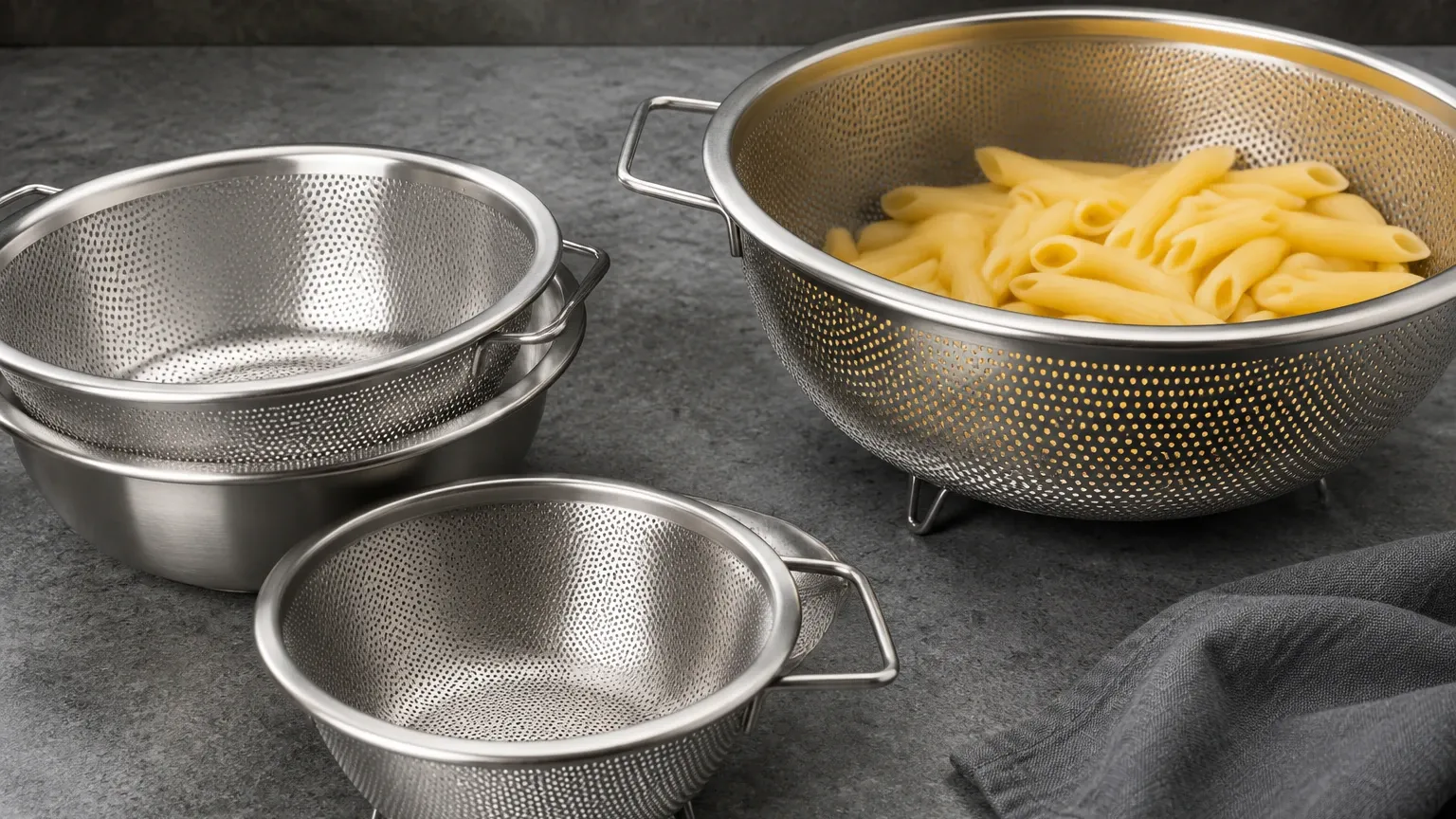
The shape of the basket—whether cylindrical, conical, or rectangular—affects the drainage pattern. For industrial strainers pasta applications, conical bottoms are often preferred for batch processing as they direct the liquid toward a central point, speeding up the separation process. For continuous belts, flat-bottomed rectangular inserts are more common to ensure an even distribution of the product across the cooling or drying zone.
Hygienic Design and Food Safety Compliance
In any B2B food processing environment, compliance with international standards such as FDA, 3-A, or EHEDG is non-negotiable. The design of the strainer must facilitate thorough cleaning and inspection.
Welded Construction
Spot welding is generally avoided in high-hygiene strainers because it creates small gaps where contaminants can hide. Instead, full TIG (Tungsten Inert Gas) welding with ground-smooth seams is the standard. This ensures that the joint between the mesh and the support frame is seamless and easy to sanitize.
CIP Compatibility
Modern pasta production lines utilize Clean-in-Place systems to reduce downtime. Strainers must be designed to withstand the high-pressure sprays and caustic chemicals used in these systems without deforming or corroding. This requires robust frame designs and high-quality mesh tensioning to prevent the media from sagging over time.
Maintenance and Replacement Cycles
While high-quality stainless steel strainers are durable, they are not indestructible. Establishing a maintenance schedule is vital for preventing unexpected line shutdowns.
Inspection for Mesh Fatigue
In high-vibration environments or systems with high-pressure pulses, the wire mesh can undergo metal fatigue. Regular visual inspections should look for broken wires or thinning of the mesh. A single broken wire can allow pasta fragments to pass through, potentially contaminating the water system or damaging downstream pumps.
Cleaning Protocols
Starch buildup is the most common issue in pasta filtration. If the strainers are not cleaned properly, the starch can harden, significantly reducing the open area. Ultrasonic cleaning is an effective method for deep-cleaning fine mesh strainers that have become blinded by dried starch or protein deposits.
Total Cost of Ownership (TCO) in Filtration
When purchasing Strainers & Baskets, procurement teams should look beyond the initial purchase price. The Total Cost of Ownership includes the unit's lifespan, the ease of cleaning (which impacts labor costs), and the impact on production efficiency.
1. Durability: A cheaper, lower-grade strainer may fail within months under the stress of thermal cycling, leading to costly production halts.
2. Efficiency: A well-engineered strainer with a high open-area ratio reduces the energy required for pumping and speeds up the production cycle.
3. Customization: Off-the-shelf solutions rarely meet the specific needs of a high-speed pasta line. Investing in a custom-designed strainer ensures that the equipment fits perfectly into the existing infrastructure, reducing installation time and leak risks.
Conclusion: Selecting the Right Partner
Industrial pasta production requires a sophisticated approach to filtration. The complexity of starch management, combined with the need for high-volume throughput and strict hygiene standards, means that "one size fits all" solutions are rarely effective. Engineers must prioritize material quality, structural design, and ease of maintenance when specifying strainers for their facilities.
By focusing on technical parameters such as mesh count, open area ratios, and SS316L construction, manufacturers can ensure their systems remain efficient and compliant. Partnering with a manufacturer that understands these industrial nuances allows for the development of customized filtration components that solve specific production challenges, ultimately leading to a more reliable and cost-effective manufacturing process.
