


Strainers Pump
In industrial fluid management, the reliability of a pumping system is fundamentally linked to the quality of its pre-filtration components. A strainers pump configuration—referring to the strategic integration of strainers within a pumping circuit—serves as the primary defense mechanism for downstream equipment. Whether dealing with centrifugal, positive displacement, or high-pressure hydraulic pumps, the presence of a robust strainer is critical to preventing mechanical wear, seal failure, and catastrophic system downtime.
For engineers and procurement professionals, selecting the correct filtration hardware is not merely a matter of fitting a pipe size; it involves a deep understanding of fluid dynamics, material compatibility, and the specific protective requirements of the pump itself. This article explores the technical nuances of pump strainers, the engineering principles behind their selection, and how customized solutions enhance operational longevity.
Understanding the Role of Strainers in Pump Protection
The primary function of a strainer in a pump system is to remove oversized solids that could damage internal components. Pumps are precision-engineered machines with tight tolerances between impellers, casings, and mechanical seals. Even small amounts of debris, such as pipe scale, welding slag, or process byproducts, can cause erosive wear or immediate blockage.
When discussing a strainers pump setup, the focus is usually on the suction side. Suction strainers are installed upstream of the pump to ensure that the fluid entering the intake is free of harmful particulates. However, filtration is also relevant on the discharge side to protect sensitive downstream components like spray nozzles, heat exchangers, and control valves.
Without adequate Strainers & Baskets, the total cost of ownership (TCO) for a pumping system rises sharply due to frequent maintenance intervals and the high cost of replacement parts. By implementing a high-performance filtration solution, facilities can ensure continuous operation and maintain the integrity of their process fluids.
Technical Considerations for Strainers Pump Applications
Selecting a strainer for a pump application requires a balance between filtration efficiency and hydraulic performance. Engineers must evaluate several key technical parameters to ensure the strainer does not negatively impact the pump's operation.
Filtration Rating: Mesh vs. Micron
Industrial strainers are typically rated by mesh size or micron levels. The mesh count refers to the number of openings per linear inch, while the micron rating measures the actual size of the particles that can pass through the media. In a strainers pump application, the goal is to select a mesh that is fine enough to protect the pump's internal clearances but coarse enough to avoid excessive flow restriction.
Open Area Ratio (OAR)
The Open Area Ratio is the relationship between the total area of the openings in the strainer element and the internal cross-sectional area of the inlet pipe. For suction-side strainers, a common engineering standard is an OAR of at least 4:1. This high ratio ensures that even as the strainer begins to collect debris, there is still enough open area to maintain flow without causing a significant pressure drop.
Pressure Drop (ΔP)
Every strainer introduces a degree of resistance to the flow. This pressure drop must be calculated for both clean and partially clogged conditions. If the pressure drop across a suction strainer becomes too high, it can lead to cavitation—a condition where the pressure of the fluid drops below its vapor pressure, causing bubbles to form and collapse violently against the impeller. This can destroy a pump in a matter of hours.
Types of Strainers & Baskets for Industrial Pumping
Different pumping environments require different strainer geometries. The choice often depends on the required flow rate, the nature of the contaminants, and the frequency of cleaning required.
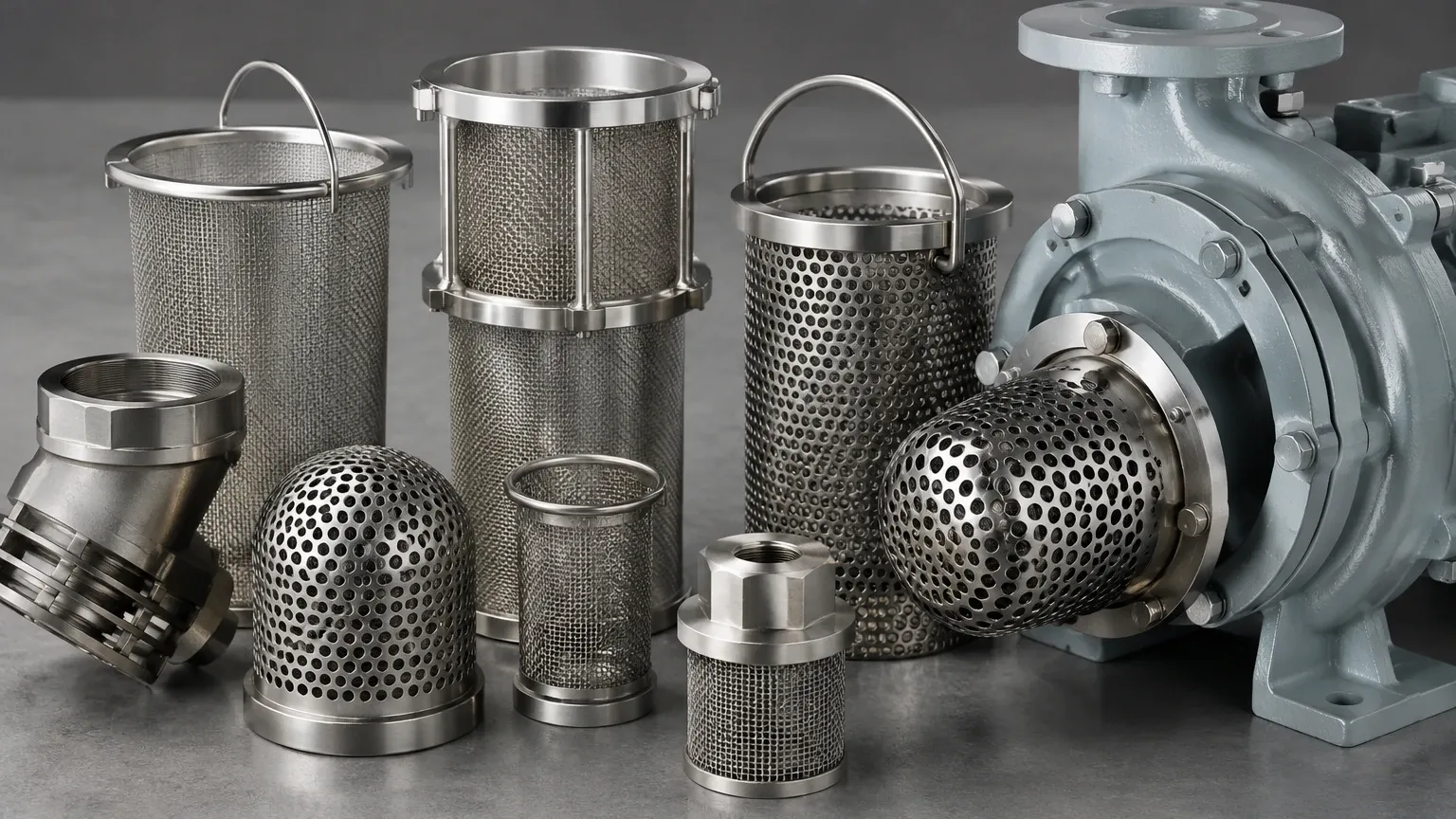
Y-Strainers
Y-strainers are the most common choice for compact spaces and high-pressure applications. They are typically used where the amount of debris is relatively low. In a strainers pump context, they are often found on the discharge side or in smaller-diameter suction lines. Their primary advantage is their ability to be installed in both horizontal and vertical positions.
Simplex Basket Strainers
Basket strainers offer a larger holding capacity than Y-strainers, making them ideal for suction-side protection where higher volumes of solids are expected. The "basket" design allows for easy removal and cleaning. These are frequently used in chemical processing and water treatment where pump protection is paramount.
Duplex Strainers
In critical processes that cannot be shut down for cleaning, duplex strainers are used. These consist of two separate strainer housings connected by a diverting valve. When one side becomes clogged, the flow is diverted to the clean side, allowing the operator to service the dirty basket without interrupting the pump's operation. This is a standard requirement in oil and gas, marine, and continuous chemical manufacturing.
Custom Fabricated Strainers
For unique industrial requirements, standard off-the-shelf components may not suffice. Custom-designed Strainers & Baskets can be engineered to fit specific flange configurations, accommodate unusual flow rates, or incorporate multi-layer wire mesh for reinforced strength. Manufacturers like Kaifil specialize in these tailored solutions, ensuring that the filtration component fits perfectly within the existing infrastructure.
Engineering for Flow Dynamics and Pressure Drop
The interaction between the strainer and the pump's Net Positive Suction Head (NPSH) is one of the most critical aspects of system design. NPSH Available (NPSHa) must always be greater than the NPSH Required (NPSHr) by the pump.
When a strainers pump system is designed, the engineer must account for the friction loss through the strainer as part of the NPSHa calculation. If the strainer is undersized or the mesh is too fine, the resulting pressure drop reduces the NPSHa, potentially leading to the aforementioned cavitation.
To mitigate this risk, high-quality strainers utilize precision-woven stainless steel wire mesh. This material provides a high percentage of open area while maintaining structural integrity under vacuum or high-pressure conditions. Furthermore, the internal geometry of the strainer housing should be designed to minimize turbulence, which can also contribute to energy loss and pump inefficiency.
Material Selection and Durability in Corrosive Environments
In industries such as chemical processing, pharmaceuticals, and food and beverage, the material of the strainer is as important as its design. Stainless steel—specifically grades 304 and 316L—is the industry standard for high-performance strainers pump components.
* Stainless Steel 304: Offers excellent strength and general corrosion resistance, suitable for water treatment and many industrial fluids.
* Stainless Steel 316L: Contains molybdenum, which provides superior resistance to chlorides and acidic environments. This is the preferred material for marine applications, chemical plants, and pharmaceutical production.
Beyond corrosion resistance, stainless steel is chosen for its durability. Unlike plastic or lower-grade metal strainers, stainless steel baskets can withstand high differential pressures without collapsing. They are also capable of withstanding high-temperature fluids and rigorous cleaning cycles, including Steam-in-Place (SIP) and Clean-in-Place (CIP) protocols in sanitary applications.
Maintenance and Operational Efficiency
A strainers pump system is only as effective as its maintenance regimen. A clogged strainer is a common cause of pump failure, as it starves the pump of fluid and leads to overheating or seal damage.
Monitoring Differential Pressure
The most effective way to manage strainer maintenance is through differential pressure monitoring. By installing pressure gauges upstream and downstream of the strainer, operators can see exactly when the basket is becoming restricted. Most industrial systems set a threshold (e.g., 5-10 psi) at which the strainer must be cleaned.
Cleaning Procedures
Depending on the design, cleaning may involve removing a basket, backwashing the system, or replacing a disposable mesh liner. For stainless steel Strainers & Baskets, manual cleaning usually involves rinsing or ultrasonic cleaning to remove embedded particulates from the wire mesh. Because these components are reusable, they offer a significantly lower long-term cost compared to disposable filters.
Replacement Cycles
While stainless steel strainers are highly durable, the mesh can eventually suffer from fatigue or mechanical damage. Regular inspection of the mesh for tears or bypass is essential. Using high-quality components from a specialized manufacturer ensures that replacement baskets fit precisely, preventing the bypass of unfiltered fluid that could reach the pump.
Custom OEM Solutions for Specialized Pumping Systems
Many industrial equipment manufacturers (OEMs) require filtration components that are integrated directly into their pump skids or specialized machinery. In these cases, a standard strainer housing may be too bulky or incorrectly oriented.
Customization options for strainers pump applications include:
* Variable Mesh Layers: Combining a coarse outer support mesh with a fine inner filtration mesh for high-strength, precision filtration.
* Specialized End Fittings: Custom flanges, NPT threads, or sanitary tri-clamp connections to match existing piping.
* Unique Geometries: Conical (witches hat) strainers, flat plate strainers, or elongated baskets designed for specific flow paths.
By working with a manufacturer that understands both the metallurgy and the fluid mechanics involved, engineers can develop filtration solutions that optimize pump performance rather than simply protecting it. This collaborative approach leads to systems that are easier to maintain and more resilient to process fluctuations.
Conclusion: Optimizing Pump Longevity through Precision Filtration
The relationship between a pump and its strainer is fundamental to industrial efficiency. A well-engineered strainers pump strategy protects expensive assets, reduces maintenance labor, and ensures the purity of the final product. By focusing on critical factors such as the Open Area Ratio, material grade, and pressure drop, technical professionals can select filtration solutions that provide reliable service for years.
Investing in high-quality stainless steel Strainers & Baskets is a proactive step toward system reliability. Whether for a new installation or an upgrade to an existing process, the right filtration component is the most cost-effective insurance policy for any industrial pumping system.
