


Strainers Water
In industrial fluid handling, the management of water quality is a fundamental requirement for protecting downstream equipment and ensuring process integrity. Industrial water systems, whether utilizing municipal supply, recycled process water, or raw intake from natural sources, inevitably carry particulate matter. To mitigate the risks of equipment damage and system downtime, engineers rely on robust mechanical separation components. Among the most critical of these are water strainers, designed to remove large-scale solids from the flow stream.
Understanding the technical nuances of how strainers water systems are designed and maintained is essential for any facility manager or procurement specialist. This guide examines the engineering principles, material considerations, and selection criteria for industrial strainers, focusing on their role in maintaining the health of complex hydraulic and processing infrastructures.
The Role of Strainers in Industrial Water Systems
Industrial water strainers serve as the first line of defense in a filtration circuit. Unlike fine filters, which are designed to remove microscopic contaminants, strainers are engineered to capture larger debris such as scale, rust, pebbles, and organic matter. Their primary function is to protect sensitive components—including pumps, control valves, flow meters, and heat exchangers—from mechanical abrasion or clogging.
When evaluating strainers water applications, the objective is to achieve a balance between filtration efficiency and system pressure. A strainer that is too fine will clog rapidly, leading to excessive pressure drops and frequent maintenance. Conversely, a strainer with openings that are too large will allow damaging particles to pass through. Therefore, the selection process begins with a thorough analysis of the influent water quality and the specific protection requirements of the downstream equipment.
Types of Water Strainers and Their Engineering Applications
Industrial strainers are categorized by their physical configuration and the method by which they are cleaned. The choice of type depends on the flow rate, the allowable pressure drop, and whether the process can be interrupted for cleaning.
Y-Strainers
Named for their "Y" shape, these strainers are typically used in pressurized lines, either liquid or steam. They are compact and suitable for applications where the amount of material to be removed is relatively small. In water systems, Y-strainers are often installed in suction lines for pumps or before control valves. Their design allows for high-pressure ratings, but they generally have a smaller dirt-holding capacity compared to basket-style designs.
Basket Strainers
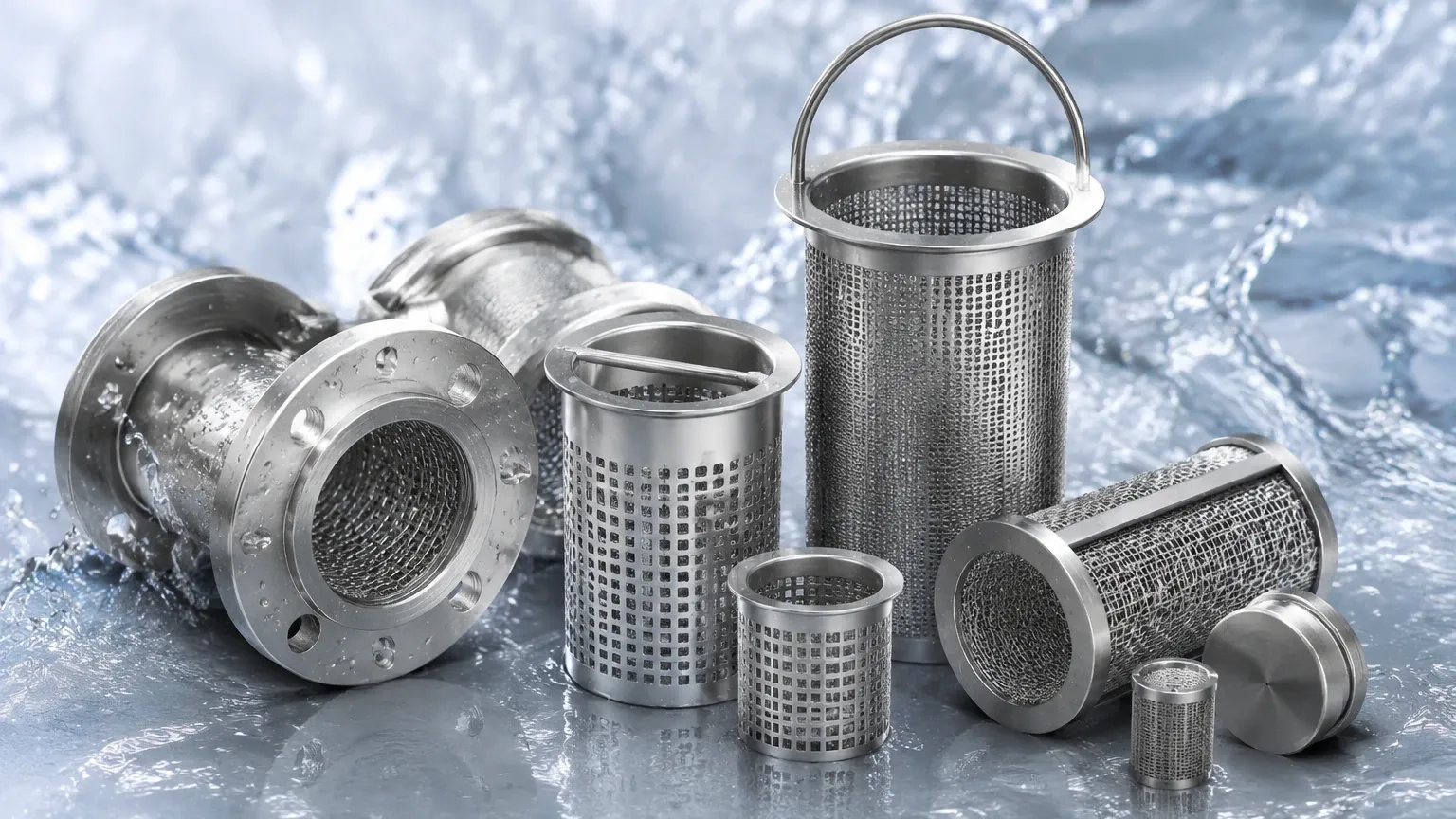
Basket strainers feature a vertical cylinder that houses a removable basket-shaped element. These are the preferred choice for high-flow water applications because they offer a larger surface area for filtration, which translates to a lower initial pressure drop and a longer service life between cleanings. For systems that require continuous operation, duplex basket strainers are employed. These consist of two separate strainer chambers connected by a diverting valve, allowing one side to be cleaned while the other remains in service.
For many heavy-duty industrial applications, Strainers & Baskets are the standard for ensuring large-volume water intake is free from macro-contaminants that could compromise cooling towers or large-scale chemical reactors.
Material Selection for Corrosion Resistance and Durability
The longevity of a water strainer is heavily dependent on its material of construction. Because water can be highly corrosive—particularly in the case of seawater, brackish water, or chemically treated process water—selecting the correct alloy is paramount.
1. Stainless Steel (304 and 316): These are the most common materials for industrial water strainers. Type 304 offers excellent resistance to general corrosion and is suitable for most freshwater applications. Type 316, which contains molybdenum, provides superior resistance to pitting and crevice corrosion, making it the standard for saline environments or water containing chlorides.
2. Carbon Steel: Often used for non-corrosive water services where cost is a primary factor. To extend its lifespan, carbon steel strainers may be coated or lined with epoxy or other protective polymers.
3. Specialty Alloys: For highly aggressive water chemistry, such as high-temperature acidic water in chemical processing, alloys like Monel or Hastelloy may be required to prevent rapid material degradation.
In addition to the housing material, the internal mesh or perforated plate must be carefully selected. Stainless steel is the industry standard for strainer elements due to its structural integrity and ease of cleaning.
Key Technical Specifications for Sizing and Selection
Sizing a strainer involves more than matching the pipe diameter. Engineers must calculate the specific hydraulic impact of the strainer on the entire system. Key parameters include:
Open Area Ratio (OAR)
The Open Area Ratio is the ratio of the total area of the openings in the strainer element to the cross-sectional area of the inlet pipe. A higher OAR (e.g., 6:1 or 8:1) indicates that the strainer can handle more debris before the pressure drop becomes critical. For water systems with high solids loading, a larger OAR is essential to prevent frequent pump cycling or flow restriction.
Micron and Mesh Ratings
Strainer elements are defined by their hole size. Perforated plates are typically measured in inches or millimeters, while wire mesh is measured by the number of openings per linear inch. In water applications, mesh sizes ranging from 20 to 200 are common. It is vital to distinguish between "nominal" and "absolute" ratings; nominal ratings indicate the average pore size, while absolute ratings indicate the largest particle that can pass through the medium.
Pressure Drop (Delta P)
Every strainer introduces a restriction to the flow, resulting in a pressure drop. Manufacturers provide flow coefficient (Cv) values to help engineers calculate the expected pressure drop at a given flow rate. A general rule of thumb for clean water systems is to design for an initial pressure drop of no more than 2 psi (0.14 bar). If the pressure drop exceeds 5-10 psi, it usually indicates that the strainer element is clogged and requires immediate attention.
Maintenance Protocols and Operational Efficiency
The performance of strainers water systems is directly tied to the frequency and quality of maintenance. Neglecting a strainer can lead to collapsed elements, pump cavitation, and contaminated downstream processes.
Monitoring Differential Pressure
The most effective way to manage strainer maintenance is through differential pressure (DP) monitoring. By installing pressure gauges on both the inlet and outlet sides of the strainer, operators can see the exact moment the element begins to blind. Automated systems can be set to trigger an alarm or initiate a backwash cycle when a specific DP threshold is reached.
Cleaning Procedures
For simplex strainers, the system must be depressurized and drained before the cover is removed. The basket or screen should be cleaned using a high-pressure water jet or a soft brush, taking care not to damage the mesh. For duplex systems, the flow is diverted to the clean chamber, allowing maintenance to occur without stopping production. In some high-volume water treatment plants, self-cleaning strainers are used, which employ internal scrapers or back-flushing mechanisms to remove debris automatically.
Spare Parts Management
To minimize downtime, facilities should maintain an inventory of critical spare parts, including replacement baskets, gaskets, and O-rings. Because strainer elements are subject to mechanical stress and potential corrosion, they should be inspected regularly for signs of fatigue or wire breakage.
Customization Options for Specific Industrial Requirements
Standard off-the-shelf strainers may not meet the needs of every industrial application. Customization allows engineers to tailor the strainer to the specific environmental and operational constraints of their facility. Common customization options include:
* Custom Connection Types: While flanged connections are standard for large industrial lines, some systems may require NPT threads, socket welds, or specialized sanitary fittings for food and beverage applications.
* Venting and Draining: Adding vent valves at the top of the strainer housing helps bleed off trapped air, while oversized drain plugs facilitate faster cleaning and debris removal.
* Magnetic Inserts: For water systems prone to iron or steel scale (common in older piping networks), magnetic inserts can be added to the strainer basket to capture fine metallic particles that might otherwise pass through the mesh.
* Reinforced Baskets: In high-pressure or high-velocity systems, standard mesh baskets may deform. Reinforcing the mesh with a heavy-duty perforated metal backing ensures the element maintains its shape under load.
By working with a specialized manufacturer, engineering teams can ensure that their Strainers & Baskets are optimized for the unique flow characteristics and contaminant profiles of their specific water source.
Conclusion: Optimizing Water Filtration Strategy
The selection and implementation of water strainers are critical components of a comprehensive industrial filtration strategy. By correctly identifying the types of contaminants present and the sensitivity of downstream equipment, engineers can select a strainer that provides maximum protection with minimal operational impact.
Whether the application involves cooling water for a power plant, process water for a pharmaceutical facility, or intake water for a municipal treatment center, the principles remain the same: prioritize material compatibility, size for appropriate pressure drops, and establish rigorous maintenance schedules. A well-engineered strainer system not only protects capital equipment but also contributes to the overall efficiency and sustainability of the industrial process by reducing waste and preventing unplanned outages.
