


T Type Strainer vs Basket Strainer
In industrial fluid handling, the selection of mechanical filtration components is critical for protecting downstream equipment such as pumps, valves, and flow meters. Among the most common configurations used in chemical processing, water treatment, and hydraulic systems are T-type strainers and basket strainers. While both serve the fundamental purpose of removing solid particles from a liquid or gas stream, their mechanical designs, flow characteristics, and maintenance requirements differ significantly.
Understanding the nuances of t type strainer vs basket strainer performance is essential for engineers and procurement teams to ensure system longevity and minimize operational downtime. This guide examines the technical specifications, installation advantages, and application-specific trade-offs of these two essential filtration solutions.
Structural Design and Flow Dynamics
The primary difference between these two components lies in their physical geometry and how fluid moves through the internal filter element.
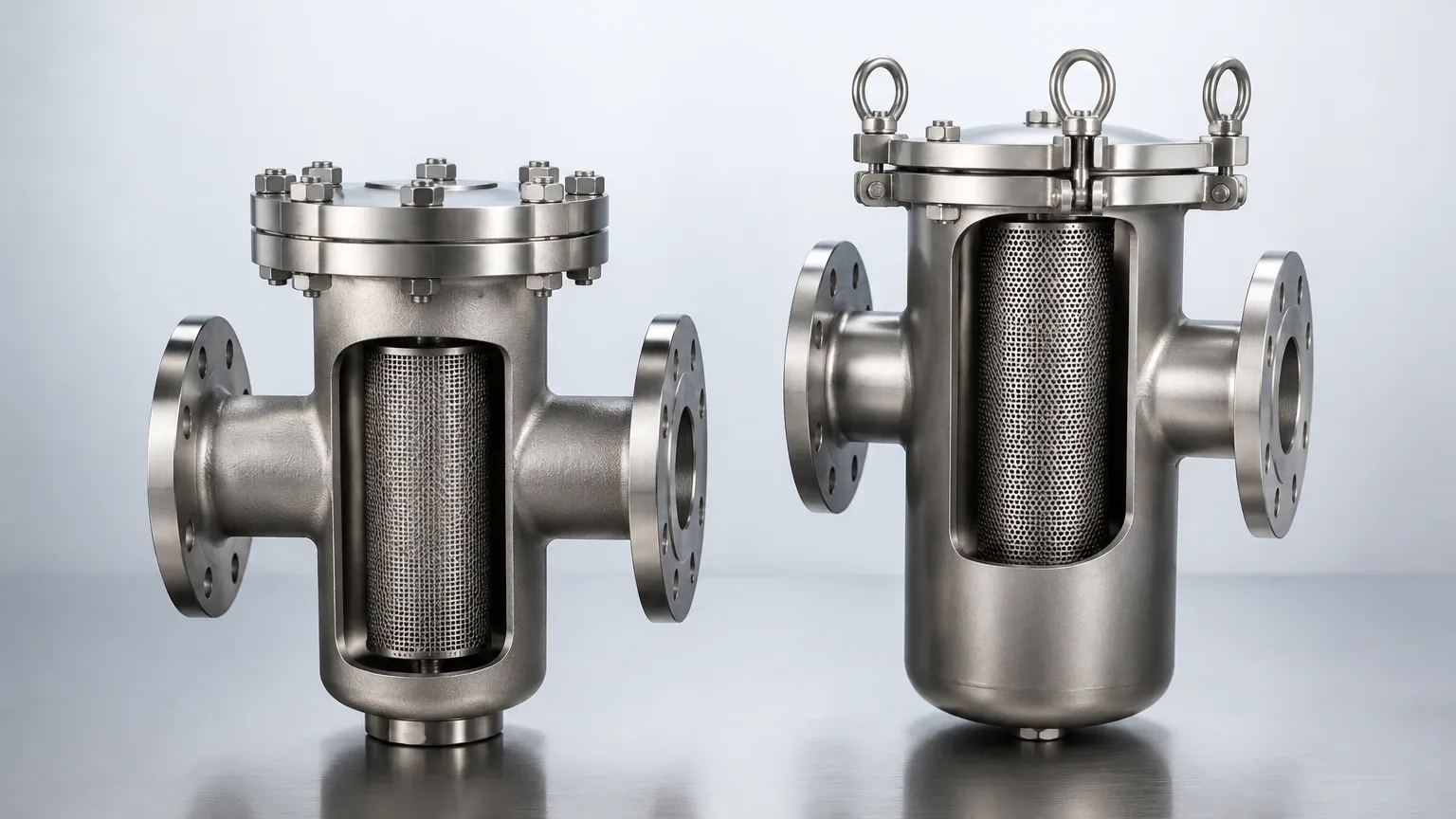
A T-type strainer, as the name suggests, features a body shaped like the letter "T." The filter element is housed in the branch of the T, perpendicular to the main flow path. This design is inherently compact and allows for a straight-through flow, which can be advantageous in systems where space is at a premium. Because of its rigid construction, the T-type strainer is often favored for high-pressure applications where a more robust housing is required to withstand mechanical stress.
In contrast, a basket strainer (also known as a pot strainer) typically features a larger, vertical chamber that houses a "basket-shaped" filter element. The fluid enters the side of the chamber, passes through the basket from the inside out (or outside in, depending on the design), and exits through the outlet. This configuration provides a much larger filtration surface area relative to the pipe size. The increased internal volume of Strainers & Baskets in the basket category allows for a significant reduction in flow velocity as the fluid enters the strainer body, which helps in the settling of heavier solids.
Comparing Dirt-Holding Capacity and Pressure Drop
When evaluating t type strainer vs basket strainer for a specific process, the Open Area Ratio (OAR) and dirt-holding capacity are the most critical performance metrics.
Basket Strainer Capacity
Basket strainers are designed for high-load environments. Because the basket element is physically larger than the cylindrical element found in a T-strainer, it can capture a greater volume of debris before the pressure drop reaches a critical level. This makes basket strainers the preferred choice for batch processes or systems where the fluid contains a high concentration of suspended solids. The larger surface area also results in a lower initial pressure drop (clean ΔP), which improves overall system efficiency and reduces the load on centrifugal pumps.
T-Type Strainer Capacity
T-type strainers have a smaller internal volume and a more compact filter element. Consequently, they have a lower dirt-holding capacity. They are typically used in "cleaner" systems where debris is infrequent or as a permanent "startup strainer" to catch welding slag and construction debris during the initial commissioning of a pipeline. If used in a high-debris environment, a T-type strainer will require much more frequent cleaning, leading to higher labor costs and potential process interruptions.
Installation Versatility and Space Constraints
Pipeline orientation often dictates the choice of strainer. This is one area where the T-type strainer offers superior flexibility.
* T-Type Strainers: These can be installed in both horizontal and vertical pipelines. In vertical installations, the flow must be downward so that gravity helps direct the debris into the strainer leg. Their compact footprint makes them ideal for skid-mounted equipment and tight piping galleries where a large basket housing simply will not fit.
* Basket Strainers: These are almost exclusively designed for horizontal piping. Because the basket must be removed vertically from the top of the housing, there must be sufficient overhead clearance for maintenance. While they take up more space, their design allows them to be installed in a "duplex" configuration—two strainers connected by a diverting valve—which allows for continuous operation during cleaning.
Maintenance and Operational Downtime
Maintenance efficiency is a key factor in the total cost of ownership (TCO) for industrial filtration. The ease with which a filter element can be cleaned or replaced directly impacts operational uptime.
In a standard simplex basket strainer, the cover is usually located at the top and can be equipped with quick-opening bolts or clamps. Once the line is depressurized, the basket can be lifted out, cleaned, and replaced relatively quickly. Because the basket is a "bucket" style, it retains the captured debris during removal, preventing it from falling back into the downstream piping.
Maintenance for a T-type strainer can be more complex. While some T-type designs allow for the element to be removed through the branch of the T, others may require more effort to access. A significant advantage of the T-type strainer is the ability to include a "blow-down" valve on the strainer cap. This allows the operator to flush out accumulated debris using the system's own pressure without opening the housing or stopping the flow. However, this is only effective for loose, non-fibrous debris; for a thorough cleaning, the line must still be shut down.
Engineering Considerations: Material and Mesh Selection
Regardless of the housing style, the performance of Strainers & Baskets depends heavily on the materials of construction and the precision of the filter media. At Kaifil, we emphasize the use of high-grade stainless steel (such as 304 or 316L) for both the housing and the internal mesh to ensure corrosion resistance and structural integrity.
Engineers must consider the following when specifying a strainer:
1. Micron Rating vs. Mesh Count: The size of the smallest particle to be removed determines the mesh selection. A finer mesh increases filtration accuracy but also increases the frequency of cleaning and the initial pressure drop.
2. Structural Reinforcement: In high-flow or high-viscosity applications, the mesh element may require a perforated metal backup to prevent collapsing or "bursting" under pressure.
3. Gasket and Seal Compatibility: The choice of EPDM, Viton, or PTFE seals must be dictated by the chemical composition and temperature of the process fluid.
When to Choose a T-Type Strainer
Choose a T-type strainer if your application meets the following criteria:
* The pipeline is vertical (downward flow).
* Space is extremely limited, or the strainer must be integrated into a compact skid.
* The system handles high-pressure steam or gases where a compact, high-strength housing is required.
* Debris loading is very low, and the strainer acts primarily as a safety guard for downstream equipment.
* The process allows for "blow-down" cleaning to extend intervals between manual element servicing.
When to Choose a Basket Strainer
Choose a basket strainer if your application requires:
* High dirt-holding capacity to handle fluids with significant particulate matter.
* Minimum pressure drop to maintain pump efficiency and flow rates.
* Ease of maintenance, where the operator needs to quickly lift out a basket for cleaning.
* Continuous operation (via a duplex configuration) where the flow cannot be stopped for maintenance.
* The capture of larger, heavier solids that require the lower velocity of a larger chamber to settle effectively.
Conclusion: Making an Informed Selection
The decision in the t type strainer vs basket strainer debate is rarely about which is "better" in an absolute sense, but rather which is better suited for the specific hydraulic conditions and maintenance philosophy of the plant. T-type strainers offer compactness and high-pressure resilience, while basket strainers provide superior capacity and lower operational resistance.
For engineers and technical professionals, confirming the flow rate, expected debris volume, and available installation footprint is the first step. By selecting the correct configuration and utilizing high-quality stainless steel components, industrial facilities can significantly reduce the risk of equipment failure and optimize their process efficiency. For those requiring specialized dimensions or unique mesh requirements, customized filtration solutions ensure that the strainer performs exactly as needed within the specific constraints of the industrial environment.
