


Unique Tea Strainers
In the industrial food and beverage sector, filtration is not merely a step in the process; it is a critical determinant of final product quality, clarity, and flavor profile. While the term "tea strainer" often evokes images of small domestic kitchen tools, the B2B landscape requires a much more sophisticated approach. For commercial tea processors, extraction equipment manufacturers, and large-scale botanical infusion facilities, the requirement for unique tea strainers translates to highly engineered, custom-fabricated filtration components designed to withstand rigorous industrial environments.
Industrial tea filtration involves managing complex organic materials, varying particle sizes, and high-temperature aqueous environments. Achieving a consistent brew while maintaining high throughput requires a deep understanding of mesh dynamics, material science, and mechanical design. This guide explores the technical parameters, engineering considerations, and selection criteria for specialized tea filtration components within the broader category of industrial Strainers & Baskets.
Engineering Considerations for Specialized Tea Filtration
When designing or procuring unique tea strainers for industrial applications, engineers must move beyond standard off-the-shelf solutions. The "uniqueness" of a strainer in a B2B context usually refers to its specific geometry, specialized mesh weave, or integrated mounting features tailored to a proprietary extraction system.
Particle Size and Micron Ratings
Tea leaves present a unique challenge because they expand when hydrated. A dry tea leaf may be several millimeters long, but during the brewing process, it releases fine particles (fines) and dust. If the filtration media is too coarse, the final liquor will be cloudy and contain sediment. If it is too fine, the strainer will clog rapidly, leading to pressure drops and reduced efficiency.
Engineers must specify the micron rating based on the specific tea grade—ranging from "Broken Orange Pekoe" to "Dust." For high-end industrial applications, stainless steel wire mesh provides the necessary precision, with ratings often ranging from 50 to 500 microns depending on the desired clarity of the infusion.
Flow Dynamics and Open Area
The efficiency of an industrial strainer is largely determined by its open area ratio. This is the ratio of the total area of the holes to the total area of the mesh or perforated sheet. A higher open area reduces the pressure drop across the filter, allowing for faster processing times. However, in unique tea strainers, the open area must be balanced against the structural integrity of the basket, especially in high-volume pressurized extraction vessels.
Design Variations in Industrial Strainers & Baskets
The physical configuration of a strainer must align with the mechanical requirements of the brewing or extraction machine. Industrial filtration components are rarely simple flat screens; they are typically three-dimensional structures designed to maximize surface area within a confined space.
Cylindrical and Conical Baskets
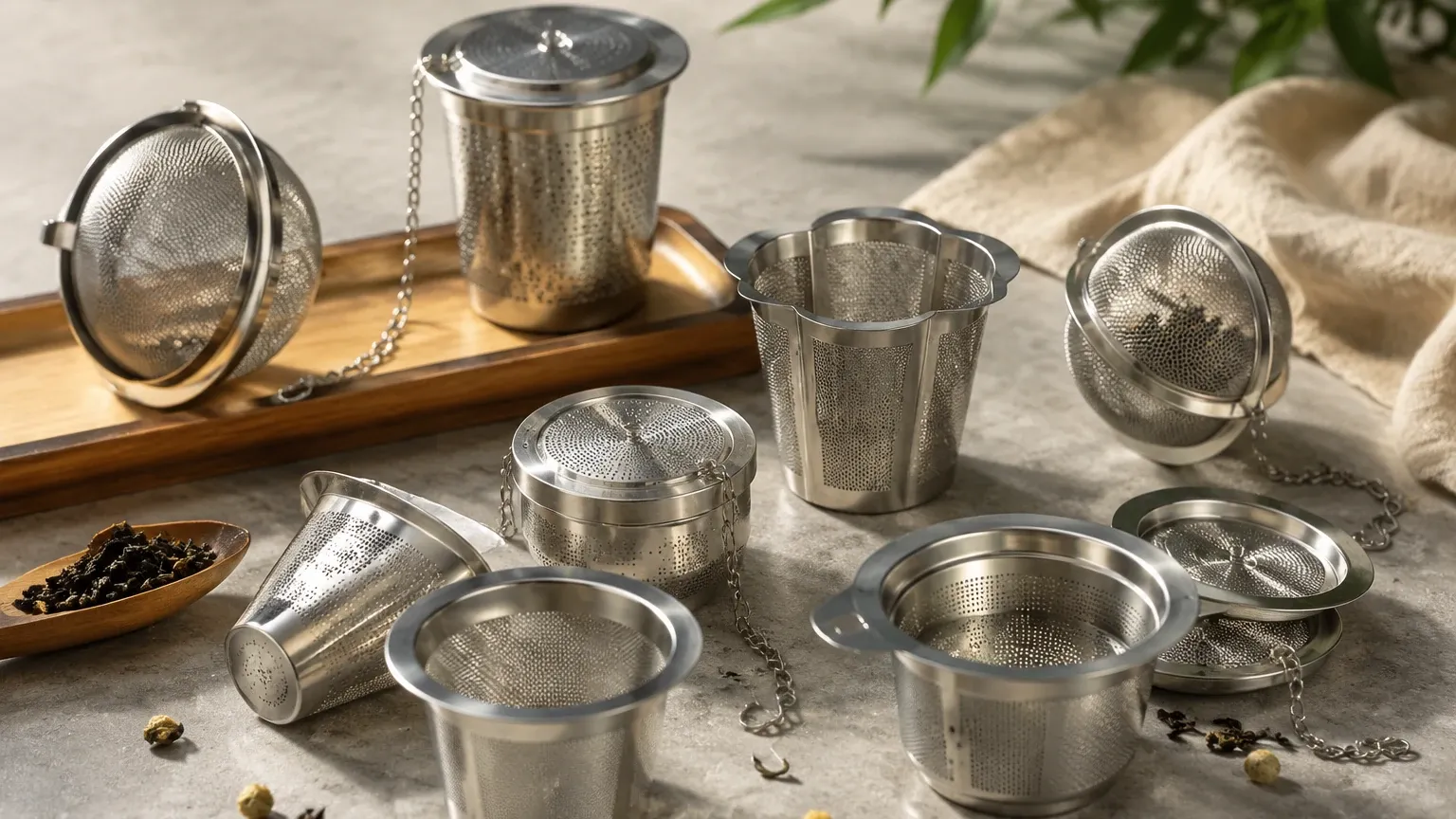
Cylindrical baskets are the most common configuration for inline strainers. They provide a large filtration surface and are relatively easy to clean. Conical strainers, often referred to as "witch's hat" strainers, are frequently used for temporary filtration during system start-up or in applications where space is limited. In custom tea processing setups, unique tea strainers may feature stepped diameters or specialized flange mounts to integrate seamlessly into automated brewing lines.
Multi-Layered Mesh Constructions
For applications requiring both high strength and fine filtration, engineers often utilize multi-layered sintered mesh or reinforced basket designs. A fine inner mesh performs the actual filtration, while a coarser outer mesh or a perforated metal plate provides the necessary structural support to prevent the fine mesh from collapsing under the weight of wet tea leaves or the force of pumped liquid.
Material Science: Why Stainless Steel is the Standard
In the food and beverage industry, material selection is governed by both performance requirements and stringent regulatory standards. For unique tea strainers, stainless steel is the undisputed material of choice due to its inert nature and durability.
Grade 304 vs. 316L Stainless Steel
- Grade 304: This is the standard for most food-grade applications. It offers excellent corrosion resistance and is suitable for most tea brewing environments where the pH levels are relatively neutral.
- Grade 316L: For applications involving flavored teas with acidic additives or for facilities that use aggressive chemical cleaning agents (CIP – Clean-In-Place), 316L is preferred. The addition of molybdenum provides superior resistance to pitting and crevice corrosion, ensuring a longer service life in demanding environments.
Surface Finishes and Hygiene
Industrial filtration components must be easy to sanitize to prevent microbial growth. Unique tea strainers often undergo specialized surface treatments such as electropolishing. This process removes microscopic peaks and valleys from the metal surface, resulting in a mirror-like finish that minimizes particle adhesion and makes the cleaning process significantly more effective. In B2B procurement, specifying the required Ra (Roughness Average) value is essential for ensuring compliance with food safety standards.
Customization and OEM Capabilities for Unique Designs
Many industrial tea equipment manufacturers require proprietary filtration components that cannot be found in a standard catalog. This is where OEM (Original Equipment Manufacturer) capabilities become vital. Customization allows for the optimization of every aspect of the strainer to fit a specific machine's footprint and performance goals.
Custom Geometries and Fittings
Whether it is a basket with a specific handle configuration for easy removal, or a strainer with integrated gaskets and threaded fittings, custom fabrication ensures that the filtration component is an integral part of the system rather than an afterthought. Unique tea strainers can be designed with reinforced rims, specialized lifting lugs, or magnetic inserts to capture any metallic contaminants that might have entered the processing line.
Prototyping and Scaling
For engineering teams developing new brewing technologies, the ability to prototype unique tea strainers is crucial. Small-batch production allows for real-world testing of flow rates and filtration efficiency before committing to large-scale manufacturing. A professional manufacturer can provide the technical guidance necessary to move from a conceptual CAD drawing to a high-performance production component.
Performance Metrics and Quality Control
To ensure that unique tea strainers meet the rigorous demands of industrial use, several performance metrics must be evaluated during the design and manufacturing phases.
Structural Integrity and Pressure Limits
Industrial strainers are often subjected to significant mechanical stress. The weight of several hundred kilograms of wet tea leaves, combined with the pressure of circulating hot water, can cause inferior strainers to deform or rupture. Quality control involves testing weld integrity and ensuring that the support structures of the Strainers & Baskets are rated for the maximum expected differential pressure.
Filtration Accuracy
Consistency is key in B2B tea production. If a batch of strainers has inconsistent mesh openings, the resulting tea will vary in clarity and taste. Manufacturers use precision weaving and laser-cutting technologies to ensure that every unique tea strainer produced meets the exact micron specifications required by the client.
Maintenance and Longevity in Food-Grade Applications
The total cost of ownership for industrial filtration components is heavily influenced by their durability and ease of maintenance. A well-engineered stainless steel strainer should last for years, provided it is maintained correctly.
Cleaning Protocols
In the tea industry, tannins can build up on the mesh over time, leading to "blinding" (clogging of the holes). Unique tea strainers designed for industrial use are typically compatible with ultrasonic cleaning, high-pressure hosing, or chemical soaking. The design should avoid "dead zones" where organic material can get trapped and become a site for bacterial growth.
Replacement Cycles
While stainless steel is highly durable, the mesh will eventually experience wear from repeated cleaning and mechanical stress. Establishing a clear inspection and replacement cycle is essential for maintaining production uptime. Engineers should look for signs of mesh fraying, weld cracking, or deformation during routine maintenance checks.
Conclusion: Selecting the Right Partner for Custom Filtration
Procuring unique tea strainers for industrial applications requires a partner who understands the intersection of food science and mechanical engineering. It is not just about buying a mesh basket; it is about investing in a component that ensures product consistency, protects downstream equipment (like pumps and filling valves), and complies with global food safety standards.
When evaluating suppliers for industrial Strainers & Baskets, technical professionals should prioritize manufacturers with a proven track record in stainless steel fabrication, a deep understanding of micron-level filtration, and the flexibility to provide customized OEM solutions. By focusing on material quality, precision engineering, and application-specific design, companies can optimize their tea processing operations for maximum efficiency and superior product quality.
