


Using Fence Strainers
In industrial fluid handling and processing, the integrity of downstream equipment—such as pumps, valves, flow meters, and spray nozzles—depends heavily on the effective removal of solid contaminants. The primary line of defense in these systems is the implementation of robust filtration components designed to intercept debris without significantly impeding flow. Within this technical landscape, the concept of "fencing" or screening fluid streams is central to operational efficiency. Whether referred to as screens, mesh inserts, or baskets, the practice of using fence strainers—specifically the internal filtration elements within industrial housings—requires a deep understanding of material science, fluid dynamics, and mechanical engineering.
Industrial Strainers & Baskets serve as the physical barrier that protects high-value assets. Unlike fine membrane filters that may target sub-micron particles, these components are engineered for high-volume debris removal and coarse to medium filtration. Selecting and using these components correctly ensures that system pressure remains stable and that maintenance intervals are predictable.
Engineering Principles of Industrial Strainers
The fundamental purpose of a strainer is to provide a coarse filtration stage that prevents large particles from damaging mechanical parts. When engineers evaluate the necessity of using fence strainers, they must first categorize the application based on the flow regime and the nature of the solids being removed.
Simplex vs. Duplex Configurations
Simplex strainers are utilized in batch processes where the system can be shut down periodically to clean or replace the basket. In contrast, duplex strainers feature two separate chambers with a diverting valve, allowing for continuous operation. While one side is active, the other can be serviced. This is critical in 24/7 chemical processing or power generation facilities where downtime results in significant financial loss.
Flow Dynamics and Pressure Drop (ΔP)
Every filtration element introduces a degree of resistance to the flow. The pressure drop across a clean strainer is a function of the fluid’s viscosity, velocity, and the open area of the mesh or perforated plate. When using fence strainers, it is a standard engineering practice to design for an open area ratio of at least 6:1 (the ratio of the internal screen’s open area to the cross-sectional area of the inlet pipe). This ensures that the initial pressure drop is minimized and that the strainer has sufficient capacity to accumulate debris before requiring service.
Material Selection for Demanding Environments
Material compatibility is the most frequent point of failure in industrial filtration. Stainless steel is the industry standard due to its mechanical strength and resistance to various forms of corrosion. When specifying materials for Strainers & Baskets, engineers typically choose between several grades depending on the chemical environment.
1. 304 Stainless Steel: Suitable for general industrial applications, water treatment, and food processing where mild corrosion resistance is required.
2. 316L Stainless Steel: The preferred choice for pharmaceutical and chemical processing. The addition of molybdenum provides superior resistance to chlorides and pitting, making it essential for marine environments or acidic fluid streams.
3. Specialty Alloys: For highly aggressive media, such as high-concentration sulfuric acid or high-temperature steam, alloys like Monel or Hastelloy may be required for the internal "fence" or mesh structure.
Beyond the chemical makeup, the physical construction of the element—whether it is a single-layer perforated plate, a multi-layer sintered mesh, or a wedge wire design—determines its durability under high-pressure surges.
Best Practices for Using Fence Strainers in Piping Systems
Proper installation and operational protocols are essential for maximizing the lifespan of the filtration element. Using fence strainers effectively involves more than just selecting the right micron rating; it requires strategic placement within the piping layout.
Orientation and Installation
Strainers must be installed in the correct orientation to ensure that gravity assists in the collection of debris. For Y-strainers, the "leg" containing the screen should point downward. For basket strainers, the housing must be level to allow the basket to sit flush against the seals. Incorrect installation can lead to "bypass," where fluid flows around the filtration element rather than through it, defeating the purpose of the strainer entirely.
Sizing the Mesh and Perforation
The "fence" inside the strainer is defined by its hole size. Perforated plates are typically measured by hole diameter (e.g., 1/8" or 1/16"), while wire mesh is measured by mesh count (the number of openings per linear inch). When using fence strainers for precision applications, engineers often use a perforated basket as a structural support for a finer inner mesh liner. This "dual-layer" approach provides the mechanical strength needed to withstand high differential pressures while achieving the necessary filtration accuracy.
Evaluating Filtration Performance and Accuracy
How do engineers determine if the strainer is performing as intended? Performance evaluation is based on three primary metrics: retention efficiency, dirt-holding capacity, and structural integrity.
Micron Rating: Absolute vs. Nominal
In the context of Strainers & Baskets, it is important to distinguish between nominal and absolute ratings. A nominal rating indicates the ability of the mesh to retain a majority of particles of a certain size, whereas an absolute rating (often achieved through precision-woven wire cloth) guarantees that no particle larger than the specified micron size will pass through. For protecting high-precision spray nozzles, an absolute rating is often mandatory.
Dirt-Holding Capacity
Using fence strainers with a larger surface area directly correlates to longer service intervals. Pleated mesh inserts are frequently used to increase the effective filtration area without increasing the footprint of the strainer housing. This is particularly useful in systems with high solids loading, where a standard cylindrical basket would clog too quickly.
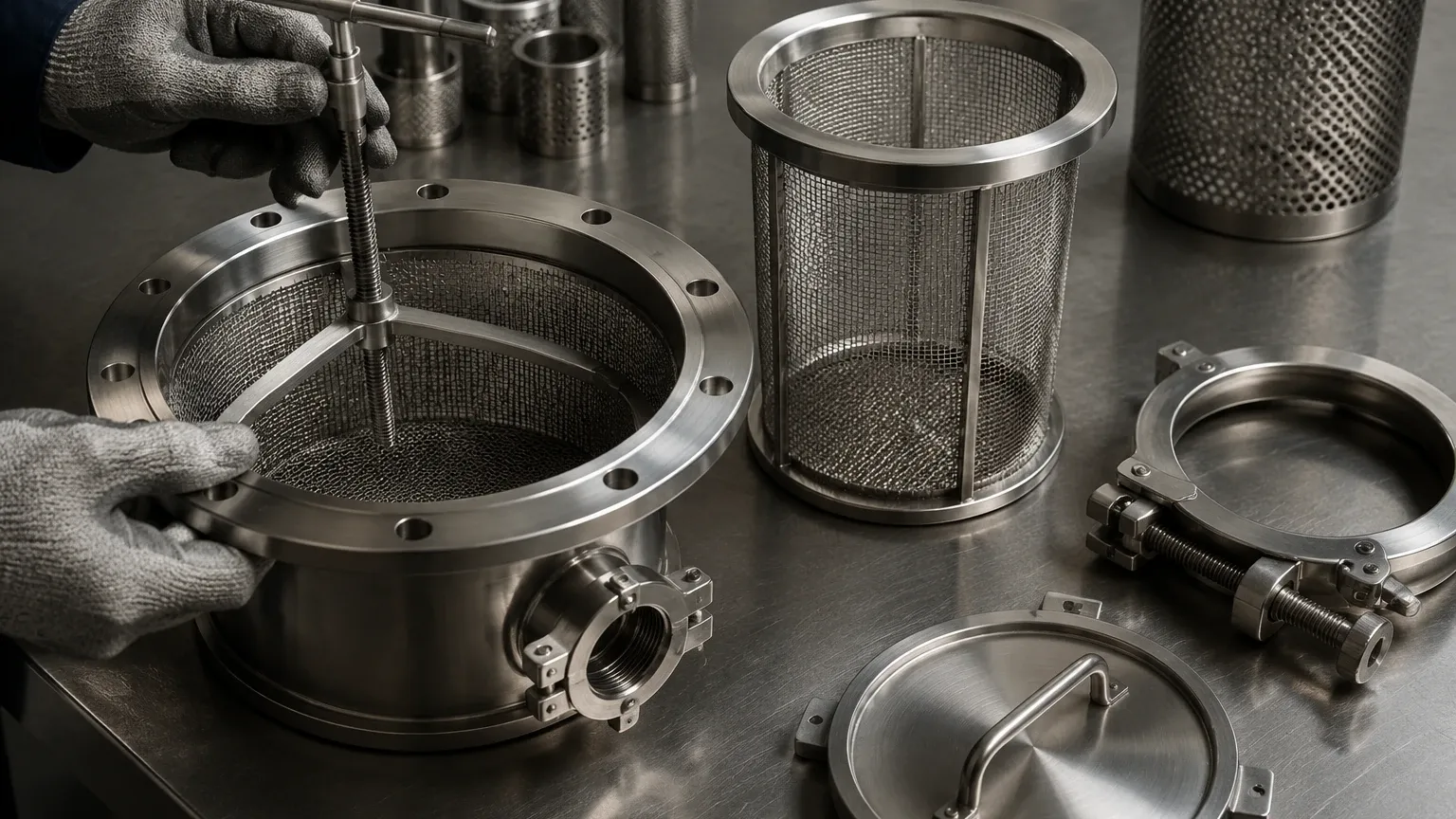
Maintenance, Cleaning, and Replacement Cycles
The total cost of ownership for industrial filtration is heavily influenced by maintenance requirements. A common mistake in using fence strainers is neglecting the differential pressure gauge.
Monitoring Differential Pressure
As debris accumulates on the mesh, the pressure drop increases. Most industrial systems are equipped with differential pressure (DP) sensors. A standard rule of thumb is to clean or replace the strainer basket when the DP reaches 10-15 psi over the clean-start pressure. Waiting too long can lead to "basket collapse," where the mechanical force of the fluid crushes the internal element, sending both the debris and pieces of the damaged mesh downstream into sensitive equipment.
Cleaning Procedures
Stainless steel baskets are generally reusable. Cleaning methods include:
* Backwashing: Reversing the flow to flush particles off the screen.
* Ultrasonic Cleaning: Using high-frequency sound waves in a solvent bath to remove fine particles embedded in the wire mesh.
* Chemical Cleaning: Using specialized agents to dissolve organic or mineral scale without damaging the stainless steel substrate.
Customization and OEM Solutions
Standard off-the-shelf strainers often fail to meet the specific requirements of complex industrial systems. Customization is frequently necessary when dealing with non-standard flow rates, unique space constraints, or highly specific filtration targets.
When collaborating with a manufacturer for custom Strainers & Baskets, engineers should provide detailed specifications regarding:
* Flange and Connection Types: Ensuring the housing integrates seamlessly with existing DIN, ANSI, or JIS piping.
* Reinforcement: Adding support rings or perforated cores for high-viscosity fluids that exert significant force on the mesh.
* Handle and Lifting Lug Designs: For large-scale baskets, ergonomic features are necessary to ensure that maintenance personnel can safely remove and clean the elements.
Using fence strainers that have been custom-engineered for a specific application reduces the risk of bypass and ensures that the filtration system does not become a bottleneck in the production process.
Conclusion: Selecting the Right Solution
Effective industrial filtration is a balance between protection and throughput. Using fence strainers as a primary method of debris control requires a rigorous approach to selection, focusing on material compatibility, pressure drop calculations, and maintenance accessibility. By prioritizing high-quality stainless steel construction and precision-engineered mesh, facilities can significantly reduce the risk of equipment failure and optimize their total cost of operation.
For engineers and purchasing teams, the focus should remain on the technical specifications of the internal elements. Whether the application involves hydraulic fluids, cooling water, or volatile chemicals, the reliability of the system is only as strong as the "fence" that protects it.
