


Valves and Strainers
In industrial fluid handling systems, the relationship between valves and strainers is one of mutual dependence and protection. While valves are responsible for controlling the flow, pressure, and direction of media, strainers serve as the primary line of defense, ensuring that the media remains free of solid contaminants that could compromise valve integrity. For engineers and procurement specialists, understanding the technical nuances of how valves and strainers interact is essential for optimizing system uptime and reducing the total cost of ownership.
Industrial piping systems are often subject to internal debris, such as weld slag, pipe scale, rust, and sediment. Without proper filtration, these particles can cause catastrophic failure in sensitive downstream components. This article examines the engineering considerations, selection criteria, and maintenance requirements for integrating high-performance filtration solutions into valve-heavy infrastructures.
The Functional Synergy Between Valves and Strainers
The integration of valves and strainers is a fundamental requirement in modern fluid handling. Valves, particularly control valves, check valves, and pressure-reducing valves, contain precision-machined internal components such as seats, discs, and stems. Even minor particulate contamination can lead to several failure modes:
1. Seat Erosion and Wire Drawing: High-velocity particles can erode the sealing surfaces of a valve. Once a small leak path is established, the high-pressure fluid creates a "wire drawing" effect, further cutting into the metal and rendering the valve unable to achieve a bubble-tight shutoff.
2. Mechanical Jamming: In valves with tight tolerances, such as solenoid valves or pilot-operated regulators, small solids can lodge in the moving parts, causing the valve to stick in an open, closed, or intermediate position.
3. Seal Degradation: Elastomeric seals and O-rings are susceptible to tearing or abrasion when exposed to abrasive solids, leading to external or internal leakage.
By installing Strainers & Baskets upstream of these components, operators can ensure that only clean media reaches the valve internals. This proactive approach extends the service life of the valves and minimizes the frequency of unplanned maintenance shutdowns.
Engineering Considerations for Strainer Selection
Selecting the right filtration component requires a deep dive into the physical and chemical properties of the application. Engineers must balance the need for fine filtration with the requirement for minimal pressure drop across the system.
Filtration Accuracy and Mesh Selection
Filtration accuracy is typically defined by mesh size or micron rating. The mesh count refers to the number of openings per linear inch of the wire mesh. As the mesh count increases, the size of the openings decreases, providing finer filtration. However, finer filtration also increases the resistance to flow.
When specifying valves and strainers, the "Open Area Ratio" (OAR) is a critical metric. The OAR is the ratio of the net free area of the screen to the internal cross-sectional area of the pipe. A higher OAR (typically 4:1 or higher) allows for longer intervals between cleanings and reduces the initial pressure drop ($\\Delta P$). For high-viscosity fluids, a lower mesh count with a reinforced basket structure is often required to prevent the mesh from collapsing under pressure.
Material Compatibility and Durability
Stainless steel is the industry standard for industrial filtration due to its corrosion resistance and mechanical strength.
* SS304: Suitable for general-purpose applications, water treatment, and mildly corrosive environments.
* SS316/316L: Preferred for chemical processing, pharmaceutical, and marine applications where resistance to chlorides and organic acids is necessary. The "L" (low carbon) variant is specifically used to prevent sensitization during welding, ensuring the integrity of the filter housing and mesh joints.
In demanding sectors like food and beverage, the surface finish of the stainless steel components is also a factor. Electropolishing or high-grit mechanical polishing may be required to prevent bacterial growth and facilitate Clean-in-Place (CIP) processes.
Comparative Analysis of Strainer Designs
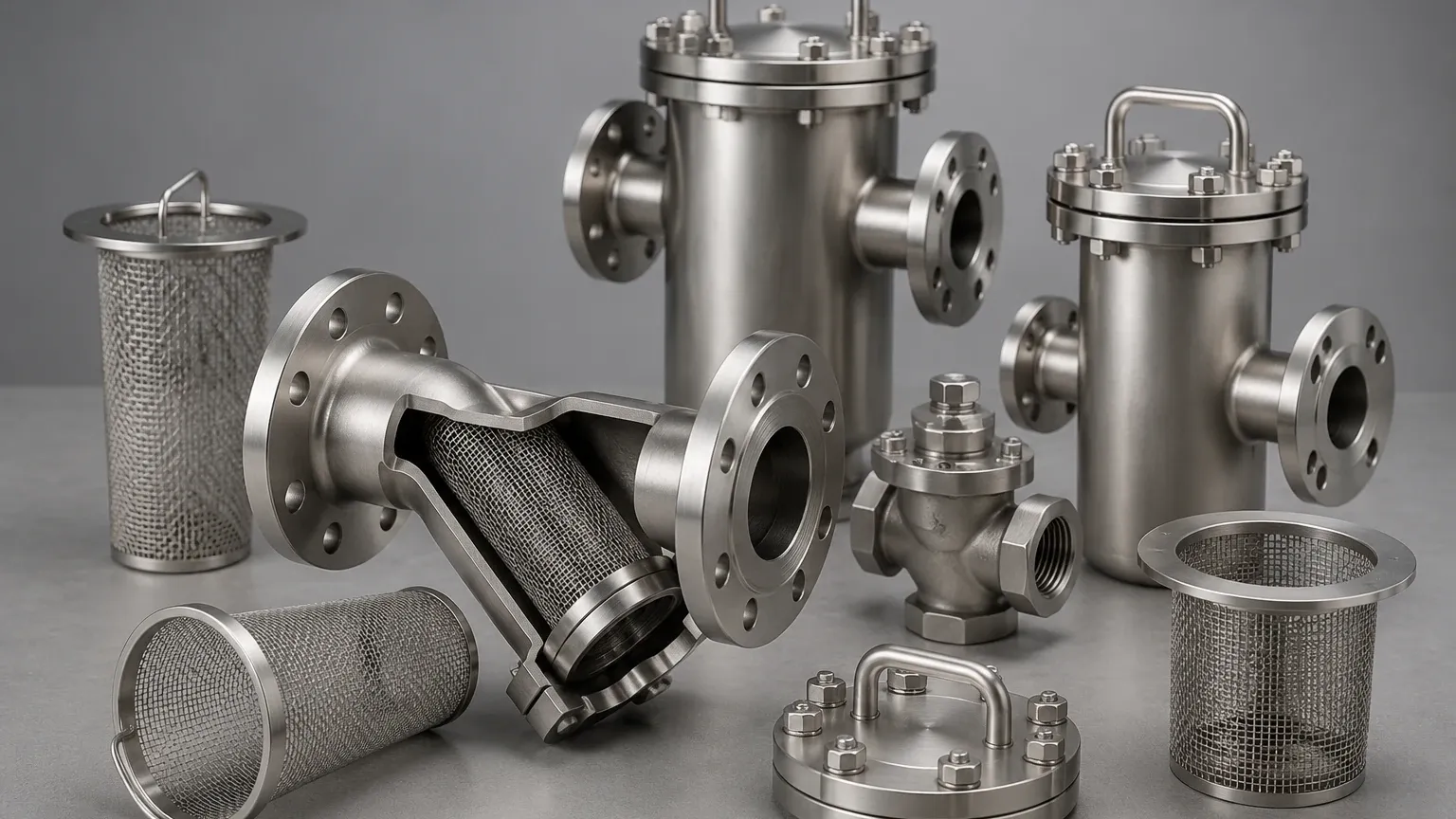
The physical configuration of the strainer must align with the piping layout and the expected solids loading. The two most common designs used in conjunction with industrial valves are Y-strainers and basket strainers.
Y-Strainers
Y-strainers are characterized by their compact, cylindrical shape and are typically used in applications with low concentrations of solids. They are well-suited for high-pressure steam, gas, or liquid lines. Their primary advantage is the ability to be installed in either horizontal or vertical (downward flow) orientations. However, they have a smaller dirt-holding capacity compared to basket designs, necessitating more frequent cleaning if the media is heavily contaminated.
Basket Strainers (Simplex and Duplex)
Basket strainers, or bucket strainers, feature a larger, vertical chamber that houses a removable basket. This design offers a significantly higher OAR and dirt-holding capacity.
* Simplex Strainers: Used in batch processes where the flow can be temporarily halted to remove and clean the basket.
* Duplex Strainers: Consist of two separate strainer chambers connected by a diverting valve. This allows for continuous operation; when one side becomes clogged, the flow is diverted to the clean chamber, allowing the operator to service the dirty basket without interrupting the process. This is critical for cooling water systems, lubrication lines, and continuous chemical reactors.
Mitigating Risks in Industrial Fluid Systems
Even with the correct hardware, certain operational risks can compromise the effectiveness of valves and strainers. Addressing these risks during the design phase is essential for long-term reliability.
Pressure Surges and Water Hammer
Sudden changes in fluid velocity, often caused by the rapid closing of a valve, can create pressure surges known as water hammer. These surges can exert immense force on the strainer mesh, potentially causing it to deform or burst. Engineers should consider installing surge suppressors or using reinforced mesh baskets in systems prone to hydraulic shock.
Bypass and Gasket Failure
If the strainer basket is not seated correctly within the housing, or if the internal gaskets fail, contaminated fluid can bypass the filter element entirely. This "bypass" allows solids to reach the downstream valves, defeating the purpose of the strainer. Regular inspection of seals and the use of precision-machined seating surfaces are necessary to prevent this issue.
Corrosion and Erosion
While stainless steel is highly resistant, it is not invincible. High-velocity abrasive particles can erode the leading edges of the mesh over time, increasing the pore size and reducing filtration efficiency. Furthermore, in chemical applications, improper material selection can lead to pitting or stress corrosion cracking. Regular ultrasonic testing or visual inspections during maintenance cycles can identify these issues before they lead to component failure.
Maintenance Protocols and Performance Monitoring
The performance of valves and strainers is best monitored through differential pressure ($\\Delta P$). By installing pressure gauges upstream and downstream of the strainer, operators can track the accumulation of debris.
The Importance of Differential Pressure
A clean strainer will have a baseline $\\Delta P$ dictated by the fluid velocity, viscosity, and mesh size. As the mesh becomes clogged, the $\\Delta P$ increases. Most industrial standards recommend cleaning or replacing the filter element when the differential pressure reaches a predetermined set point (often 5-10 psi above baseline). Allowing the $\\Delta P$ to rise too high can cause the mesh to collapse or significantly increase the energy consumption of the system's pumps.
Cleaning Procedures
For stainless steel wire mesh filters, cleaning often involves backflushing or manual washing. In the food and pharmaceutical industries, ultrasonic cleaning is frequently used to remove microscopic particles trapped within the weave of the mesh. It is vital to inspect the mesh for any signs of fraying or broken wires after cleaning, as these can become contaminants themselves.
Customization and Technical Specifications for OEM
Many industrial applications require bespoke filtration solutions that standard off-the-shelf products cannot meet. Customization options for strainers and baskets include:
* Custom Dimensions: Tailoring the height, diameter, and flange connections to fit within existing space-constrained piping skids.
* Reinforcement: Adding perforated metal backing or internal support frames to wire mesh baskets to handle high-pressure differentials.
* Specialty Coatings: Applying coatings for enhanced chemical resistance or to reduce friction in high-viscosity applications.
* Multi-Stage Filtration: Incorporating multiple layers of mesh with varying micron ratings into a single basket to capture a wide range of particle sizes.
As a professional manufacturer, Kaifil specializes in these customized stainless steel filtration solutions, providing the engineering expertise required to match filtration performance with specific valve requirements.
Pre-Purchase Checklist for Engineering Teams
Before finalizing a specification for valves and strainers, purchasing and engineering teams should confirm the following data points with their supplier:
1. Media Characteristics: What is the fluid? What is its viscosity at operating temperature? Are there corrosive elements present?
2. Flow Parameters: What are the minimum, normal, and maximum flow rates? What is the maximum allowable pressure drop?
3. Contaminant Profile: What is the nature of the solids (hard, soft, fibrous)? What is the expected solids loading (ppm)?
4. Operational Environment: Is the system subject to vibration, pressure surges, or extreme temperature fluctuations?
5. Compliance Requirements: Does the application require adherence to specific standards such as ASME, FDA, or 3A Sanitary Standards?
By addressing these factors, organizations can ensure that their investment in valves and strainers results in a robust, efficient, and low-maintenance fluid handling system. For detailed product specifications and engineering support, technical teams are encouraged to review the available options for industrial-grade filtration components.
