


Vegetable Strainers
In industrial food processing, the efficiency of washing, grading, and debris removal stages often determines the quality of the final product and the longevity of downstream equipment. Vegetable strainers, categorized under the broader engineering classification of industrial Strainers & Baskets, serve as critical filtration components designed to separate solids from liquids or to sort produce by size. Unlike domestic kitchenware, industrial-grade vegetable strainers are precision-engineered components manufactured to withstand high-pressure flows, corrosive cleaning agents, and continuous mechanical stress.
For engineers and procurement professionals in the food and beverage sector, selecting the correct strainer involves a detailed analysis of material compatibility, flow dynamics, and sanitary compliance. This guide examines the technical specifications and engineering considerations essential for integrating high-performance vegetable strainers into industrial processing lines.
Industrial Applications of Vegetable Strainers
Vegetable strainers are utilized across various stages of the food supply chain, from initial harvest washing to final packaging. Their primary function is the removal of oversized contaminants—such as soil, stones, stems, and leaves—from the process stream. However, their utility extends beyond simple debris removal.
Washing and Blanching Lines
In large-scale vegetable washing systems, water is often recirculated to conserve resources. Strainers and baskets are installed in the recirculation loop to capture organic matter that could otherwise clog spray nozzles or contaminate the fresh water supply. During blanching, where vegetables are treated with hot water or steam, heat-resistant stainless steel strainers are required to handle thermal expansion while maintaining structural integrity.
Protection of Downstream Equipment
One of the most critical roles of industrial vegetable strainers is the protection of pumps, heat exchangers, and flow meters. Particulate matter or stray vegetable fragments can cause mechanical wear or catastrophic failure if they reach high-speed impellers. By installing a robust basket strainer before the pump intake, facilities can significantly reduce maintenance downtime and extend the service life of expensive machinery.
Size Grading and Sorting
Custom-manufactured perforated baskets allow processors to sort vegetables by diameter. By utilizing specific hole patterns and sizes, engineers can design a multi-stage filtration system that separates "prime" product from smaller fragments or "fines" that may be diverted for pureeing or juice extraction.
Material Selection for Sanitary Filtration
In the food processing industry, material selection is governed by strict sanitary standards, such as those established by the FDA and EHEDG. Stainless steel is the industry standard for vegetable strainers due to its non-reactive properties and ease of sterilization.
Stainless Steel 304 vs. 316L
* Type 304: This is the most common grade used for general vegetable processing. It offers excellent corrosion resistance to water and most organic acids found in produce. It is cost-effective and provides the necessary structural strength for large-capacity baskets.
* Type 316L: For applications involving high-salinity brines, acidic marinades, or aggressive chemical cleaning cycles (CIP), Type 316L is preferred. The addition of molybdenum enhances its resistance to pitting and crevice corrosion, making it essential for high-risk environments.
Surface Finish and Passivation
To prevent bacterial growth, the surface of the strainer must be exceptionally smooth. Industrial vegetable strainers often undergo electropolishing or mechanical polishing to achieve a specific Ra (Roughness Average) value. Passivation is also a critical final step in the manufacturing process, where the surface is treated with a mild oxidant to remove free iron and enhance the protective chromium oxide layer, ensuring the component remains rust-free throughout its operational life.
Engineering Considerations in Strainers & Baskets Design
Designing an effective filtration system requires more than just selecting a mesh size. Engineers must calculate several variables to ensure the strainer does not become a bottleneck in the production line.
Open Area Ratio
The "Open Area Ratio" is the relationship between the total area of the holes in the strainer and the cross-sectional area of the inlet pipe. For vegetable processing, a ratio of at least 4:1 or 6:1 is often recommended. A higher open area reduces the initial pressure drop across the filter and allows for longer intervals between cleaning cycles, as the strainer can accumulate more debris before flow is significantly restricted.
Pressure Drop (Delta P)
Every strainer introduces a degree of resistance to the flow. Engineers must calculate the clean pressure drop and the maximum allowable pressure drop before cleaning is required. If the pressure drop becomes too high, it can lead to cavitation in pumps or the physical collapse of the strainer basket. Reinforced support cages are often integrated into larger vegetable strainers to prevent deformation under high differential pressure.
Micron Rating and Mesh Selection
The "micron rating" defines the size of the particles the strainer will capture. For vegetable washing, a coarse perforated plate (ranging from 1mm to 5mm) might be sufficient. However, for finer applications like juice filtration or seed removal, a fine wire mesh liner may be added to the interior of the basket. Selecting a mesh that is too fine will lead to frequent clogging, while a mesh that is too coarse will fail to protect downstream equipment.
Comparison of Perforated and Wire Mesh Baskets
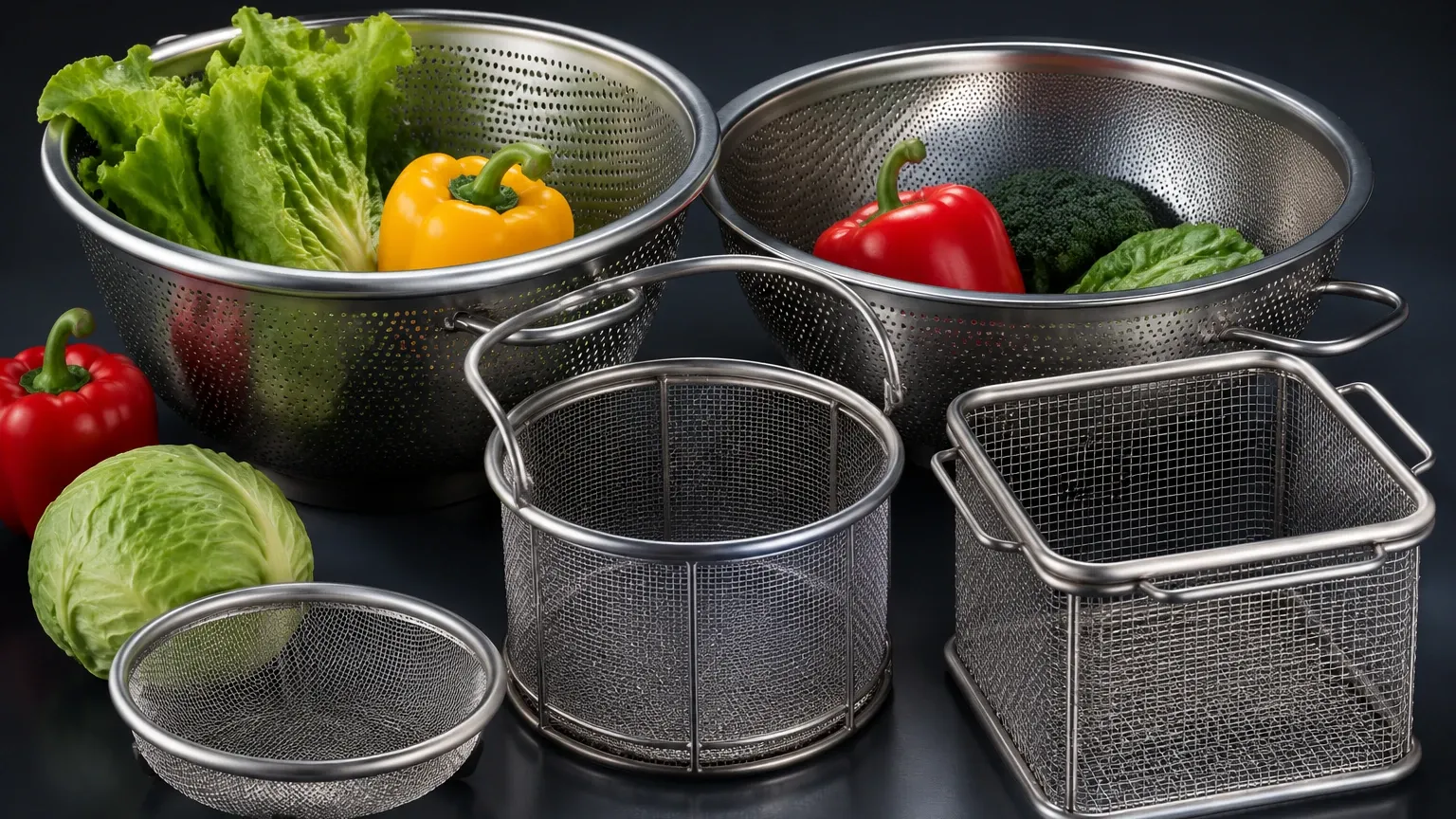
Industrial vegetable strainers generally utilize two types of filtration media: perforated metal and woven wire mesh. Often, these two are combined to provide both strength and precision.
Perforated Metal Baskets
Perforated baskets are manufactured by punching holes into a solid metal sheet. They are characterized by their extreme durability and structural rigidity. In vegetable processing, perforated plates are ideal for high-volume primary filtration where the debris is large and heavy. Common patterns include staggered round holes, which provide a high open area while maintaining the strength of the metal bridge between the holes.
Woven Wire Mesh Liners
When finer filtration is required, a woven wire mesh is used. This mesh can be produced in various weaves, such as plain weave or twilled weave. Because wire mesh is inherently more fragile than perforated plate, it is typically used as a liner inside a perforated "backup" basket. This combination allows for the fine filtration of vegetable particulates while the perforated outer shell provides the necessary mechanical support to withstand the force of the fluid flow.
Maintenance, Cleaning, and Operational Longevity
The total cost of ownership for vegetable strainers is heavily influenced by how easily they can be cleaned and maintained. In a B2B environment, downtime is the primary enemy of profitability.
Clean-in-Place (CIP) Compatibility
Modern food processing lines utilize CIP systems to clean equipment without disassembly. Vegetable strainers must be designed without "dead zones" or sharp internal corners where organic material can lodge and decay. Smooth radius welds and polished surfaces are essential for ensuring that caustic cleaning solutions can reach every surface of the strainer.
Manual Cleaning and Quick-Release Mechanisms
In many vegetable processing applications, the volume of solids is so high that manual cleaning of the basket is necessary. Engineers should look for strainer housings equipped with quick-release covers (such as swing bolts or V-band clamps) that allow operators to remove, empty, and replace the basket in minutes. This minimizes the interruption to the production cycle.
Replacement Cycles
While stainless steel strainers are durable, they are not permanent. Wire mesh liners can eventually fatigue due to pressure fluctuations, and perforated baskets can suffer from erosion over many years of service. Establishing a regular inspection schedule is vital. Signs of wear include frayed wires, distorted hole patterns, or thinning of the metal at the weld points. Using high-quality OEM components ensures that replacement baskets fit perfectly within existing housings, maintaining the integrity of the seal.
Customization and OEM Solutions for Food Processing
No two vegetable processing lines are identical. Factors such as the specific type of vegetable, the temperature of the water, the required flow rate, and the physical layout of the plant necessitate customized solutions.
Tailored Basket Configurations
Manufacturers like Kaifil specialize in producing custom Strainers & Baskets tailored to specific engineering drawings. Customization options include:
* Flange and Connection Types: Matching existing piping standards (ANSI, DIN, JIS).
* Handle Designs: Ergonomic handles or lifting lugs for large, heavy baskets.
* Magnetic Inserts: Adding magnetic separators to the basket to capture ferrous metal fragments that may have entered the line from upstream machinery.
* Multi-Stage Filtration: Designing baskets with multiple layers of varying mesh sizes to capture different grades of material in a single pass.
Collaborative Engineering
When purchasing industrial vegetable strainers, it is beneficial to work with a manufacturer that understands the nuances of fluid dynamics. By providing data on the fluid's viscosity, the expected solids loading, and the desired flow rate, engineers can receive a optimized design that balances filtration efficiency with energy consumption.
Conclusion: Selecting the Right Strainer for Your Facility
Choosing the right vegetable strainer is a technical decision that impacts the entire production facility. A well-engineered strainer protects expensive pumps, ensures product consistency, and maintains the high sanitary standards required in food processing.
Before finalizing a purchase, technical teams should confirm the following:
1. Material Grade: Is SS304 sufficient, or does the process require SS316L?
2. Structural Integrity: Can the basket withstand the maximum pump pressure if it becomes 100% clogged?
3. Filtration Accuracy: Does the micron rating align with the requirements of downstream nozzles or equipment?
4. Ease of Access: Can the basket be serviced quickly to minimize downtime?
By focusing on these factual engineering boundaries, procurement teams can secure filtration solutions that deliver long-term reliability and performance in demanding industrial environments.
