


Y Type Strainers
In industrial fluid handling systems, the protection of sensitive downstream equipment is a critical engineering priority. Components such as pumps, control valves, flow meters, and steam traps are susceptible to damage or operational failure caused by entrained solids, scale, and debris. Among the various mechanical separation technologies available, y type strainers represent one of the most versatile and cost-effective solutions for removing particulate matter from pressurized liquid, gas, or steam lines.
As a specialized manufacturer of stainless steel filtration components, Kaifil understands that selecting the correct strainer involves more than matching pipe diameters. It requires a deep dive into metallurgy, fluid dynamics, and maintenance accessibility to ensure long-term system integrity. This guide examines the technical specifications, engineering considerations, and selection criteria essential for integrating these components into high-performance industrial environments.
Engineering Fundamentals of Y Type Strainers
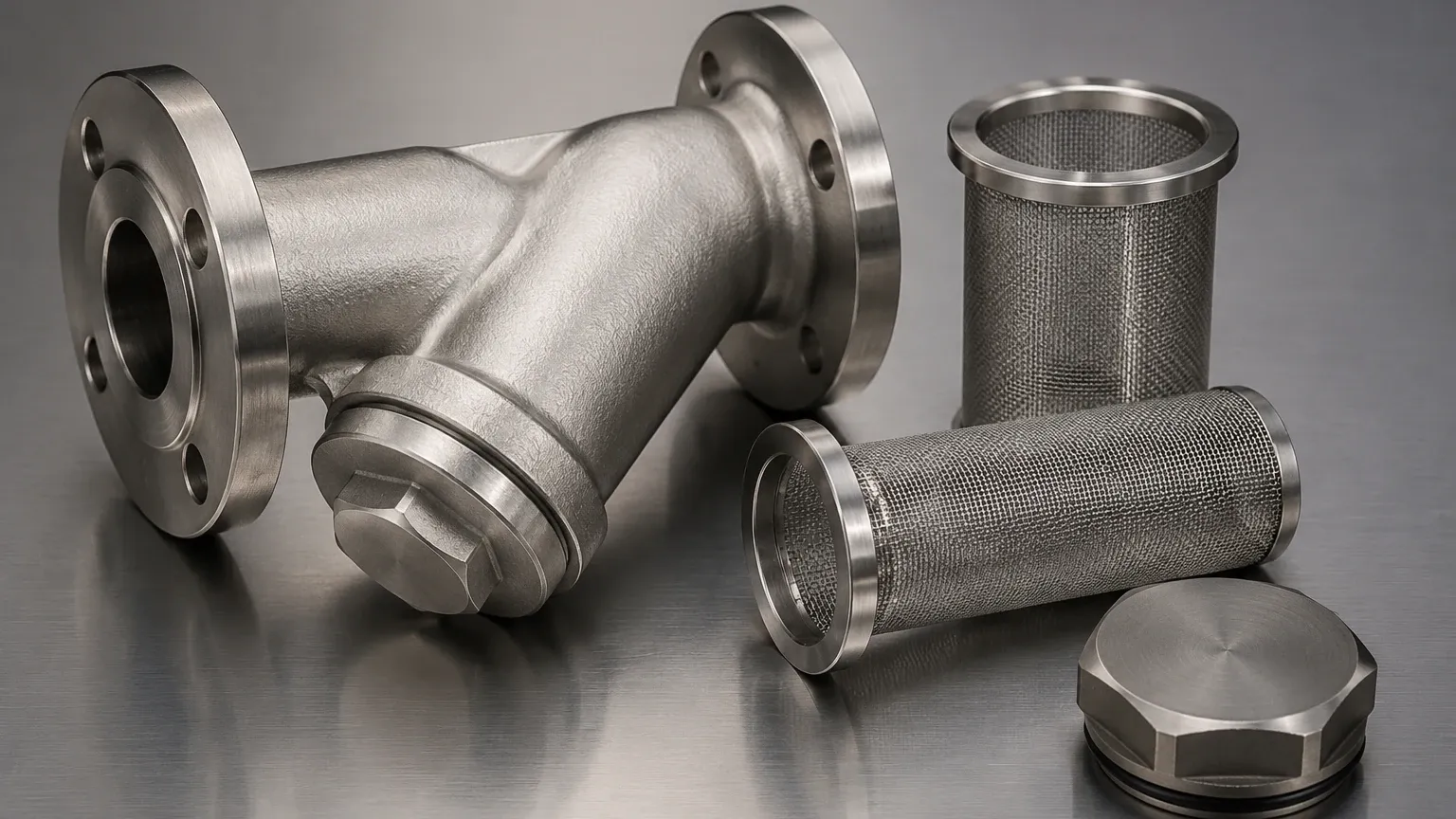
The "Y" strainer derives its name from its physical configuration, where a side leg branches off the main flow path at an angle, typically 45 degrees. This leg houses the filter element—usually a perforated metal cylinder or a wire mesh screen—which intercepts solids as the fluid passes through.
The primary advantage of the Y-pattern design is its compact footprint and the ability to handle high-pressure applications. Unlike basket strainers, which often require a larger body to accommodate a high volume of debris, the Y-pattern is streamlined, minimizing weight and material costs while maintaining structural rigidity. This makes them the preferred choice for steam and high-pressure gas lines where the total volume of solids is relatively low, but the potential for damage from even small particles is high.
Within the broader category of Strainers & Baskets, the Y-configuration is uniquely suited for systems where the cleaning frequency is moderate and the installation space is constrained. The design allows for a "blow-off" port in the strainer cap, enabling the removal of accumulated debris without stopping the flow or opening the unit, provided a blow-down valve is installed.
Material Selection and Chemical Compatibility
In the chemical processing, pharmaceutical, and food and beverage sectors, the material of construction for y type strainers is paramount. While cast iron or carbon steel may suffice for simple water utility lines, industrial processes involving corrosive media or high-purity requirements demand stainless steel.
Stainless Steel Grades
Kaifil specializes in manufacturing filtration solutions using high-grade alloys to meet specific environmental challenges:
- Grade 304 Stainless Steel: Suitable for general industrial applications, offering excellent strength and basic corrosion resistance for water and mild chemical service.
- Grade 316/316L Stainless Steel: The industry standard for pharmaceutical and marine environments. The addition of molybdenum provides superior resistance to chlorides and pitting, while the low-carbon (316L) variant prevents sensitization during welding, ensuring the integrity of the strainer body and mesh.
- Specialty Alloys: For highly aggressive chemical environments involving concentrated acids or high-temperature oxidation, alloys like Duplex stainless steel or Hastelloy may be required to prevent premature failure of the strainer housing and internal screen.
Gasket and Seal Considerations
The choice of sealing material in the strainer cap is just as critical as the metal body. Engineers must confirm compatibility with the process fluid and operating temperature. Common options include PTFE for chemical inertness, EPDM for water and steam, and Viton for high-temperature oil and hydrocarbon applications.
Screen Design and Filtration Efficiency
The internal element is the core of the strainer's performance. In industrial applications, these elements are typically categorized into two types: perforated screens and wire mesh screens.
Perforated Screens
These are manufactured by punching a large number of holes into a flat sheet of metal, which is then rolled into a cylinder. They are characterized by the hole diameter (e.g., 1/16", 1/8") and the percentage of open area. Perforated screens are robust and ideal for removing larger debris like pipe scale or welding slag.
Wire Mesh Screens
For finer filtration requirements, a stainless steel wire mesh is used. This mesh is often layered over a perforated metal basket for structural support. In y type strainers, mesh counts can range from 20 mesh (840 microns) down to 400 mesh (37 microns). When specifying mesh, engineers must balance the need for fine filtration with the resulting pressure drop. A finer mesh will capture smaller particles but will also clog more rapidly, increasing the frequency of maintenance.
The Importance of Open Area Ratio
A critical engineering metric is the ratio of the screen's net open area to the cross-sectional area of the inlet pipe. A high ratio (typically 3:1 or 4:1) ensures that the strainer does not become a significant bottleneck in the system. As debris accumulates, this ratio decreases, leading to an increase in differential pressure.
Performance Evaluation: Pressure Drop and Flow Dynamics
Every component added to a piping system introduces a pressure drop ($ΔP$). For y type strainers, the pressure drop is a function of the fluid's velocity, viscosity, and density, as well as the cleanliness of the internal screen.
Calculating the Flow Coefficient (Cv)
The $C_v$ value represents the volume of water in gallons per minute that will flow through the strainer with a pressure drop of 1 psi. Engineers use $C_v$ to size strainers correctly. A common mistake is sizing a strainer based solely on the existing pipe size. If the flow rate is high, a line-sized strainer may create an unacceptable pressure drop, necessitating a larger unit with reducers.
Viscosity Impacts
In hydraulic and oil processing applications, fluid viscosity varies significantly with temperature. High-viscosity fluids pass through the mesh with greater resistance, which can lead to localized turbulence and accelerated wear on the screen. Kaifil provides technical support to help engineers calculate the corrected pressure drop for non-aqueous fluids, ensuring that the pump head is sufficient to overcome the strainer's resistance even when partially loaded with debris.
Installation and Maintenance Best Practices
The orientation of a Y strainer is vital for its functionality. Unlike some other filter types, the Y-pattern allows for both horizontal and vertical installation, provided the flow is downward in vertical runs.
Orientation for Liquid and Steam
- Liquid Service: In horizontal lines, the "leg" of the Y should point downward. This allows gravity to help trap debris in the collection pocket and prevents the solids from falling back into the main line during shutdown.
- Steam Service: In horizontal steam lines, the Y strainer should be installed with the leg in a horizontal plane (on its side). This prevents the collection of condensate in the pocket, which could otherwise lead to water hammer and erosion.
The Blow-Down Connection
One of the most valuable features of the Y-design is the blow-off port. By replacing the standard pipe plug in the strainer cap with a ball valve, operators can flush the screen while the system is under pressure. This "blow-down" procedure is effective for removing loose debris, though it does not replace the need for periodic manual inspection and deep cleaning of the mesh.
Customization and OEM Solutions
Standard off-the-shelf strainers often fail to meet the rigorous demands of specialized industrial processes. As a manufacturer, Kaifil provides customized y type strainers tailored to specific engineering requirements. Customization options include:
1. Non-Standard Dimensions: Adjusting the face-to-face length to fit existing piping footprints without the need for extensive re-piping.
2. Reinforced Elements: For high-pressure differential applications where a standard screen might collapse, Kaifil designs reinforced internal baskets with internal bracing or heavier gauge perforated metal.
3. Specialized Coatings: Applying internal linings or external coatings for enhanced chemical resistance or aesthetic requirements in cleanroom environments.
4. Differential Pressure Taps: Integrating upstream and downstream ports to allow for the installation of pressure gauges or transmitters, enabling real-time monitoring of screen clogging.
Total Cost of Ownership (TCO) Considerations
When evaluating Strainers & Baskets for a project, the initial purchase price is only one component of the total cost. Engineers must also consider:
- Maintenance Labor: How easily can the screen be accessed? Y strainers with bolted covers are slower to service than those with threaded caps, but they offer better sealing for high-pressure or hazardous media.
- Energy Costs: A poorly sized strainer with a high permanent pressure drop increases the energy consumption of the system's pumps over the life of the installation.
- Equipment Protection: The cost of a strainer is negligible compared to the cost of repairing a high-precision flow meter or replacing a damaged pump impeller due to debris ingestion.
By selecting a high-quality stainless steel Y strainer, facilities can significantly reduce downtime and extend the mean time between failures (MTBF) for their entire fluid handling infrastructure.
Conclusion: Confirming Technical Requirements
Before finalizing a purchase of y type strainers, purchasing teams and engineers should confirm several key data points with the manufacturer:
1. Maximum Operating Pressure and Temperature: Ensure the body and seal ratings exceed the system's design limits.
2. Filtration Grade: Define the micron or mesh size based on the smallest orifice in the downstream equipment.
3. Flow Rate and Allowable Pressure Drop: Verify that the $C_v$ of the selected unit aligns with the system's hydraulic balance.
4. Material Certification: Request Mill Test Reports (MTRs) to verify the grade of stainless steel, especially in regulated industries like food or pharma.
Kaifil continues to support global industrial sectors by providing precision-engineered filtration components that balance durability with technical performance. Whether for a new installation or a system retrofit, choosing the right Y strainer is a foundational step in ensuring process reliability.
