


Zurn Strainer Basket
In industrial and commercial fluid management, the integrity of a system often depends on the smallest components. Among these, the strainer basket serves as a primary line of defense, protecting downstream equipment such as pumps, valves, and heat exchangers from debris and particulate matter. When sourcing a zurn strainer basket or a compatible high-performance replacement, engineers and procurement professionals must look beyond simple dimensions to evaluate material properties, hydraulic efficiency, and long-term durability.
As a specialized manufacturer of Strainers & Baskets, Kaifil understands that industrial filtration requires a balance between flow rate and particle retention. This article provides a technical overview of the engineering considerations required when selecting, specifying, and maintaining strainer baskets for demanding applications.
Understanding the Role of Strainer Baskets in Industrial Systems
Strainer baskets are mechanical components designed to remove solids from flowing liquids or gases. Unlike thin-walled filters intended for fine polishing, a basket strainer is built for high-capacity debris collection. In systems utilizing Zurn-style housings, these baskets are typically used in floor drains, roof drains, and pipeline strainers to intercept large contaminants before they can cause mechanical failure or process contamination.
From an engineering perspective, the strainer basket is a sacrificial yet critical component. It must withstand the kinetic energy of the fluid flow, the weight of the captured debris, and the potential chemical aggression of the process media. Failure to select the correct basket configuration can lead to increased pressure drops, reduced flow efficiency, or catastrophic structural failure of the basket itself, which may allow debris to bypass the filtration stage.
Engineering Specifications for Zurn Strainer Basket Replacements
When replacing an existing zurn strainer basket, matching the OEM dimensions is only the first step. To ensure optimal performance, several technical specifications must be verified:
1. Dimensional Accuracy and Seating
The basket must seat perfectly within the strainer body. An improper fit allows "bypass," where fluid flows around the edges of the basket rather than through the filtering media. Key measurements include the top flange diameter, the overall height, and the taper angle of the basket body. In high-pressure applications, a precision-machined flange is often necessary to maintain a tight seal.
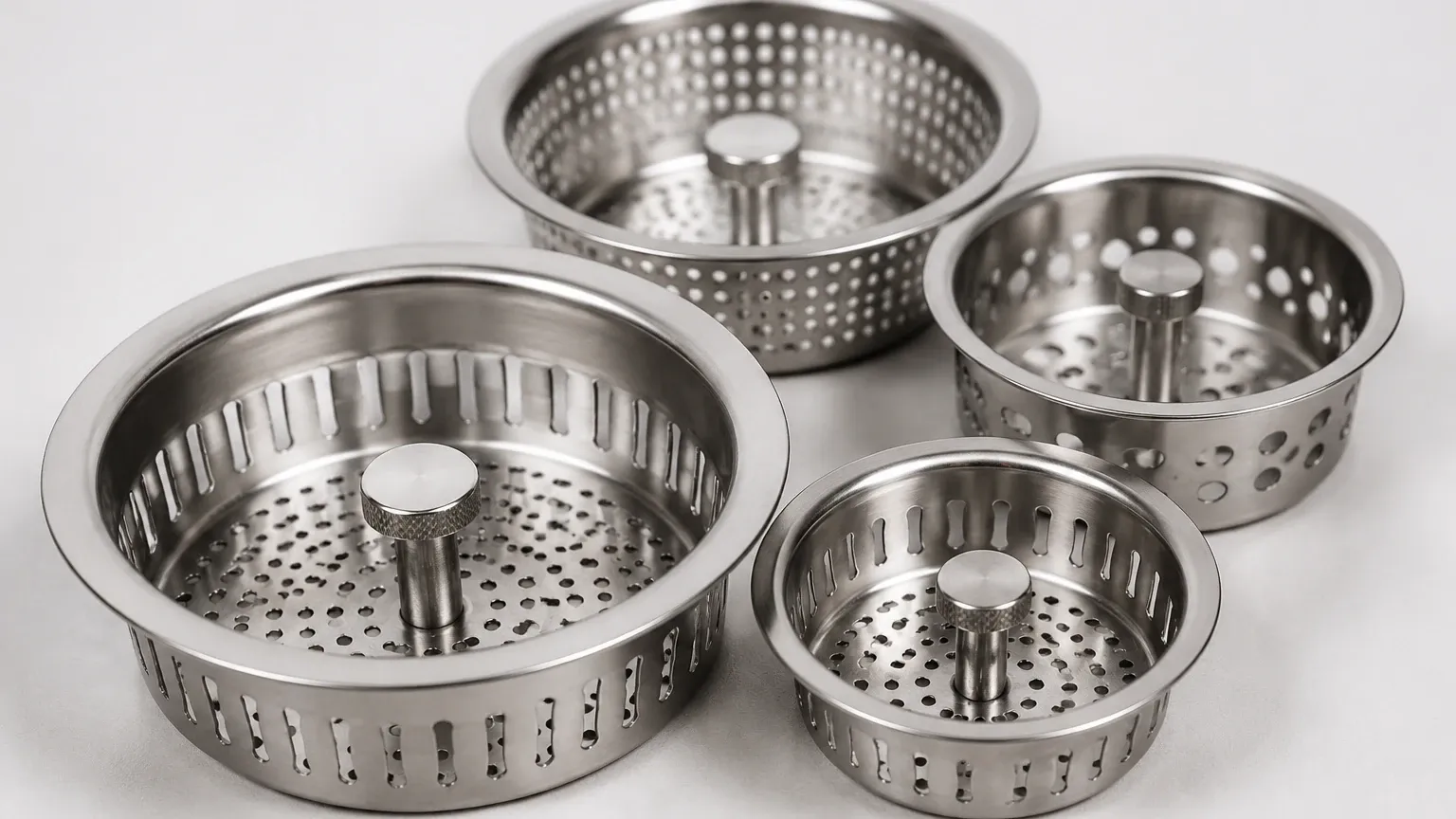
2. Perforation and Hole Patterns
The structural integrity of the basket is determined by its perforation pattern. Common patterns include staggered or straight-row holes. Staggered patterns generally offer a higher percentage of open area, which reduces the initial pressure drop (ΔP). Standard perforation sizes for industrial baskets range from 1/32" to 1/2", depending on the size of the debris being targeted.
3. Structural Reinforcement
For large-diameter baskets or those used in high-viscosity fluids, internal or external reinforcement may be required. This can include heavy-duty mesh overlays, longitudinal support ribs, or reinforced bottom plates. These features prevent the basket from collapsing or "telescoping" under the pressure of a heavy debris load.
Material Selection and Chemical Compatibility
The choice of material is the most significant factor in determining the service life of a zurn strainer basket. While standard commercial applications might utilize plastic or galvanized steel, industrial environments demand more robust alloys.
* Stainless Steel 304: The most common choice for general industrial use. It offers excellent corrosion resistance to most organic chemicals and many inorganic chemicals. It is widely used in food and beverage, pharmaceutical, and general manufacturing applications.
* Stainless Steel 316/316L: Specified for environments containing chlorides or high-salinity fluids. The addition of molybdenum in SS316 provides superior resistance to pitting and crevice corrosion, making it the standard for chemical processing and marine environments.
* Specialty Alloys: In highly corrosive or high-temperature environments, materials such as Monel, Hastelloy, or Titanium may be required. These alloys are selected based on the specific chemical profile and temperature fluctuations of the process fluid.
Selecting the wrong material can lead to rapid oxidation or stress corrosion cracking. For instance, using SS304 in a high-chloride environment can result in localized pitting that eventually compromises the structural integrity of the basket, leading to debris bypass.
Evaluating Filtration Efficiency: Perforation vs. Mesh Lining
A critical decision for engineers is whether to use a perforated basket alone or a perforated basket lined with wire mesh. This choice is dictated by the required filtration accuracy, often measured in microns or mesh count.
Perforated Baskets
Perforated baskets are ideal for removing large solids. They are easier to clean and are structurally more robust. However, the smallest hole that can be economically drilled or punched into metal is limited. If the application requires the removal of particles smaller than 0.033 inches (approx. 840 microns), a mesh lining is usually necessary.
Mesh-Lined Baskets
By lining a perforated basket with fine stainless steel wire mesh, filtration levels can reach as low as 5 microns. The perforated metal acts as a support structure (the "backup tube"), while the mesh performs the actual filtration. When specifying a mesh-lined zurn strainer basket, engineers must consider the "Open Area Ratio."
The Open Area Ratio (OAR) is the ratio of the total area of the holes in the basket to the cross-sectional area of the inlet pipe. A common industry standard is an OAR of 6:1 or 8:1. A higher OAR means the strainer can accumulate more debris before the pressure drop becomes excessive, thereby extending the time between cleaning cycles.
Maintenance and Longevity: When to Replace Your Strainer Basket
Total cost of ownership (TCO) for filtration components is heavily influenced by maintenance requirements and replacement frequency. A well-engineered basket should last for years, provided it is maintained correctly.
Indicators for Replacement
1. Deformation: If the basket appears warped or the flange is no longer flat, it may be suffering from pressure-induced stress. A deformed basket will not seat correctly, leading to bypass.
2. Erosion: High-velocity fluids, especially those containing abrasive particles, can erode the metal over time. This thins the walls and enlarges the perforations, reducing filtration accuracy.
3. Blinding: Permanent clogging of the mesh or perforations that cannot be removed by standard cleaning methods. This leads to a permanent increase in the system's baseline pressure drop.
Cleaning Protocols
To maximize the life of a zurn strainer basket, a regular cleaning schedule must be established based on the debris load. In many industrial settings, differential pressure gauges are installed across the strainer. When the pressure drop reaches a predetermined limit (typically 5-10 psi over the clean drop), the basket should be removed and cleaned. Over-cleaning can lead to mechanical wear, while under-cleaning can lead to basket collapse due to high differential pressure.
Customization Options for Demanding Applications
Standard off-the-shelf baskets often fail to meet the specific needs of specialized industrial processes. Custom manufacturing allows for the optimization of the basket to match the exact flow dynamics and debris characteristics of a system.
Kaifil specializes in providing customized solutions for Strainers & Baskets. Customization options include:
* Variable Perforation Sizes: Combining different hole sizes in a single basket to manage multi-stage filtration.
* Handle Configurations: Custom handles (e.g., slant handles, heavy-duty bars, or lifting eyes) to facilitate easier removal in deep or confined housings.
* Magnetic Inserts: Adding magnetic rods to the center of the basket to capture fine ferrous particles that might otherwise pass through the mesh.
* Electropolishing: A chemical treatment that smooths the surface of the stainless steel at a molecular level. This reduces the adhesion of biological or sticky materials, making the basket easier to clean and improving corrosion resistance.
Conclusion: Making Informed Procurement Decisions
Selecting a zurn strainer basket is a technical decision that impacts the efficiency and safety of the entire fluid system. By focusing on material compatibility, structural integrity, and the open area ratio, engineers can ensure they are choosing a component that provides reliable protection for their downstream assets.
For purchasing teams, it is essential to confirm the specific alloy grade, the required micron rating, and the expected flow conditions before placing an order. Working with a manufacturer that understands these technical nuances ensures that the replacement parts will perform as well as, if not better than, the original components. Whether for standard commercial drainage or high-pressure industrial pipelines, the right strainer basket is an investment in system uptime and process purity.
