


Zurn Strainers
In industrial fluid handling and piping systems, the protection of downstream equipment—such as pumps, valves, and heat exchangers—is a critical engineering priority. Among the most recognized names in commercial and industrial fluid control are Zurn strainers, which serve as a primary line of defense against particulate contamination. However, for engineers and purchasing teams operating in specialized sectors like chemical processing, pharmaceuticals, or high-pressure hydraulics, understanding the technical nuances of these components and their custom alternatives is essential for maintaining system integrity.
Industrial filtration requires a balance between flow efficiency and particle retention. Whether utilizing standard off-the-shelf models or seeking customized Strainers & Baskets designed for specific chemical compatibilities, the selection process must be guided by rigorous technical criteria. This article explores the engineering considerations behind strainer selection, the performance expectations of Zurn strainers, and the advantages of high-performance stainless steel components in demanding environments.
Understanding the Role of Industrial Strainers and Baskets
At its core, a strainer is a closed vessel with a cleanable screen element designed to remove foreign particles from a process fluid. While the terms are often used interchangeably, there is a technical distinction between a simple strainer and the more robust basket-style configurations.
Strainers are typically categorized by their geometry, with Y-strainers and basket strainers being the most prevalent. Y-strainers are often preferred for high-pressure applications where the amount of debris to be removed is relatively low. Conversely, basket strainers—often referred to as "pot strainers"—feature a larger internal volume, allowing them to collect a significant amount of debris before requiring cleaning. This makes them ideal for suction-side pump protection and gravity-flow applications where pressure drop must be minimized.
For many facilities, the choice between a standard industrial unit and a custom-engineered solution depends on the nature of the fluid. While many zurn strainers are optimized for water and HVAC applications, industrial processes involving corrosive chemicals or high-temperature steam often require the precision and durability of specialized stainless steel wire mesh or perforated metal components.
Technical Evaluation Criteria for Zurn Strainers and Alternatives
When evaluating zurn strainers or comparable filtration solutions, engineers must look beyond basic pipe size. The following technical parameters determine the long-term viability of the installation:
1. Pressure Rating and Temperature Limits
Every strainer housing is rated for a maximum allowable working pressure (MAWP) at a specific temperature. Standard cast iron or bronze strainers may suffice for municipal water lines, but high-temperature industrial processes require 304 or 316L stainless steel to prevent thermal fatigue and stress corrosion cracking.
2. Open Area Ratio (OAR)
One of the most overlooked metrics in strainer selection is the Open Area Ratio. This is the ratio of the total open area of the internal screen to the cross-sectional area of the inlet pipe. A high-performance basket strainer should ideally have an OAR of 4:1 or higher. A higher ratio ensures that the strainer can accumulate more debris without causing a significant increase in differential pressure, thereby extending the time between maintenance cycles.
3. Filtration Accuracy (Micron vs. Perforation)
Standard strainers often come with perforated plates (e.g., 1/16" or 1/8" holes). While effective for large debris like scale or welding slag, these are insufficient for finer filtration. In these instances, a stainless steel wire mesh liner is added to the basket. Selecting the correct mesh count is a trade-off: a finer mesh provides better protection but increases the frequency of cleaning and the initial pressure drop.
Material Selection and Chemical Compatibility
The longevity of a strainer system is dictated by its material composition. While Zurn provides a wide range of solutions for commercial plumbing, industrial-grade filtration often demands materials that can withstand aggressive chemical environments.
* Cast Iron and Ductile Iron: Commonly used for water and non-corrosive fluids due to cost-effectiveness. However, they are susceptible to rust and are generally not recommended for food-grade or pharmaceutical applications.
* Bronze and Brass: Excellent for seawater and certain cooling water applications where galvanic corrosion is a concern.
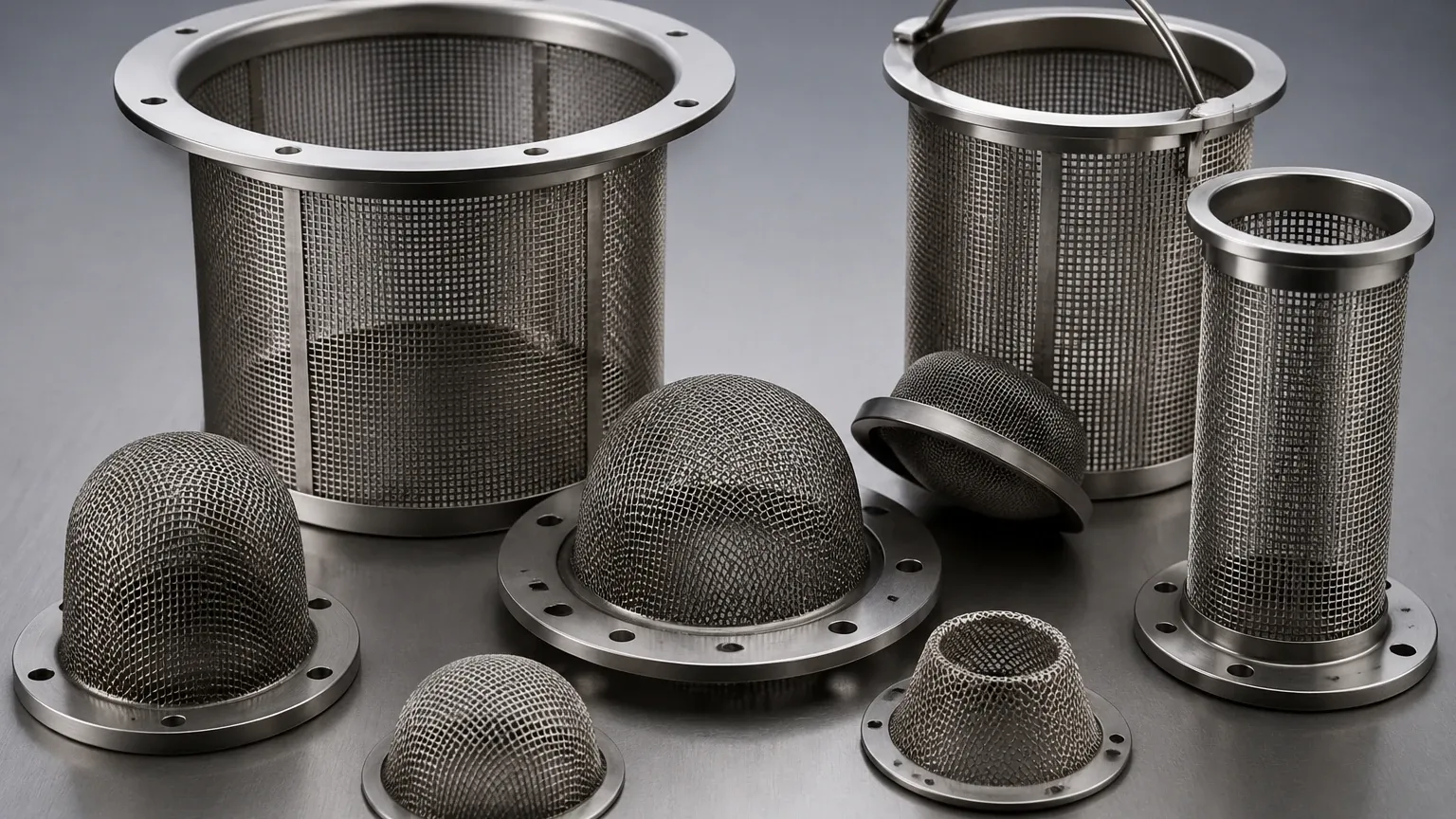
* Stainless Steel (304/316L): The industry standard for chemical processing and food production. Stainless steel provides superior resistance to pitting and crevice corrosion. Kaifil specializes in manufacturing these high-performance components, ensuring that the internal Strainers & Baskets maintain their structural integrity even under high-velocity flow conditions.
For engineers, verifying the chemical compatibility of the housing, the screen, and the gaskets (EPDM, Viton, or PTFE) is a non-negotiable step in the procurement process. A failure to match materials to the process fluid can lead to catastrophic housing failure or downstream contamination.
Optimizing Performance: Pressure Drop and Filtration Accuracy
In any industrial piping system, the "clean pressure drop" is the initial loss of pressure across a new or freshly cleaned strainer. As debris accumulates, the differential pressure $(\Delta P)$ increases. If the $\Delta P$ exceeds the design limit of the internal basket, the screen may collapse, allowing contaminants to bypass the filter and damage expensive downstream equipment.
To optimize performance, engineers should consider the following:
* Flow Velocity: High-velocity systems can cause turbulence within the strainer housing, leading to erosion of the mesh. It is often advisable to size the strainer one step larger than the pipe size to reduce velocity and pressure drop.
* Viscosity Adjustments: The pressure drop calculations for water do not apply to viscous fluids like oils or resins. Higher viscosity fluids require larger surface areas and coarser mesh to maintain acceptable flow rates.
* Burst Pressure of the Element: The internal basket must be engineered to withstand the maximum possible differential pressure of the system. Custom-manufactured baskets from Kaifil utilize reinforced frames and precision-welded wire mesh to ensure they do not deform under stress.
Maintenance, Replacement Cycles, and Custom Components
Maintenance is the single most significant factor in the total cost of ownership for industrial strainers. A "blinded" strainer (one that is completely clogged) can cause pump cavitation, leading to thousands of dollars in repair costs.
Monitoring Differential Pressure
The most effective way to manage zurn strainers or any industrial filtration unit is through the installation of differential pressure gauges. By monitoring the pressure before and after the strainer, maintenance teams can establish a clear threshold for when the basket needs to be pulled and cleaned.
Cleaning Protocols
For simplex strainers, the system must be shut down or the flow diverted to clean the basket. In continuous process industries, duplex strainers (which feature two chambers and a diverter valve) are used to allow cleaning without interrupting flow. When cleaning stainless steel mesh baskets, it is important to use methods that do not damage the fine wires—ultrasonic cleaning or low-pressure air/water backwashing are often preferred over mechanical brushing.
Custom OEM Replacements
Over time, even the most durable baskets will wear out. Many facilities find that the original equipment manufacturer (OEM) replacement parts are either prohibitively expensive or have long lead times. Manufacturers like Kaifil provide a critical service by producing custom-dimensioned stainless steel baskets that fit perfectly into existing Zurn or other brand housings. These custom components can be upgraded with finer mesh, reinforced handles, or magnetic inserts to capture fine metallic particles that standard screens might miss.
Sourcing Custom Strainers & Baskets for Specialized Applications
While standard zurn strainers are highly effective for their intended commercial and light industrial applications, complex engineering projects often require a more tailored approach. Whether you are dealing with high-viscosity fluids, extreme temperatures, or the need for ultra-fine filtration, the selection of the internal element is just as important as the housing itself.
When sourcing Strainers & Baskets, it is vital to partner with a manufacturer that understands the mechanical stresses of industrial filtration. Customization options such as specialized alloy selection, varying perforation patterns, and multi-layered wire mesh construction allow engineers to fine-tune their systems for maximum efficiency.
Before finalizing a purchase, technical teams should confirm:
1. The specific micron rating required for downstream protection.
2. The maximum flow rate and associated pressure drop.
3. The compatibility of the housing and seal materials with the process fluid.
4. The availability of replacement elements to minimize downtime.
By focusing on these factual engineering boundaries, procurement teams can ensure they select a filtration solution that provides reliable service, protects critical assets, and delivers a low total cost of ownership throughout the lifecycle of the plant.
