


1 Wire Screen
In the landscape of industrial filtration, the term "1 wire screen" typically refers to a specialized construction method where a single, continuous profile wire is wrapped and welded onto support rods to create a high-precision filtration surface. This technology is most commonly associated with Wedge Wire Screens, which are engineered to provide superior mechanical strength and filtration efficiency compared to traditional woven wire mesh. For engineers and procurement professionals, understanding the technical nuances of this single-wire construction is essential for optimizing process performance in demanding environments such as chemical processing, water treatment, and food production.
Understanding the Role of 1 Wire Screen in Industrial Filtration
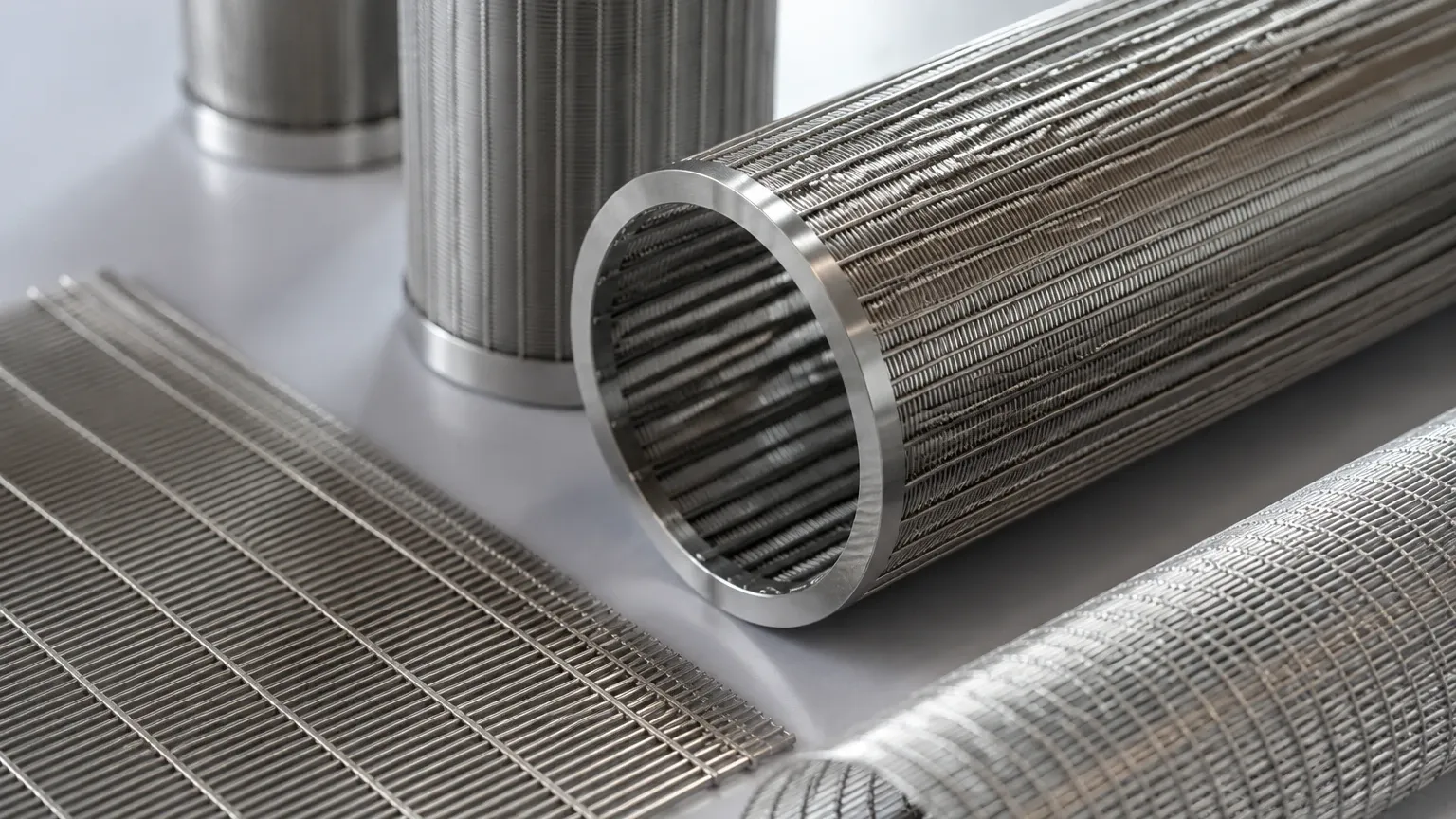
The fundamental design of a 1 wire screen involves a V-shaped profile wire that is helically wrapped around an array of longitudinal support rods. At every intersection where the wire crosses a rod, a high-strength resistance weld is applied. This creates a rigid, one-piece structure that maintains precise slot openings even under significant pressure or mechanical stress.
Unlike woven mesh, which relies on the interlacing of multiple wires that can shift or deform over time, the fixed nature of a 1 wire screen ensures consistent filtration accuracy. The "1 wire" aspect is critical because it allows for a continuous slot that runs the entire length or circumference of the filter element. This design minimizes the number of potential failure points and provides a smooth surface that facilitates easier cleaning and maintenance.
Technical Specifications of Wedge Wire Screens
When evaluating a 1 wire screen for industrial applications, engineers must consider several geometric and structural variables. The performance of the screen is dictated by the interaction between the profile wire, the slot width, and the support rods.
The V-Shaped Profile
The most distinctive feature of this technology is the V-shaped (or wedge-shaped) profile of the wire. The wire is positioned so that the widest part of the V faces the incoming flow. This creates a slot that widens inwardly. As particles pass through the initial opening, the increasing space behind the slot prevents them from becoming wedged or trapped—a common issue known as "blinding" in standard mesh filters.
Slot Opening Precision
Slot openings in a 1 wire screen can be manufactured with extremely tight tolerances, often down to 20 microns. Because the wire is continuous, the slot width remains uniform across the entire surface. This precision is vital for applications requiring exact particle size exclusion, such as catalyst recovery or fine sand control in oil and gas wells.
Support Rod Configurations
The support rods provide the structural skeleton for the screen. Depending on the application, these rods can be round, rectangular, or teardrop-shaped. The spacing and diameter of these rods determine the collapse strength and burst pressure of the filter element. For high-pressure hydraulic systems, support rod density is typically increased to prevent deformation.
Material Selection and Durability Factors
Material integrity is a non-negotiable factor in industrial filtration. Kaifil utilizes high-grade stainless steel to ensure that every 1 wire screen can withstand corrosive environments and extreme temperatures.
1. Stainless Steel 304: The standard choice for general industrial applications, offering good corrosion resistance and excellent formability. It is widely used in food and beverage processing where sanitation is a priority.
2. Stainless Steel 316L: Specified for more aggressive environments, such as chemical processing or marine applications. The addition of molybdenum and lower carbon content provides enhanced resistance to pitting and crevice corrosion.
3. Duplex and Exotic Alloys: For highly specialized needs involving high-chloride environments or extreme thermal cycling, materials like Duplex 2205 or Monel may be used to extend the service life of the filtration component.
Performance Advantages: Why Engineers Specify Wedge Wire
The transition from conventional filtration media to a 1 wire screen is often driven by the need for higher operational efficiency and reduced downtime. Several performance characteristics set this technology apart:
Non-Clogging Design
As mentioned, the two-point contact between the particle and the V-wire ensures that any particle smaller than the slot width passes through freely. This self-cleaning property is essential for continuous processes where manual cleaning is impractical.
High Open Area vs. Structural Strength
Engineers often face a trade-off between open area (which dictates flow rate) and structural integrity. A 1 wire screen allows for a very high percentage of open area while maintaining a rigid structure. By adjusting the wire profile and support rod spacing, Kaifil can customize a screen that balances high throughput with the ability to handle heavy loads.
Backwashing Efficiency
In automated filtration systems, backwashing is used to clear the filter surface. The smooth, flat surface of a wedge wire screen allows the backwash flow to effectively dislodge accumulated solids. Unlike mesh, where particles can get caught in the wire crossovers, the 1 wire screen's geometry ensures a more complete and rapid cleaning cycle.
Application-Specific Configurations
The versatility of the 1 wire screen allows it to be adapted into various forms, including cylindrical cartridges, flat panels, and curved sieve bends.
* Water Intake Screens: Used in power plants and desalination facilities, these large-scale cylindrical screens protect pumps and downstream equipment from debris while maintaining low approach velocities to protect aquatic life.
* Food and Beverage Processing: In brewing, wedge wire is used for lauter tun bottoms to provide efficient wort separation. The precise slots ensure clear liquid recovery while supporting the weight of the grain bed.
* Chemical and Petrochemical: These screens serve as internal components in reactors, such as center pipes and scale traps, where they must resist both chemical attack and high mechanical stress.
* Pulp and Paper: Used in pressure screens and fiber recovery, the durability of the stainless steel construction handles the abrasive nature of wood pulp fibers.
1 wire screen
Critical Selection Criteria for Purchasing Teams
When sourcing a 1 wire screen, purchasing teams should work closely with engineering to confirm several key parameters. Providing accurate data at the outset reduces the risk of performance failures and ensures a lower total cost of ownership.
Flow Rate and Pressure Drop
The desired flow rate (GPM or m³/h) and the maximum allowable pressure drop across the screen will dictate the required open area. A screen with a wire profile that is too large may restrict flow, while a wire that is too thin may not survive the system's operating pressure.
Particle Characterization
Understanding the shape, size, and concentration of the particles being filtered is crucial. For example, needle-like particles may require a different slot configuration than spherical particles to prevent bypass.
Customization Requirements
Industrial systems rarely use "off-the-shelf" solutions. Confirmation of end-fitting types (threaded, flanged, or plain), overall dimensions, and reinforcement requirements is necessary. Kaifil provides extensive OEM capabilities to match specific equipment footprints and operational demands.
Maintenance and Total Cost of Ownership (TCO)
While the initial investment in a 1 wire screen may be higher than that of disposable or woven mesh filters, the long-term economic benefits are significant. The durability of stainless steel wedge wire means fewer replacements and less frequent system shutdowns.
Cleaning Protocols
Most 1 wire screens can be cleaned using ultrasonic baths, high-pressure water jets, or chemical soaking without damaging the structural integrity of the welds. This reusability is a major factor in reducing the environmental impact and operational costs of a facility.
Wear Resistance and Lifespan
In abrasive applications, such as mining or wastewater treatment, the thickness of the profile wire can be increased to provide a "wear allowance." This ensures that the screen remains within its functional slot tolerance even as the surface gradually erodes over years of service.
Conclusion
The 1 wire screen, embodied in the modern wedge wire design, represents a pinnacle of industrial filtration engineering. By combining the precision of a single, continuous wire with the strength of resistance welding, these components offer a level of reliability that standard mesh cannot match. Whether the goal is to improve product purity, protect expensive downstream machinery, or reduce maintenance intervals, selecting the right Wedge Wire Screens is a strategic decision for any technical operation.
For engineers looking to integrate these solutions, focusing on material grade, slot precision, and structural reinforcement will ensure that the filtration system performs as intended throughout its service life. Kaifil remains committed to providing the technical expertise and manufacturing precision required to meet these rigorous industrial standards.
