


K Wedge
In the demanding landscape of industrial filtration, the selection of screen profiles is a critical engineering decision that directly impacts process efficiency, equipment longevity, and maintenance overhead. Among the various geometries available for liquid-solid separation, the k wedge profile—a specific designation within the broader category of Wedge Wire Screens—stands out for its structural integrity and hydraulic performance. For engineers and procurement specialists, understanding the nuances of these profiles is essential for optimizing filtration systems in sectors ranging from chemical processing to food and beverage production.
Industrial filtration requires more than just a barrier; it requires a precision-engineered surface capable of withstanding high pressure, corrosive environments, and continuous mechanical stress. Kaifil specializes in manufacturing these high-performance components, ensuring that every custom filtration solution meets the rigorous standards of modern industrial applications.
Understanding Wedge Wire Screen Profiles and the K Wedge Designation
Wedge wire screens are constructed by resistance-welding V-shaped wires onto longitudinal support rods. This process creates a screen with a continuous slot that widens inwardly, a design feature that is fundamental to preventing clogging and blinding. The "k wedge" terminology typically refers to a specific wire profile characterized by its width-to-height ratio and the angle of the V-shape, which determines the screen's open area and mechanical strength.
The geometry of the wire is the primary factor in determining the screen's performance. A standard wedge wire profile provides a two-point contact for particles, ensuring that any particle passing through the surface opening will continue through the screen without becoming lodged. The k wedge profile is often selected when an application requires a specific balance between a high percentage of open area and the structural rigidity necessary to handle heavy loads or high-velocity flows.
When evaluating these profiles, engineers must consider the "K factor," which relates to the hydraulic capacity of the screen. A well-designed profile minimizes turbulence as fluid passes through the slots, reducing energy consumption in pumping systems and maintaining a consistent flow rate even as solids accumulate on the surface.
Engineering Advantages of K Wedge Wire Construction
The primary advantage of utilizing k wedge profiles in industrial screens is the inherent non-clogging characteristic. Unlike woven wire mesh, which can trap particles within the intersections of the weave, the smooth, continuous slots of a wedge wire screen allow for efficient backwashing and mechanical cleaning.
Structural Rigidity and Durability
One of the defining features of this construction is its exceptional strength-to-weight ratio. By welding the surface wire to every intersection with the support rods, the resulting structure functions as a single, rigid unit. This is particularly important in applications such as vibrating screens or high-pressure intake filters where the screen is subjected to cyclic loading. The k wedge profile is designed to resist deformation under these conditions, maintaining precise slot tolerances over thousands of hours of operation.
Precision Slot Control
In precision filtration, the accuracy of the slot opening is paramount. Kaifil utilizes advanced manufacturing techniques to ensure that slot widths are consistent across the entire surface of the screen. This precision allows for the reliable removal of particles down to specific micron ratings, which is critical for protecting downstream equipment like pumps, nozzles, and heat exchangers.
Enhanced Flow Dynamics
The V-shaped profile of the k wedge creates a venturi effect as fluid passes through the slot. This accelerated flow helps to clear smaller particles away from the screen surface, further reducing the risk of blinding. For engineers, this translates to lower pressure drops across the filter media and extended intervals between cleaning cycles.
Material Performance and Chemical Compatibility
The effectiveness of a k wedge screen is not only a function of its geometry but also the materials used in its construction. Industrial environments often involve exposure to aggressive chemicals, extreme temperatures, and abrasive solids. Selecting the correct alloy is vital for ensuring the total cost of ownership remains low.
1. Stainless Steel 304: The standard choice for many general industrial applications, offering good corrosion resistance and excellent mechanical properties at a cost-effective price point.
2. Stainless Steel 316L: Preferred for pharmaceutical, food and beverage, and marine applications. The addition of molybdenum provides enhanced resistance to pitting and crevice corrosion, especially in chloride-rich environments.
3. Duplex and Super Duplex Steels: For highly corrosive chemical processing or offshore applications, these alloys provide superior yield strength and resistance to stress corrosion cracking.
4. Specialty Alloys: In cases involving extreme heat or specific chemical sensitivities, materials like Monel, Hastelloy, or 904L may be utilized to ensure the longevity of the filtration component.
Kaifil’s expertise in material selection ensures that the k wedge screens are matched to the specific chemical and thermal profiles of the application, preventing premature failure due to corrosion or material fatigue.
Key Performance Metrics for Industrial Filtration
When specifying Wedge Wire Screens with a k wedge profile, engineering teams must evaluate several key performance metrics to ensure the component is fit for purpose.
Open Area Calculation
The percentage of open area is a critical metric that dictates the flow capacity of the screen. It is calculated based on the slot width and the width of the surface wire. While a larger open area reduces pressure drop, it may also reduce the mechanical strength of the screen. Engineers must find the optimal balance that satisfies both hydraulic requirements and structural demands.
Pressure Differential (ΔP)
Understanding the maximum allowable pressure drop across the screen is essential for system design. A k wedge profile with optimized geometry can maintain a lower ΔP for longer periods, even as the cake layer builds up. This efficiency is a hallmark of high-quality industrial filtration components.
Mechanical Load Capacity
In applications like trommel screens or heavy-duty dewatering, the screen must support the weight of the material being processed. The spacing and size of the support rods, combined with the k wedge wire profile, determine the collapse strength and burst pressure of the filter cartridge or panel.
Customization Options for Specific Industrial Applications
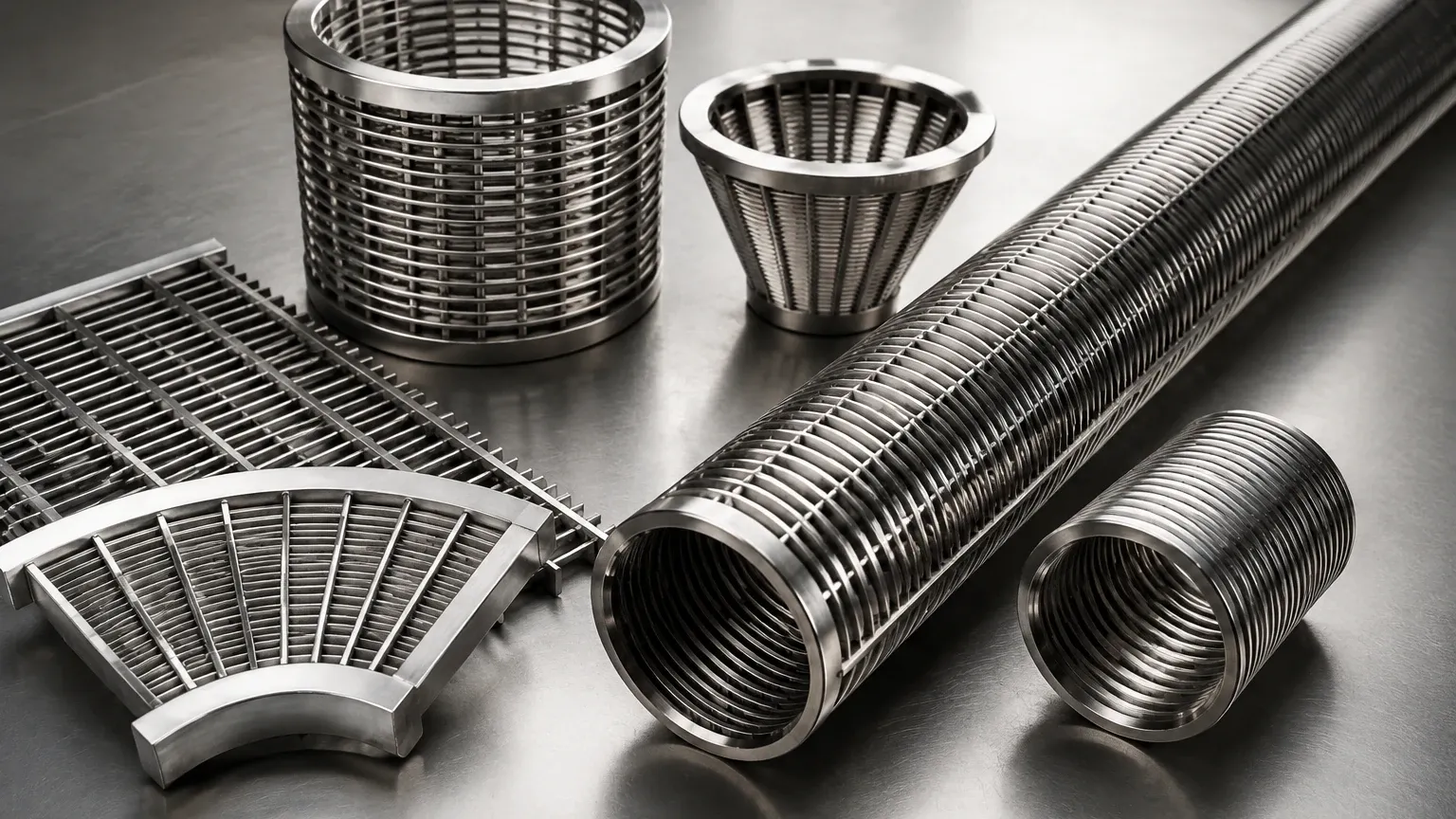
No two industrial processes are identical, which is why customization is a core component of Kaifil’s service offering. The k wedge profile can be adapted into various forms to suit specific equipment configurations.
* Cylindrical Filter Cartridges: Used in pressurized housing for liquid filtration, these can be designed for outside-in or inside-out flow patterns.
* Flat Panels: Ideal for vibrating decks, architectural grilles, or floor drains in food processing facilities.
* Sieve Bends (Parabolic Screens): Used extensively in mineral processing and wastewater treatment for gravity-fed dewatering.
* Resin Traps: Critical safety components in water treatment systems that prevent the loss of expensive ion exchange resins.
Customization extends beyond shape; it includes the selection of end fittings (flanges, threaded connectors, or reinforced rings), surface finishes (electropolishing or pickling), and the integration of internal reinforcement for high-vacuum or high-pressure scenarios.
Procurement and Quality Assurance: What Engineers Must Verify
When moving from the design phase to procurement, there are several technical details that purchasing teams and engineers should confirm with the manufacturer to ensure the quality of the k wedge screens.
1. Slot Tolerance Verification:
Confirm that the manufacturer can provide documented evidence of slot width consistency. Even minor deviations can lead to the passage of oversized particles or localized clogging.
2. Weld Integrity:
In wedge wire construction, the strength of the resistance weld is everything. Incomplete welds can lead to wire displacement or structural failure under vibration. Ask about the quality control measures used to inspect weld penetration and consistency.
3. Surface Smoothness:
For applications in the food, beverage, and pharmaceutical industries, the surface finish must meet specific Ra (Roughness Average) values to prevent bacterial growth and ensure the efficacy of Clean-in-Place (CIP) procedures.
4. Total Cost of Ownership (TCO):
While the initial purchase price is a factor, the TCO includes the cost of downtime, replacement frequency, and cleaning labor. A high-quality k wedge screen from a professional manufacturer like Kaifil often provides a lower TCO by significantly extending the service life of the component and reducing maintenance requirements.
Maintenance and Lifecycle Management
Proper maintenance is key to maximizing the lifespan of k wedge filtration components. Because of their robust stainless steel construction, these screens are highly resilient, but they are not indestructible. Regular inspection for signs of mechanical wear, erosion, or chemical pitting is recommended.
Cleaning protocols should be tailored to the type of contaminant. For organic fouling, chemical cleaning or high-pressure steam may be appropriate. For mineral scaling, acid washing might be required. The advantage of the k wedge profile is that its smooth surface and widening slots make these cleaning processes much more effective than they would be with traditional mesh filters.
By choosing a manufacturer with deep technical expertise in custom stainless steel filtration, companies can ensure they receive a product that is not just a commodity, but a precision-engineered solution designed for the specific rigors of their industry. Kaifil remains committed to providing these high-performance components, supporting global industries with durable, efficient, and reliable filtration technology.
