


Static Wedge Wire Screens
In industrial liquid-solid separation, the efficiency of a process often depends on the reliability of the filtration media. Static wedge wire screens, frequently referred to as sieve bends or side-hill screens, represent a fundamental component in gravity-fed separation systems. Unlike mechanical vibrating screens that require external power sources and frequent maintenance of moving parts, static wedge wire screens utilize the kinetic energy of the fluid and the specific geometry of the screen surface to achieve high-capacity filtration.
For engineers and procurement professionals, selecting the right Wedge Wire Screens involves understanding the fluid dynamics at play, the metallurgical requirements of the application, and the long-term operational costs associated with different screen configurations. This guide examines the technical specifications and engineering considerations essential for integrating static wedge wire screens into industrial workflows.
The Engineering Principles of Static Wedge Wire Screens
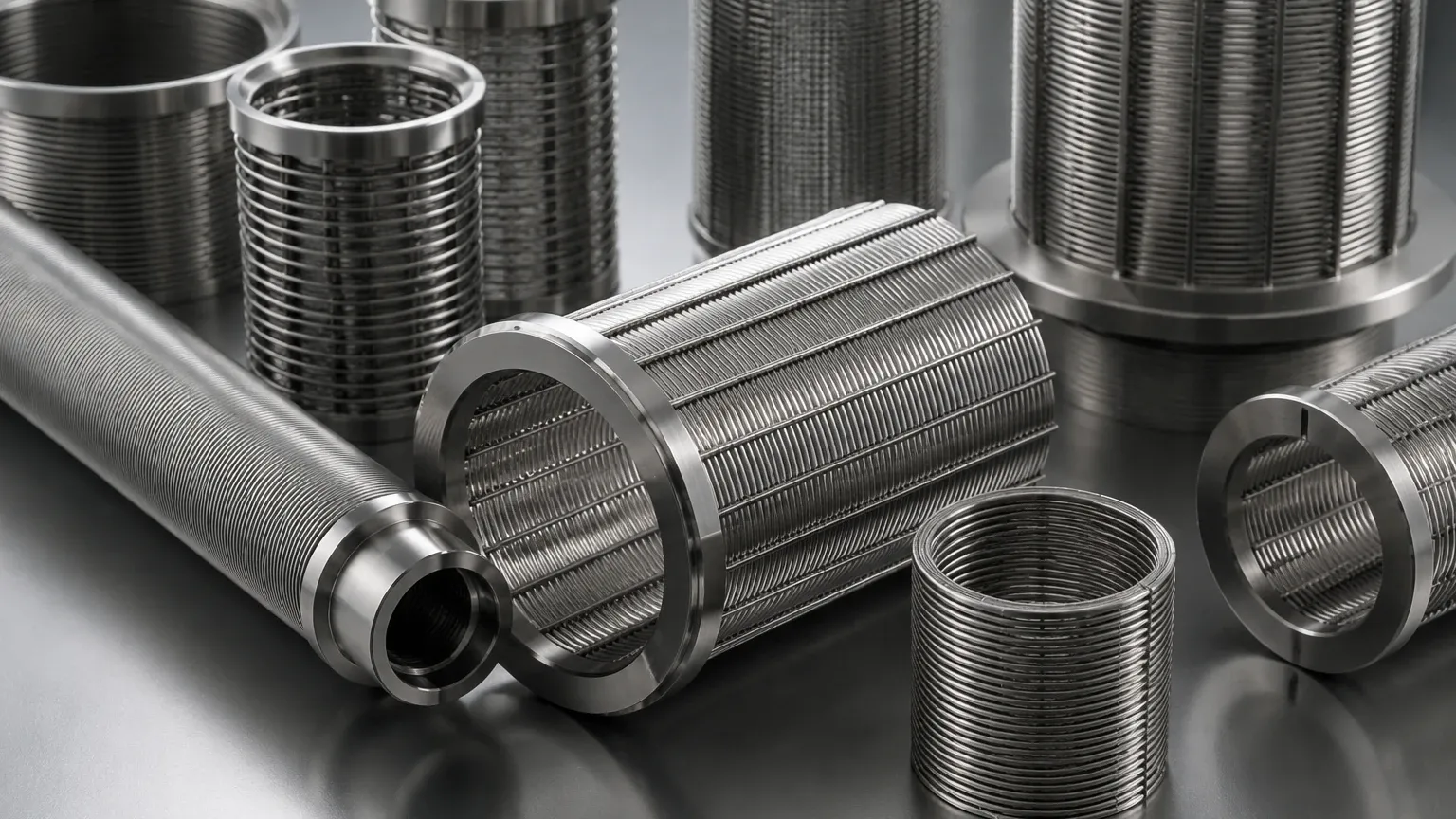
The primary function of static wedge wire screens is to separate solids from liquids through a shearing action. The screen is typically constructed from V-shaped profile wires welded onto support rods at consistent intervals. In a static configuration, the screen is often curved (sieve bend) or inclined at a steep angle.
As the slurry or process water flows over the screen surface, the sharp leading edge of each V-shaped wire shears off a thin layer of the liquid, directing it through the slot. The solids, due to their size and momentum, continue across the screen surface to the discharge point. This "shearing" effect allows for a much higher flow rate than traditional flat mesh screens because it actively pulls the liquid through the gaps rather than relying solely on gravity.
The Non-Clogging Advantage
One of the most critical technical advantages of using wedge wire in a static application is its non-clogging characteristic. The V-shaped profile creates a slot that widens inwardly. Any particle that manages to pass through the narrowest point of the slot (the surface) will easily fall through the widening gap without becoming wedged. This is a significant improvement over woven wire mesh, where particles often become trapped in the intersections of the weave, leading to "blinding" and reduced throughput.
Key Evaluation Criteria for Industrial Selection
When specifying static wedge wire screens for a project, engineers must look beyond basic dimensions. Several technical variables determine whether the screen will meet the required performance benchmarks and service life.
Material Selection and Corrosion Resistance
Industrial environments often involve aggressive chemicals, high temperatures, or abrasive particles. Choosing the correct alloy is the first step in ensuring durability:
* Grade 304 Stainless Steel: Suitable for general industrial applications, food processing, and standard water treatment where corrosion risk is moderate.
* Grade 316L Stainless Steel: Recommended for pharmaceutical, chemical processing, and marine environments. The addition of molybdenum provides superior resistance to chlorides and pitting.
* Duplex Stainless Steels: Utilized in heavy mining or highly acidic chemical environments where both high mechanical strength and extreme corrosion resistance are required.
Slot Size Precision
The slot size (the gap between the profile wires) determines the filtration accuracy. For static wedge wire screens, slot sizes can range from as small as 50 microns to several millimeters. It is essential to confirm that the manufacturer can maintain tight tolerances across the entire screen surface. Inconsistent slot widths can lead to poor separation efficiency and the loss of valuable solids in the filtrate.
Wire Profile and Tilt Angle
The shape of the wire itself—its width and height—affects the screen's open area and structural integrity. Furthermore, in many static sieve bend designs, the profile wires are tilted at a slight angle. This tilt enhances the shearing effect, allowing the screen to handle higher volumes of liquid without increasing the overall footprint of the equipment.
Performance Expectations in Demanding Applications
Static wedge wire screens are utilized across a broad spectrum of industries due to their ability to handle high solids loading with minimal intervention. Understanding the performance expectations in these sectors helps in setting realistic operational goals.
Wastewater and Water Treatment
In municipal and industrial wastewater treatment, static screens are used for primary screening to remove large debris, plastics, and organic matter before the water reaches pumps or fine filtration stages. They are valued for their ability to operate continuously without the risk of mechanical failure common in motorized raked screens.
Food and Beverage Processing
From corn wet milling to sugar processing and brewery mash separation, the hygienic properties of stainless steel wedge wire are indispensable. Static screens allow for the recovery of starch or grains while maintaining a cleanable surface that resists bacterial growth. The smooth surface of the wedge wire ensures that organic solids are not damaged during the separation process.
Mineral and Pulp Processing
In mining, static wedge wire screens are used for dewatering and media recovery. The abrasive nature of mineral slurries requires screens with high mechanical strength and wear resistance. Similarly, in the pulp and paper industry, these screens are used for fiber recovery and white water filtration, where the ability to handle high flow rates is paramount.
Customization and System Integration
Every industrial facility has unique spatial and flow requirements. Static wedge wire screens are rarely "off-the-shelf" components; they require customization to fit existing housings or to meet specific hydraulic profiles.
Specifying Dimensions and Curvature
For sieve bends, the radius of the curve is a critical design factor. A tighter radius might be necessary for compact installations, but it changes the velocity of the fluid and the efficiency of the separation. Engineers should provide the manufacturer with the expected flow rate (GPM or m³/h) and the concentration of solids to determine the optimal screen area and curvature.
Support Structures and Reinforcement
Because static screens often bear the weight of heavy slurries, the internal support rods must be engineered for structural rigidity. Depending on the span of the screen, additional reinforcement frames or "U-sections" may be welded to the back of the screen to prevent sagging or vibration-induced fatigue. Custom mounting flanges and side plates can also be integrated to ensure a leak-proof fit within the screen box.
Maintenance and Total Cost of Ownership
While static wedge wire screens are low-maintenance compared to moving machinery, they are not maintenance-free. To optimize the total cost of ownership (TCO), a proactive approach to screen health is necessary.
Cleaning Protocols
Over time, fats, oils, or biological films can accumulate on the screen surface. While the wedge wire design resists mechanical clogging, chemical fouling can still occur. Regular pressure washing or the use of automated spray bars can maintain the open area. In the food industry, Clean-In-Place (CIP) systems are often integrated directly into the screen housing.
Monitoring Wear Patterns
Abrasive solids will eventually wear down the sharp leading edges of the profile wires. As these edges round off, the shearing efficiency decreases, and more liquid may carry over with the solids. Periodic inspections should focus on the "impact zone" where the slurry first hits the screen. High-quality stainless steel construction from a reputable manufacturer like Kaifil ensures that the material thickness is sufficient to withstand years of abrasive wear before a replacement is needed.
Long-term Value
The initial investment in high-grade stainless steel Wedge Wire Screens is often offset by the reduction in energy costs (no motors), the elimination of spare parts for mechanical drives, and the extended service life of the filtration media. When compared to polymer-based screens or thin woven meshes, the durability of wedge wire provides a lower TCO over the life of the plant.
Technical Confirmation Before Procurement
Before finalizing a purchase order for static wedge wire screens, technical teams should confirm the following details with the manufacturer to ensure the product is fit for purpose:
1. Flow Direction: Confirm whether the flow is from the inside out or outside in (for cylindrical static screens) or across the flat/curved surface. The orientation of the V-wire must be correct to ensure the non-clogging feature works.
2. Solids Characteristics: Provide data on particle size distribution, shape (spherical vs. angular), and abrasiveness. This influences the choice of slot size and wire profile.
3. Chemical Compatibility: Verify that the chosen stainless steel grade is compatible with any cleaning agents or process chemicals used in the system.
4. Pressure and Load Requirements: Ensure the support rod spacing is sufficient to handle the maximum expected hydraulic head or solids build-up during a system surge.
By focusing on these engineering details, purchasing teams can secure filtration components that enhance process efficiency, reduce downtime, and provide reliable service in the most demanding industrial environments. Kaifil’s expertise in manufacturing custom stainless steel filtration solutions ensures that each static wedge wire screen is built to the exact specifications required for precision industrial performance.
