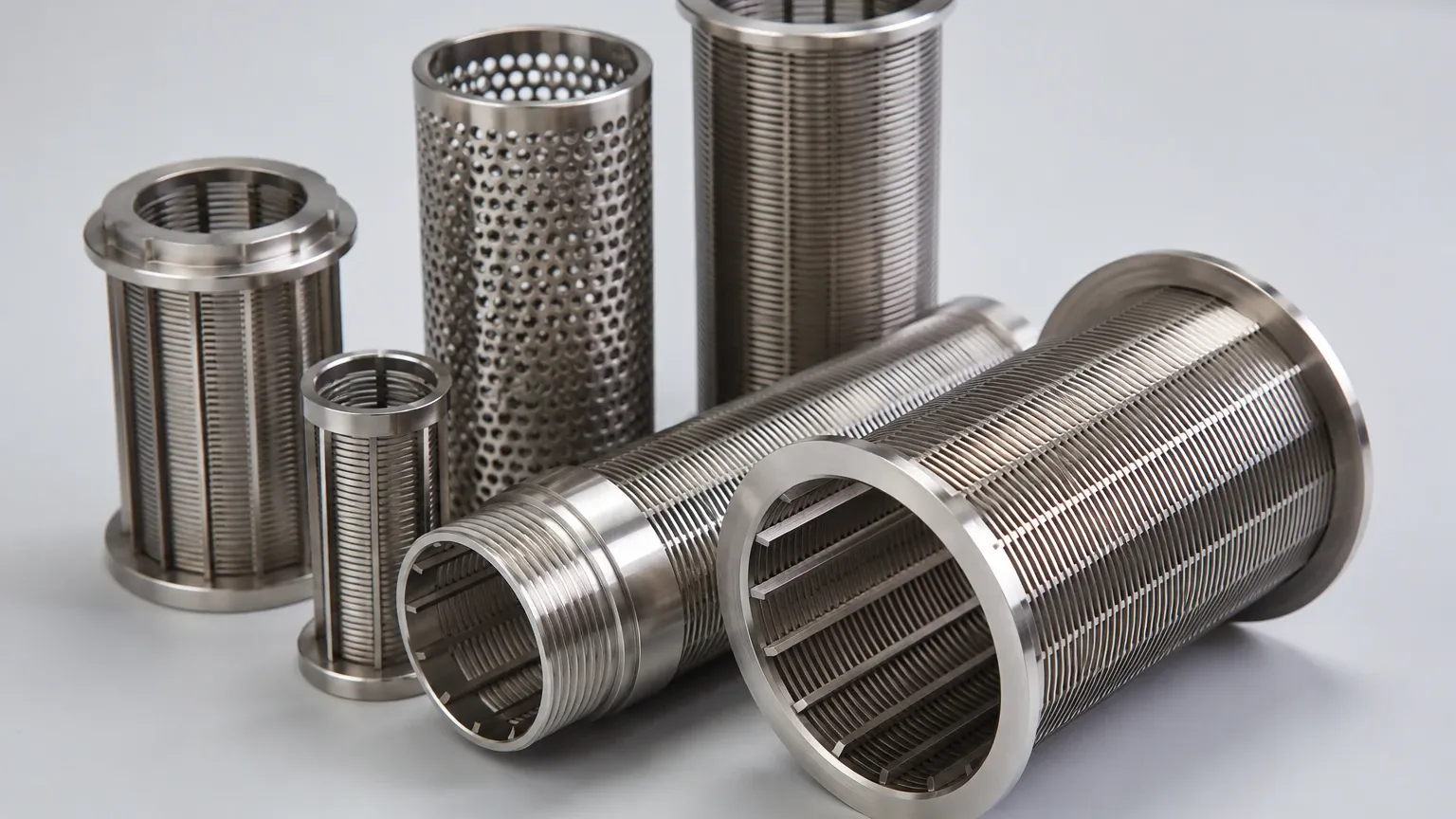
Wedge Wire Screen Filter
In industrial liquid-solid separation, the choice of filtration media directly impacts operational efficiency, maintenance frequency, and product purity. Among the various technologies available, the wedge wire screen filter stands out as a robust, precision-engineered solution designed for demanding environments. Unlike traditional woven mesh or perforated plates, wedge wire utilizes a specific geometric profile to provide superior mechanical strength and a unique non-clogging surface. For engineers and procurement teams, understanding the technical nuances of these components is essential for optimizing filtration systems in chemical processing, water treatment, and food production.
The Geometry of Performance: V-Shaped Wire and Non-Clogging Design
The fundamental advantage of a wedge wire screen filter lies in the shape of the individual wires. These wires are typically "V" or wedge-shaped in cross-section. During the manufacturing process, the surface wires are resistance-welded onto support rods at each intersection. This creates a slot that is narrowest at the surface and widens toward the interior of the filter.
This geometry provides a critical functional benefit: two-point contact. When a particle attempts to pass through the screen, it only touches the edges of the V-shaped wire at the surface. If the particle is smaller than the slot width, it passes through freely. Because the opening widens immediately behind the surface, there is no internal structure to trap the particle. This design effectively eliminates "blinding" or clogging, which is a common failure mode in woven wire mesh where particles can become lodged within the weave. For high-viscosity fluids or media with irregular particle shapes, Wedge Wire Screens offer a level of reliability that reduces downtime and extends the intervals between cleaning cycles.
Key Technical Specifications for Industrial Selection
Selecting the correct wedge wire screen filter requires a detailed analysis of the application's physical and chemical demands. Engineering teams must evaluate several core specifications to ensure the filter performs as expected under pressure.
1. Slot Width (Aperture)
The slot width is the most critical dimension, as it determines the filtration rating. Precision manufacturing allows for slot openings as small as 20 microns, though industrial applications often range from 50 microns to several millimeters. It is important to note that the slot tolerance must be tightly controlled; inconsistent slot widths lead to "bypass," where oversized particles pass through wider gaps, compromising the downstream process.
2. Wire Profile and Support Rods
The size and shape of the surface wire (the "V" profile) and the support rods determine the mechanical strength of the filter. Heavier wire profiles can withstand higher differential pressures and abrasive materials but may reduce the total open area. Engineers must balance the need for structural integrity against the required flow rate.
3. Open Area Calculation
The percentage of open area is calculated by the formula: `Slot Width / (Slot Width + Wire Width) x 100`. A higher open area results in lower pressure drops and higher flow capacities. In systems where pumping costs are a significant portion of the total cost of ownership, maximizing the open area without sacrificing the strength of the wedge wire screen filter is a primary design goal.
Material Selection and Metallurgical Considerations
Industrial filtration environments are often corrosive or involve extreme temperatures. Therefore, the metallurgy of the wedge wire screen filter is as important as its physical design. Most high-performance filters are fabricated from stainless steel alloys due to their durability and resistance to oxidation.
* AISI 304/304L: The standard choice for general industrial use, providing good corrosion resistance and cost-effectiveness for water treatment and non-acidic chemical applications.
* AISI 316/316L: Contains molybdenum, which significantly enhances resistance to chlorides and pitting. This is the preferred material for pharmaceutical, food and beverage, and marine environments.
* Duplex Stainless Steels: For highly aggressive chemical processing or high-pressure oil and gas applications, Duplex alloys offer superior yield strength and exceptional resistance to stress corrosion cracking.
* Specialty Alloys: In cases involving high-temperature sulfuric acid or other extreme reagents, alloys like Hastelloy or Monel may be required to prevent premature structural failure.
Structural Configurations: From Flat Panels to Cylindrical Cartridges
The versatility of the welding process allows a wedge wire screen filter to be formed into various geometries to suit different equipment types. The orientation of the slot relative to the flow is a key engineering decision.
* Flat Panels: Used in vibrating screens, dewatering machines, and floor intakes. These panels provide a rigid, flat surface that can handle heavy loads of solids.
* Cylindrical Cartridges (Radial Flow): In these designs, the surface wires run around the circumference of the cylinder. They are ideal for candle filters, strainers, and automatic backwashing systems. They can be designed for outside-to-inside (FOTI) or inside-to-outside (FITO) flow.
* Axial Flow Cylinders: The surface wires run parallel to the axis of the cylinder. This configuration is often used in screw press separators or internal rotary screens where a scraper or brush moves across the surface to remove solids.
* Conical and Sieve Bend Screens: Custom-shaped filters used in centrifuges or gravity-fed dewatering applications (static sieves). The curved profile of a sieve bend utilizes the Coanda effect to improve separation efficiency.
Industrial Applications: Solving Specific Filtration Challenges
The unique properties of the wedge wire screen filter make it the preferred choice across several specialized sectors:
Water and Wastewater Treatment
In municipal and industrial water treatment, these screens are used for intake water filtration, protecting downstream pumps and membranes from debris. They also serve as resin traps in ion exchange units, ensuring that expensive resin beads are not lost during backwash cycles.
Food and Beverage Processing
Hygiene is paramount in food production. The smooth surface of stainless steel wedge wire is easy to clean and sanitize. Common applications include lauter tun screens in brewing, juice extraction, and vegetable processing dewatering. The rigid structure prevents the filter from deforming under the weight of grain or fruit pulp.
Chemical and Petrochemical
In catalyst bed support systems, wedge wire provides a stable platform that allows for high flow rates while retaining catalyst beads. The high pressure and temperature resistance of all-welded stainless steel construction are vital for safety and process continuity in refinery operations.
Pulp and Paper
Screening and fractionation of wood fibers require filters that can handle high volumes of abrasive slurry. The durability of wedge wire minimizes the need for frequent replacements in these 24/7 manufacturing environments.
Maintenance, Cleaning, and Service Life
One of the strongest arguments for the adoption of wedge wire technology is the total cost of ownership. While the initial capital expenditure may be higher than that of disposable polymer filters or thin wire mesh, the long-term savings are substantial.
Cleaning Mechanisms
Because of the non-clogging V-wire design, these filters are exceptionally responsive to cleaning. In automatic systems, backwashing (reversing the flow) or back-pulsing with air or fluid effectively dislodges surface-accumulated solids. Mechanical cleaning via scrapers or brushes is also highly effective, as the rigid surface wires can withstand the friction without being damaged or displaced.
Durability and Replacement Cycles
A well-specified wedge wire screen filter can last for years, even in abrasive conditions. Unlike woven mesh, which may fray or develop "tracking" (where the wires shift and change the aperture size), the fusion-welded joints of wedge wire maintain a constant slot width throughout the life of the component. This consistency ensures that the filtration quality does not degrade over time.
Technical Checklist for Procurement
When consulting with a manufacturer like Kaifil for a custom wedge wire solution, engineers should have the following data points prepared to ensure an accurate design:
1. Fluid Characteristics: Viscosity, density, and chemical composition (to determine material grade).
2. Solids Profile: Particle size distribution, shape (spherical, fibrous, or angular), and concentration.
3. Flow Requirements: Minimum and maximum flow rates, and the maximum allowable pressure drop across the clean screen.
4. Operating Conditions: Normal and maximum operating temperatures and pressures, including potential pressure spikes.
5. Mechanical Interface: Connection types (flanges, threaded fittings, or plain ends) and the physical dimensions required to fit existing housing.
6. Cleaning Method: Will the filter be cleaned manually, via backwash, or with a mechanical scraper?
By addressing these factors during the design phase, technical teams can ensure that the wedge wire screen filter provides the necessary precision and longevity required for their specific industrial application. The result is a more stable process, reduced waste, and a more efficient bottom line.