Wedge Wire Screen Manufacturing Process
In industrial filtration, the mechanical integrity and precision of a filter element directly dictate the efficiency of the entire processing line. Wedge wire screens, often referred to as profile wire screens, are among the most robust and versatile filtration components available. Unlike traditional woven wire mesh or perforated plates, the wedge wire screen manufacturing process involves a sophisticated fusion of material science and automated precision welding. For engineers and procurement specialists, understanding this process is essential for evaluating the quality, durability, and performance of Wedge Wire Screens in demanding environments such as chemical processing, water treatment, and food production.
Material Selection and Wire Profiling
The foundation of a high-performance wedge wire screen lies in the selection of raw materials. Most industrial applications demand high corrosion resistance and structural strength, making stainless steel the primary choice. At Kaifil, the manufacturing process typically begins with high-grade stainless steel alloys, most commonly AISI 304, 316L, or specialized Duplex steels for highly corrosive or high-temperature environments.
The "wedge" in wedge wire refers to the V-shaped profile of the surface wire. This profile is achieved through a precision cold-rolling process. Round wire is pulled through a series of dies to create a triangular or wedge-shaped cross-section. This geometry is critical; the V-shape allows for a two-point contact with particles, creating a widening gap in the direction of flow. This design inherently minimizes clogging and facilitates easier backwashing or mechanical cleaning. During the cold-rolling phase, the material undergoes work hardening, which increases its tensile strength and wear resistance, ensuring the screen can withstand high differential pressures during operation.
The Core Wedge Wire Screen Manufacturing Process: Resistance Welding
The defining characteristic of wedge wire is the method by which the profile wires are attached to the support rods. This is not a simple assembly but a continuous, automated resistance welding process.
In a specialized wedge wire welding machine, the support rods (which provide the structural skeleton) are positioned at set intervals. The V-shaped profile wire is then wrapped around or laid across these support rods. As the profile wire makes contact with each support rod, a high-intensity electrical current is passed through the contact point while simultaneous pressure is applied. This creates a fusion weld at every single intersection.
This automated wedge wire screen manufacturing process ensures that the screen is a single, monolithic unit. Unlike woven mesh, where wires can shift or fray under pressure, the welded intersections of wedge wire provide exceptional dimensional stability. For cylindrical screens, the machine rotates the support rod cage while precisely feeding the profile wire in a spiral, resulting in a continuous, seamless cylinder with a consistent slot opening.
Precision Slot Control and Engineering Tolerances
For engineers, the most critical specification of a wedge wire screen is the slot width, or the gap between the profile wires. This gap determines the filtration rating (micron rating) and the open area of the screen. In the wedge wire screen manufacturing process, slot width is controlled by the speed at which the profile wire is fed relative to the movement of the support rods.
Modern CNC-controlled welding machines allow for extremely tight tolerances, often down to ±0.05mm or better, depending on the application. The ability to maintain a uniform slot across the entire surface of a large panel or cylinder is what separates high-quality industrial filters from standard hardware. A uniform slot ensures that the flow velocity remains constant across the screen, preventing localized high-pressure zones that could lead to premature wear or "breakthrough" of contaminants.
During production, manufacturers must also calculate the "Open Area" percentage. This is the ratio of the total slot area to the total screen surface area. A higher open area reduces the pressure drop across the filter and increases flow capacity, but it must be balanced against the structural requirements of the application. Engineers must confirm these calculations during the design phase to ensure the screen can handle the intended flow rates without mechanical failure.
Structural Configurations and Customization
The flexibility of the wedge wire screen manufacturing process allows for a wide variety of configurations tailored to specific industrial equipment.
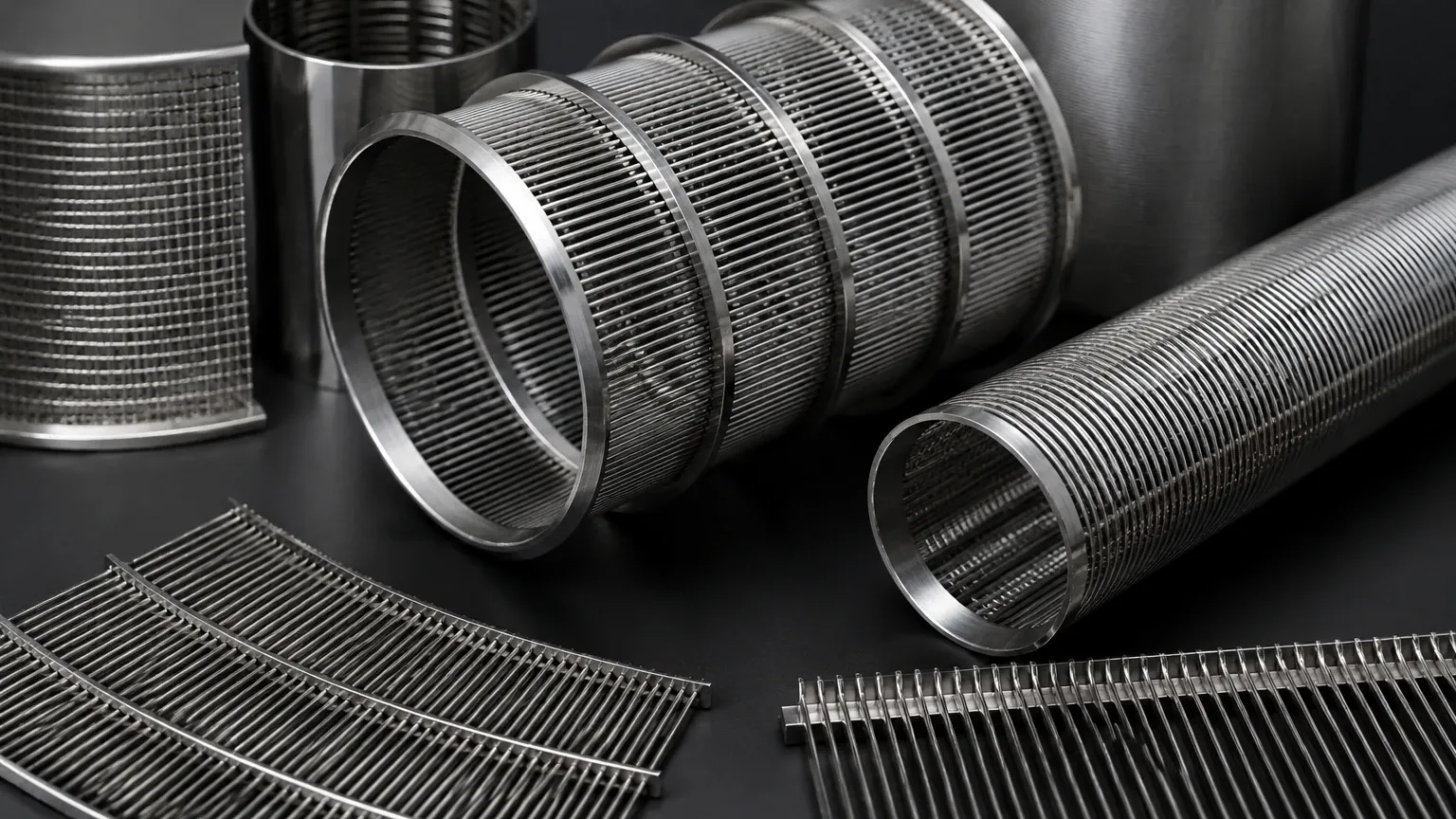
1. Flat Panels: Used in vibrating screens, floor drains, and intake screens. These are manufactured by welding the wire onto flat support rod arrangements and then cutting them to the required dimensions.
2. Cylindrical Screens (Filter Cartridges): These can be manufactured with the profile wire on the outside (FOTI – Flow Out To In) or on the inside (FITO – Flow In To Out). The direction of the V-shape relative to the flow is a key engineering decision based on whether the filter is cleaned via internal scrapers or external backpulsing.
3. Curved Screens (Sieve Bends): Flat panels are precisely rolled or formed into an arc. These are commonly used in mineral processing and wastewater treatment for gravity-fed dewatering.
Kaifil specializes in customizing these structures, including the addition of reinforced flanges, end caps, and internal support frames to meet the specific mechanical loads of hydraulic systems or high-pressure chemical reactors.
Post-Production Finishing and Quality Assurance
Once the welding process is complete, the wedge wire screen undergoes several finishing steps to ensure longevity and hygiene, particularly for the pharmaceutical and food industries.
* Cutting and Deburring: Screens are cut to size using plasma, laser, or mechanical saws. Deburring is essential to remove any sharp edges that could trap debris or cause injury during maintenance.
* Pickling and Passivation: This chemical process removes the "heat tint" or oxidation caused by the welding process. It restores the chromium oxide layer on the stainless steel, which is vital for corrosion resistance.
* Electropolishing: For high-purity applications, electropolishing provides a mirror-like finish, reducing surface roughness to a sub-micron level. This prevents bacterial growth and makes the screen even easier to clean.
Quality control is integrated into every stage of the wedge wire screen manufacturing process. Standard testing includes dimensional inspections using digital calipers and optical comparators to verify slot accuracy. For high-pressure applications, hydrostatic testing or collapse testing may be performed to ensure the screen can withstand the specified differential pressure without deforming.
Engineering Considerations for Selection
When specifying wedge wire screens, engineers should look beyond the basic dimensions. The total cost of ownership is heavily influenced by how the screen was manufactured. A screen with poorly controlled welds will eventually suffer from "wire stripping," where the profile wires detach from the support rods under the stress of backwashing or mechanical cleaning.
Key confirmations to make before purchasing include:
* Burst/Collapse Pressure: Does the support rod spacing provide enough rigidity for the operating pressure?
* Chemical Compatibility: Is the selected alloy suitable for the pH and temperature of the process fluid?
* Flow Direction: Is the V-profile oriented correctly to maximize the self-cleaning effect?
* Slot Uniformity: What are the manufacturer’s tolerances for slot width across the entire surface?
By focusing on these technical details, procurement teams can ensure they receive a filtration component that offers long-term reliability and minimal downtime.
Conclusion
The wedge wire screen manufacturing process is a specialized engineering discipline that combines high-strength materials with precision welding technology. From the initial cold-rolling of the V-profile wire to the final passivation of the welded structure, every step is designed to produce a filter that is mechanically superior to traditional alternatives. As a professional manufacturer, Kaifil provides the expertise necessary to navigate these technical choices, delivering custom stainless steel filtration solutions that meet the rigorous demands of modern industry. Whether for a high-capacity water intake or a precision pharmaceutical separator, the integrity of the wedge wire screen begins with a controlled and validated manufacturing process.