


Wedge Wire Screen Open Area Calculation
In industrial filtration and separation processes, the efficiency of a system is often dictated by the geometric configuration of the filter media. For engineers and technical procurement teams, understanding the wedge wire screen open area calculation is fundamental to predicting flow rates, pressure drops, and the overall longevity of the filtration equipment. Wedge wire screens, known for their precision and structural integrity, rely on the relationship between the surface wire width and the slot opening to define their performance characteristics.
As a specialized manufacturer of stainless steel filtration solutions, Kaifil emphasizes the importance of precise engineering in the design of Wedge Wire Screens. This article provides a technical deep dive into the mathematics of open area, the variables that influence these calculations, and the practical implications for industrial applications.
Understanding the Importance of Open Area in Industrial Filtration
The "open area" of a wedge wire screen refers to the percentage of the total screen surface that is unobstructed, allowing fluid or gas to pass through. It is the primary metric used to determine the hydraulic capacity of a screen. In B2B industrial environments—ranging from chemical processing to food and beverage production—the open area directly impacts several critical operational parameters:
1. Flow Velocity: A higher open area allows for lower approach velocities, which reduces the risk of particle impingement and minimizes the potential for "blinding" or clogging of the screen.
2. Pressure Drop (ΔP): The resistance to flow is inversely proportional to the open area. Minimizing pressure drop is essential for reducing energy consumption in pumping systems and maintaining consistent process flow.
3. Filtration Efficiency: While the slot width determines the size of particles retained, the open area determines how much volume can be processed per unit of time.
4. Cleaning Cycles: Screens with optimized open areas often require less frequent backwashing or manual cleaning, as the distribution of solids across the surface is more uniform.
The Standard Formula for Wedge Wire Screen Open Area Calculation
The calculation for the open area of a wedge wire screen is relatively straightforward, yet it requires precise measurements of the screen's components. Unlike woven wire mesh, where the wire diameter and mesh count are used, wedge wire calculations focus on the width of the V-shaped profile wire and the distance between those wires (the slot size).
The Basic Formula
The percentage of open area (% OA) is calculated using the following formula:
% Open Area = [S / (S + W)] × 100
Where:
* S (Slot Width): The clear distance between two adjacent profile wires (also known as the aperture or gap).
* W (Wire Width): The width of the top surface of the V-shaped profile wire.
Example Calculation
If an engineer specifies a wedge wire screen with a slot width of 0.5 mm and uses a profile wire that is 1.5 mm wide, the calculation would be:
* % OA = [0.5 / (0.5 + 1.5)] × 100
* % OA = [0.5 / 2.0] × 100
* % OA = 25%
This means that 25% of the screen's surface is available for flow, while 75% is occupied by the structural profile wire.
Key Variables Influencing Effective Filtration Area
While the basic formula provides the theoretical open area of the screen surface, several other factors can influence the "effective" open area in a real-world industrial setting. Engineers must account for these variables during the design phase to ensure the Wedge Wire Screens perform as expected under load.
Support Rod Interference
In many designs, especially for heavy-duty cylinders or large flat panels, support rods are welded perpendicular to the profile wires. While these rods are located behind the filtration surface, they can partially obstruct the flow path if they are excessively large or spaced very closely together. In high-precision applications, the area occupied by the support rods may be subtracted from the total area to determine the net effective open area.
Profile Wire Shape (The V-Wire Advantage)
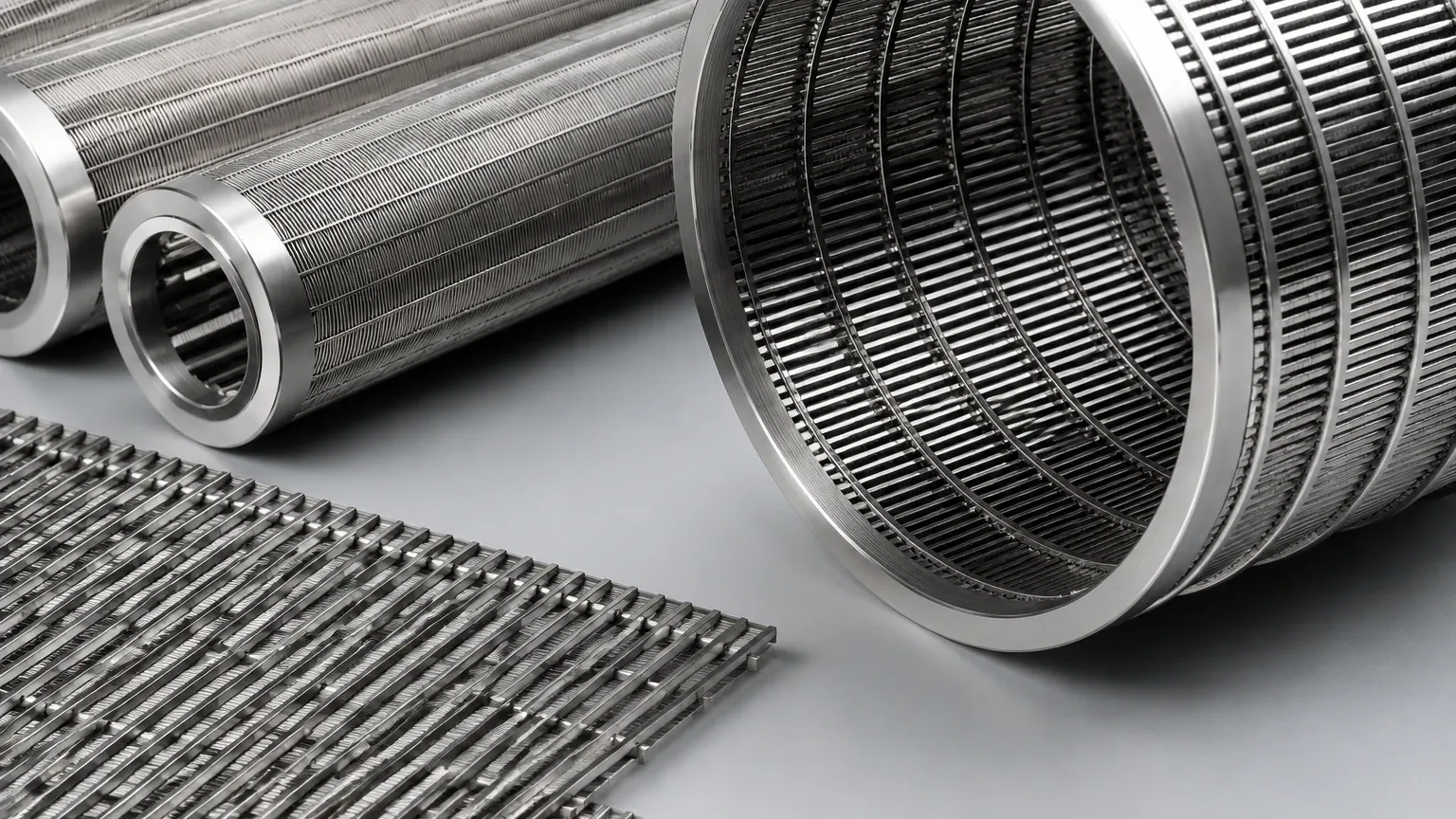
Kaifil utilizes V-shaped profile wires because they create a widening gap inward. This design ensures that any particle small enough to pass through the initial slot width will continue through the screen without getting wedged. While the V-shape does not change the initial wedge wire screen open area calculation, it significantly improves the "functional" open area over time by preventing internal clogging.
Manufacturing Tolerances
In precision filtration, even a deviation of 0.05 mm in slot width can significantly alter the open area percentage, especially with very fine slots (e.g., 0.1 mm). High-quality manufacturing processes ensure that the slot width remains consistent across the entire surface of the screen, providing predictable hydraulic performance.
Balancing Open Area with Mechanical Integrity
A common challenge in filtration engineering is the trade-off between maximizing open area and maintaining the mechanical strength of the screen. A higher open area is generally achieved by either increasing the slot width or decreasing the wire width.
The Risks of Excessive Open Area
If the profile wire (W) is too narrow relative to the pressure of the fluid or the weight of the filter cake, the screen may suffer from:
* Deformation: The wires may bend or shift, altering the slot width and compromising filtration accuracy.
* Fatigue Failure: In high-vibration environments or systems with frequent pressure pulsations, thin wires are more susceptible to metal fatigue.
* Reduced Service Life: Thinner wires provide less "wear life" in abrasive applications where the media contains sand, crystals, or other erosive particles.
Structural Reinforcement
To maintain a high open area while ensuring durability, Kaifil engineers often recommend increasing the frequency or diameter of the support rods rather than increasing the width of the surface profile wire. This allows the screen to withstand higher differential pressures without sacrificing the flow capacity defined by the wedge wire screen open area calculation.
Practical Applications and Flow Rate Considerations
The calculated open area is used by process engineers to determine the total required surface area of a filter vessel. This is often done by calculating the "flux rate" (volume per unit area per unit time).
Water Treatment and Intake Screens
In water intake systems, environmental regulations often limit the approach velocity to protect aquatic life. By using the open area calculation, engineers can size the screen large enough to ensure the velocity remains below the threshold (typically 0.15 m/s) while still meeting the facility's water demand.
Food and Pharmaceutical Processing
In these industries, hygiene and cleanability are paramount. A screen with a well-calculated open area ensures that the flow is turbulent enough to prevent stagnant zones where bacteria could grow, yet efficient enough to allow for rapid CIP (Clean-In-Place) cycles.
Petrochemical and Catalyst Recovery
Wedge wire screens are frequently used as catalyst support grids. Here, the open area must be calculated to support the immense weight of the catalyst bed while ensuring the gas or liquid distribution remains uniform across the reactor diameter. Incorrect open area calculations in these settings can lead to "channeling," where the fluid bypasses parts of the catalyst bed, reducing reaction efficiency.
How to Optimize Your Wedge Wire Screen Specifications
When requesting a quote or designing a system, providing the desired open area is just the starting point. To receive a truly optimized filtration component, engineers should confirm the following details with the manufacturer:
1. Operating Pressure and Differential Pressure (ΔP): This determines the necessary wire strength and support rod spacing.
2. Media Characteristics: Is the fluid corrosive, abrasive, or viscous? This influences material selection (e.g., 316L vs. Duplex stainless steel) and the choice of profile wire.
3. Flow Direction: Will the flow be from the outside-in (FOTI) or inside-out (FITO)? This affects whether the profile wire is wrapped on the exterior or interior of the support rods.
4. Required Slot Velocity: Calculating the velocity through the slots helps in predicting potential erosion and the likelihood of particle shearing.
At Kaifil, we provide comprehensive technical support to help our clients navigate the complexities of Wedge Wire Screens design. By combining advanced manufacturing capabilities with a deep understanding of fluid dynamics, we ensure that every screen is tailored to the specific mechanical and hydraulic requirements of the application.
Conclusion
The wedge wire screen open area calculation is a vital tool for any engineer involved in industrial separation. It serves as the bridge between theoretical design and operational reality. While the math itself—% OA = [S / (S + W)] × 100—is simple, the implications for pressure drop, flow velocity, and structural durability are profound. By carefully selecting the slot width and profile wire dimensions, and by partnering with an experienced manufacturer like Kaifil, industrial facilities can achieve a filtration solution that offers both high performance and a low total cost of ownership.
