


Wedge Wire Screen Sizes
In industrial filtration and separation, the efficiency of a system is often determined by the precision of its components. Wedge wire screens, known for their structural integrity and non-clogging characteristics, are a primary choice for engineers in sectors ranging from wastewater treatment to chemical processing. However, selecting the correct wedge wire screen sizes involves more than just choosing a length and width. It requires a deep understanding of profile wire dimensions, slot widths, support rod spacing, and how these factors interact with the fluid dynamics of a specific application.
At Kaifil, we specialize in manufacturing custom stainless steel filtration solutions. Understanding the technical nuances of Wedge Wire Screens is essential for optimizing flow rates, ensuring particle retention, and extending the service life of the equipment. This guide provides a technical overview of the dimensions and sizing considerations necessary for informed procurement and engineering design.
The Geometry of Wedge Wire Construction
To understand wedge wire screen sizes, one must first understand the two-component architecture of the screen: the profile wire (surface wire) and the support rod.
Profile Wires
The profile wire is the V-shaped or wedge-shaped wire that forms the filtration surface. The size of this wire is critical because it determines the mechanical strength of the screen and the total open area. Profile wires are usually designated by their width and height. For instance, a common profile might be 1.5mm wide and 2.5mm high. A larger profile wire offers greater resistance to abrasion and mechanical stress but may reduce the total open area if the slot size remains constant.
Support Rods
Support rods are the structural ribs welded perpendicularly to the profile wires. These rods can be round, triangular, or rectangular (flat bars). The size and frequency of these rods—known as the support rod pitch—determine the load-bearing capacity of the screen. In high-pressure applications, such as deep-well strainers or heavy-duty vibratory screens, larger support rods and tighter spacing are required to prevent deformation.
Defining Slot Sizes and Filtration Accuracy
The most critical dimension in any filtration specification is the slot size, often referred to as the aperture or gap. This is the distance between two adjacent profile wires.
Precision and Tolerance
Unlike woven wire mesh, which can shift under pressure, wedge wire provides a fixed, rigid slot. Wedge wire screen sizes for slots typically range from as small as 20 microns (0.02mm) up to 10mm or more. For high-precision industrial applications, maintaining a tight tolerance on the slot width is paramount. Even a slight deviation can allow oversized particles to pass through or cause premature blinding of the screen.
The V-Shape Advantage
The "wedge" in wedge wire refers to the inward-opening V-shape of the slot. This geometry ensures that any particle that passes through the narrowest point at the surface will continue to move freely through the widening gap. When calculating wedge wire screen sizes, engineers must consider the angle of this V-shape, as it influences the self-cleaning properties during backwashing or mechanical cleaning cycles.
Calculating Open Area and Flow Capacity
The "Open Area" is a percentage representing the total area of the slots relative to the total surface area of the screen. It is the primary metric used to calculate flow velocity and pressure drop.
The Formula
The percentage of open area can be calculated using the following formula:
Open Area % = [Slot Size / (Slot Size + Wire Width)] × 100
For example, if an engineer specifies a slot size of 0.5mm and uses a profile wire with a width of 1.5mm, the open area would be:
[0.5 / (0.5 + 1.5)] × 100 = 25%.
Engineering Trade-offs
When determining wedge wire screen sizes, there is a constant balance between open area and structural durability. A larger open area results in a lower pressure drop and higher flow capacity, which is ideal for gravity-fed systems. However, increasing the open area usually requires either narrowing the profile wire or widening the slot. Narrower wires may reduce the lifespan of the screen in abrasive environments, while wider slots may compromise filtration precision.
Standard Dimensions and Custom Formats
Wedge wire screens are highly versatile and can be fabricated into various physical formats, each with its own set of dimensional standards.
Flat Panels
Flat panels are used in sieve bends, vibratory decks, and floor drains. Sizes can vary from small laboratory inserts to large industrial decks measuring several meters in length and width. When specifying panel sizes, engineers must also define the framing requirements (e.g., angle iron or flat bar edges) which add to the overall footprint.
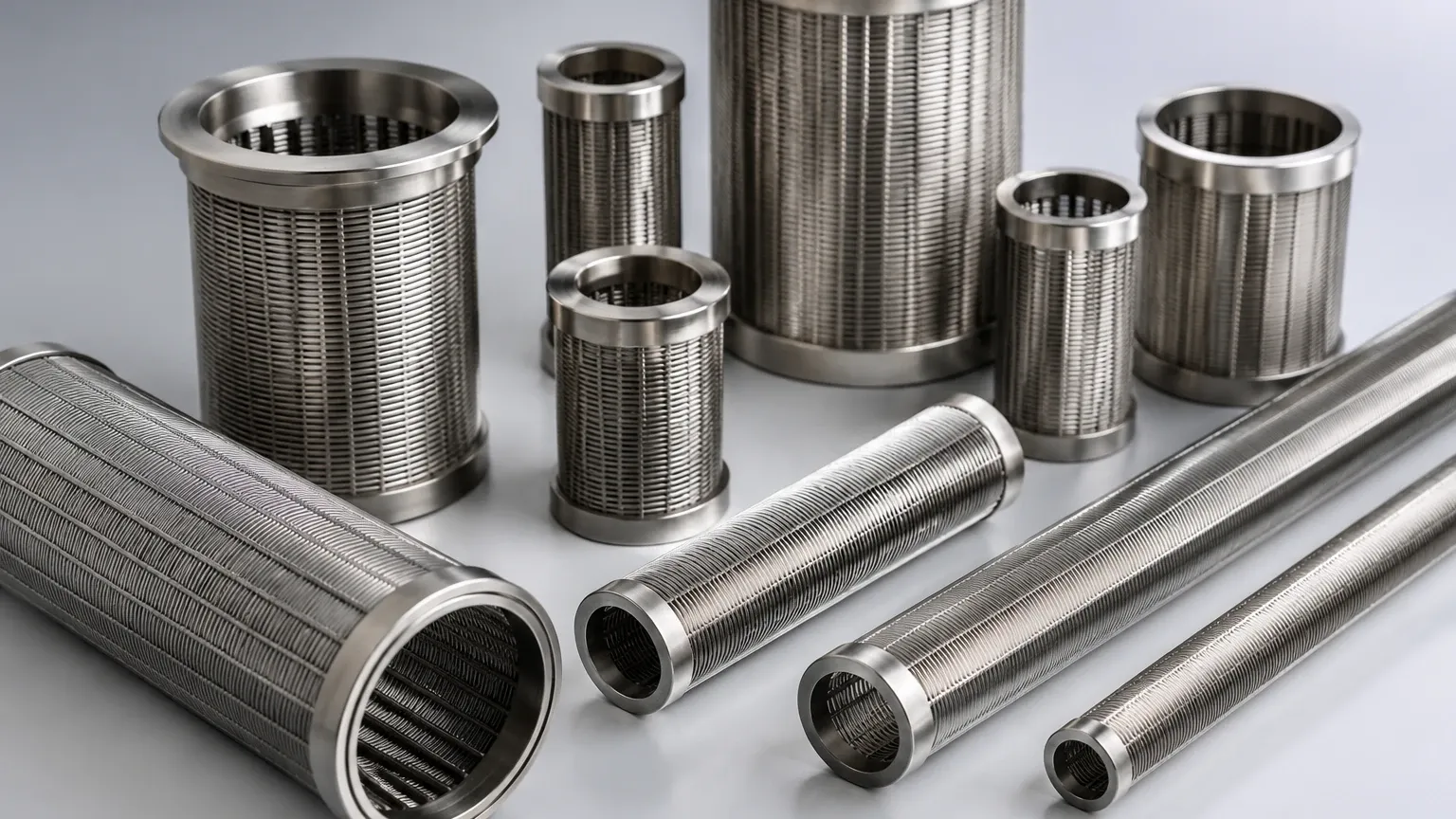
Cylindrical Screens (Filter Cartridges and Strainers)
For pressurized systems, wedge wire is often formed into cylinders. There are two main construction types:
1. Radial Slots (FOTI – Flow Out-To-In): The profile wires run circumferentially around the cylinder, and support rods run axially. This is common for standard filter cartridges.
2. Axial Slots (FITO – Flow In-To-Out): The profile wires run parallel to the axis of the cylinder, providing a smooth internal surface. This is often used in screw press separators where internal augers move material across the screen.
Standard diameters for these cylinders range from 25mm to over 1000mm, with lengths customized to fit specific vessel housings.
Material Selection and Its Impact on Sizing
While the physical dimensions define the fit and function, the material grade defines the environment in which those wedge wire screen sizes can operate. Kaifil primarily utilizes high-grade stainless steel to ensure longevity.
* SS304: Suitable for general industrial use where corrosion is not a primary concern.
* SS316L: The industry standard for chemical processing, pharmaceutical, and food and beverage applications due to its superior resistance to pitting and chloride corrosion.
* Duplex Stainless Steels: Used in highly aggressive environments, such as seawater filtration or acidic chemical streams, where high mechanical strength and corrosion resistance are both required.
The choice of material can influence the thickness of the wire required. For instance, in a highly corrosive environment, an engineer might specify a slightly larger profile wire to provide a "corrosion allowance," ensuring the screen maintains its structural integrity even after years of surface oxidation.
Application-Specific Sizing Considerations
Different industries have varying requirements for wedge wire screen sizes based on the nature of the media being filtered.
Water Treatment and Intake
In municipal water intake, screens must be sized to prevent the entrainment of aquatic life. This often requires very large surface areas with low approach velocities, necessitating large-panel wedge wire structures with specific slot sizes (often around 2mm to 9mm) to meet environmental regulations.
Food and Beverage Processing
In brewing or starch production, the screens must facilitate easy cleaning and sanitation. Small profile wires are often preferred here to maximize open area, while the overall screen size must be compatible with CIP (Clean-In-Place) systems. Slot sizes are typically very fine, ranging from 0.1mm to 0.5mm.
Pulp and Paper
Screening wood fibers requires robust wedge wire screen sizes that can withstand high-frequency vibrations and abrasive slurry. Here, the height of the profile wire is increased to provide a deeper wear zone, extending the interval between replacements.
Technical Checklist for Specifying Wedge Wire Screens
When consulting with a manufacturer like Kaifil, providing a complete dimensional profile ensures the final product meets the operational demands. Engineers should confirm the following data points:
1. Slot Opening: The required filtration rating (in mm or microns).
2. Profile Wire Code: The width and height of the surface wire.
3. Support Rod Type and Spacing: The distance between rods and their cross-sectional shape.
4. Overall Dimensions: Length, width, or diameter/height for cylinders.
5. Flow Direction: Whether the fluid moves from the outside-in or inside-out.
6. Material Grade: Based on the chemical compatibility of the fluid.
7. Mechanical Load: The maximum differential pressure the screen must withstand.
Conclusion
Selecting the appropriate wedge wire screen sizes is a technical process that balances hydraulic performance with mechanical durability. By precisely defining the profile wire, slot width, and support structure, engineers can achieve a filtration solution that minimizes downtime and maximizes throughput.
As a professional manufacturer, Kaifil provides the engineering support and manufacturing precision needed to deliver custom wedge wire solutions for the most demanding industrial environments. Whether you require a standard replacement cartridge or a custom-designed intake screen, understanding these dimensional variables is the first step toward optimized filtration performance.
