


Wedge Wire Screening
In industrial separation and filtration, the efficiency of a system often hinges on the mechanical design of the filter media. Wedge wire screening has emerged as a critical technology for high-demand applications where traditional woven wire mesh or perforated plates may fail to provide the necessary durability or flow characteristics. Characterized by its unique V-shaped profile wire, this screening method offers distinct engineering advantages in terms of structural integrity, non-clogging performance, and precision slot control.
For engineers and procurement teams, understanding the technical nuances of wedge wire is essential for optimizing process uptime and reducing maintenance costs. This guide examines the engineering principles, material considerations, and application-specific designs that define high-performance wedge wire solutions.
The Engineering Principles of Wedge Wire Screening
The fundamental advantage of wedge wire screening lies in its geometric configuration. Unlike traditional mesh, which consists of interwoven wires that create multiple contact points for particles to become trapped, wedge wire is constructed from individual profile wires resistance-welded onto perpendicular support rods.
The V-Shaped Profile
This V-shaped geometry is the core of the "non-blinding" or non-clogging characteristic. Because the narrowest part of the slot is at the surface where the fluid enters, any particle that passes through the initial opening will continue to move freely through the widening gap. In contrast, standard mesh often traps near-size particles within the weave, leading to "blinding" and a rapid increase in pressure drop.
Continuous Slot Design
Because the profile wires are welded at every intersection with the support rods, the resulting slot is continuous. This design maximizes the open area percentage compared to perforated metals, allowing for higher flow rates and lower initial pressure differentials. For industrial processes involving high-viscosity fluids or high solids loading, this continuous slot design ensures that the screen remains functional for longer intervals between cleaning cycles.
Key Design Parameters for Industrial Applications
When specifying Wedge Wire Screens for a project, several mechanical variables must be balanced to meet the specific demands of the application. These parameters dictate not only the filtration efficiency but also the mechanical lifespan of the component.
Slot Width and Precision
Slot width is the distance between the surface of two adjacent profile wires. In precision manufacturing, these slots can be engineered from as small as 20 microns up to several millimeters. The consistency of this slot width across the entire surface of the screen is vital; even minor deviations can allow oversized particles to pass through, potentially damaging downstream equipment like pumps or high-pressure nozzles.
Profile Wire and Support Rod Selection
The size and shape of the profile wire (the "wedge") and the support rod (the structural backbone) are chosen based on the expected pressure load and the abrasiveness of the media. Heavy-duty applications, such as mining or large-scale water intake, require thicker profile wires to withstand physical impact, while fine chemical filtration may prioritize a thinner wire to maximize the open area.
Flow Direction (FOTI vs. FITO)
Engineers must specify the direction of flow relative to the V-shape.
* Flow-Out-to-In (FOTI): The flat surface of the profile wire is on the outside of a cylinder, and the V-shape narrows toward the center. This is common in intake screens and drum filters.
* Flow-In-to-Out (FITO): The flat surface is on the inside, which is ideal for internal filtration where solids are collected on the inner surface for easy removal by a mechanical scraper or backwashing system.
Material Science and Corrosion Resistance
Industrial filtration environments are frequently aggressive, involving corrosive chemicals, extreme temperatures, or abrasive slurries. Selecting the correct alloy is the most significant factor in preventing premature failure due to stress corrosion cracking or pitting.
1. Stainless Steel 304: The standard choice for general industrial use, providing good corrosion resistance and mechanical strength for non-acidic environments.
2. Stainless Steel 316L: Preferred for pharmaceutical, food and beverage, and marine applications. The addition of molybdenum and lower carbon content provides superior resistance to chlorides and organic acids.
3. Duplex Stainless Steels: Used in high-stress or highly corrosive chemical processing where standard 300-series steels may suffer from localized corrosion.
4. Specialty Alloys: For extreme environments, alloys like Monel or Hastelloy can be utilized, though these are typically reserved for specific chemical compatibility requirements.
At Kaifil, the focus remains on ensuring that material selection aligns with the specific chemical and thermal profile of the client’s process, ensuring that the wedge wire screening components maintain their structural integrity over years of service.
Applications Across Critical Industries
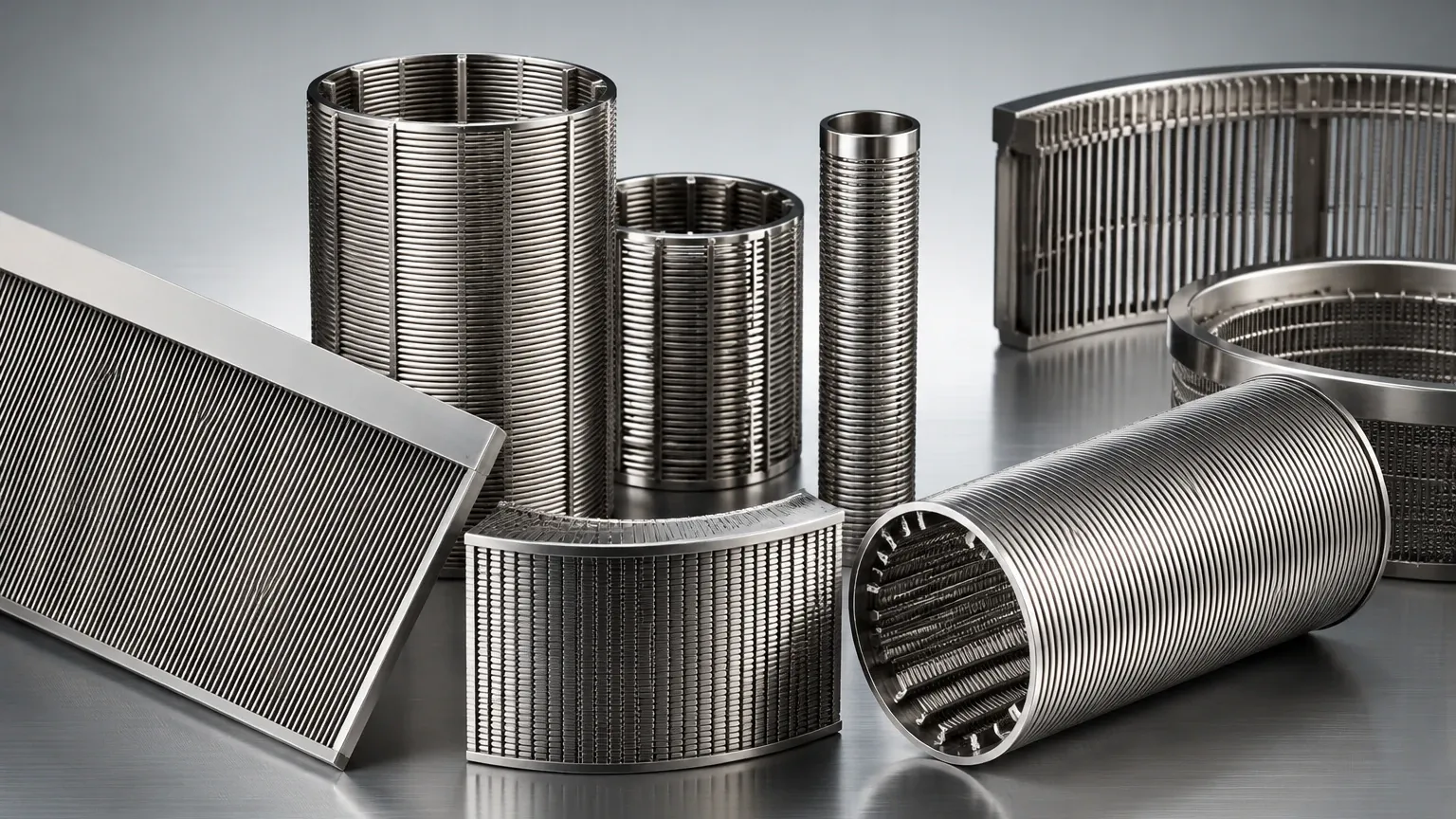
The versatility of wedge wire screening makes it a staple in sectors where reliability is non-negotiable. Its ability to be fabricated into various shapes—flat panels, curved sieves, cylinders, and conical baskets—allows it to be integrated into diverse machinery.
Water Treatment and Intake
In municipal and industrial water treatment, wedge wire is used for intake screens to protect pumps and downstream systems from debris. The low-velocity flow through the large open area of the screens helps prevent the impingement of aquatic life while maintaining a steady supply of raw water.
Food and Beverage Processing
Hygiene and cleanability are paramount in food processing. Wedge wire’s smooth surface and lack of "dead zones" (where bacteria can grow) make it ideal for sugar refining, brewery mash tuns, and vegetable processing. The ability to withstand high-pressure steam cleaning (CIP – Clean In Place) is a significant advantage over synthetic or woven media.
Chemical and Petrochemical
In catalyst recovery and reactor internals, wedge wire must withstand high temperatures and differential pressures. The rigid construction prevents the media from deforming under the weight of catalyst beds, ensuring uniform flow distribution across the reactor vessel.
Pulp and Paper
Wedge wire is used in pressure screens and fractionation systems to separate fibers from contaminants. The high mechanical strength of the welded structure allows these screens to operate under the significant centrifugal forces generated in high-speed pulping equipment.
Maintenance, Cleaning, and Total Cost of Ownership
While the initial capital expenditure for wedge wire screening may be higher than for disposable cartridges or woven mesh, the total cost of ownership (TCO) is often significantly lower. This is due to three primary factors: durability, cleanability, and energy efficiency.
Mechanical Cleaning and Backwashing
Unlike depth filters that trap particles within a matrix, wedge wire is a surface filter. This allows for highly effective mechanical cleaning. Automated scrapers can move across the surface to remove solids without interrupting the flow. Similarly, backwashing—reversing the fluid flow to flush particles off the surface—is more effective with wedge wire because the V-shaped slots provide a clear path for the release of debris.
Energy Efficiency
The high open area of wedge wire reduces the resistance to flow. For a pump-driven system, lower resistance translates directly into lower energy consumption. Over the lifespan of a large-scale filtration plant, the energy savings can offset the initial cost of the stainless steel components.
Replacement Cycles
A well-engineered stainless steel wedge wire screen can last for years, whereas woven mesh may fray or tear, and plastic media may degrade under UV or chemical exposure. Engineers should monitor the pressure differential across the screen; a consistent increase that cannot be resolved by backwashing may indicate surface scaling or physical wear of the profile wires, signaling the need for professional inspection or replacement.
Technical Checklist for Procurement and OEM Customization
To ensure the successful integration of wedge wire screening into an industrial system, technical teams should confirm the following data points before moving to the production phase:
* Micron/Slot Rating: Determine the exact particle size that must be retained. For safety, the slot size is usually 50% to 80% of the smallest particle size to be removed.
* Operating Pressure and Delta P: What is the maximum pressure the screen will face, and what is the maximum allowable pressure drop before cleaning is required?
* Flow Rate Requirements: Calculate the total surface area needed to maintain the required flow velocity without causing turbulence or excessive wear.
* Housing and Interface: How will the screen be mounted? Standard options include flanges, threaded fittings, or reinforced end rings for drop-in replacement.
* Surface Treatment: Does the application require pickling and passivation, electropolishing, or a specific surface roughness (Ra) value for sanitary compliance?
By addressing these factors during the design phase, Kaifil helps engineers develop customized filtration solutions that meet the specific mechanical and chemical rigors of their industry. Whether it is a standard flat panel or a complex internal reactor component, the precision of the wedge wire screening process remains a cornerstone of modern industrial separation.
