


Engineering Guide to 3 4 Wire Mesh Filters for Industrial Applications
In the landscape of industrial fluid management, precision and durability are the cornerstones of operational efficiency. Among the various components used to ensure fluid purity, 3 4 wire mesh filters—referring to specific sizing such as 3/4-inch diameters or port connections—play a critical role in protecting sensitive downstream equipment. These components are not merely consumables; they are engineered barriers designed to withstand high pressures, corrosive chemicals, and extreme temperatures.
For engineers and procurement specialists, selecting the right filtration media requires a deep understanding of material science, fluid dynamics, and mechanical design. This guide explores the technical nuances of Wire Mesh Filter Cylinders & Tubes, providing the factual foundation necessary for informed decision-making in B2B industrial environments.
1. Technical Specifications of 3 4 Wire Mesh Filters
The designation "3 4" in the context of industrial wire mesh filters often refers to the nominal size of the filter housing connection (3/4" NPT or BSP) or the outer diameter of the filter tube itself. Regardless of the specific measurement context, these filters are characterized by their stainless steel construction and precise pore distribution.
Material Composition
Most high-performance wire mesh filters are manufactured from austenitic stainless steels, primarily Grade 304 and Grade 316L.
* Stainless Steel 304: Offers excellent strength and basic corrosion resistance, making it suitable for hydraulic oils, air filtration, and non-acidic aqueous solutions.
* Stainless Steel 316L: Contains molybdenum, which provides superior resistance to pitting and crevice corrosion in chloride-rich environments. This is the standard choice for pharmaceutical, food and beverage, and marine applications.
Weave Types and Micron Ratings
The performance of 3 4 wire mesh filters is dictated by the weave pattern of the wire. Common patterns include:
* Plain Weave: The simplest pattern where wires cross over and under each other. It provides a high open area and low pressure drop, ideal for coarse filtration.
* Dutch Weave: Uses thicker warp wires and finer weft wires driven closely together. This creates a tortuous path for particles, allowing for much finer micron ratings (down to 5-10 microns) while maintaining high mechanical strength.
* Twill Weave: Allows for thicker wires in a given mesh count, increasing the durability of the filter cylinder under high-pressure pulses.
2. Structural Design: Wire Mesh Filter Cylinders & Tubes
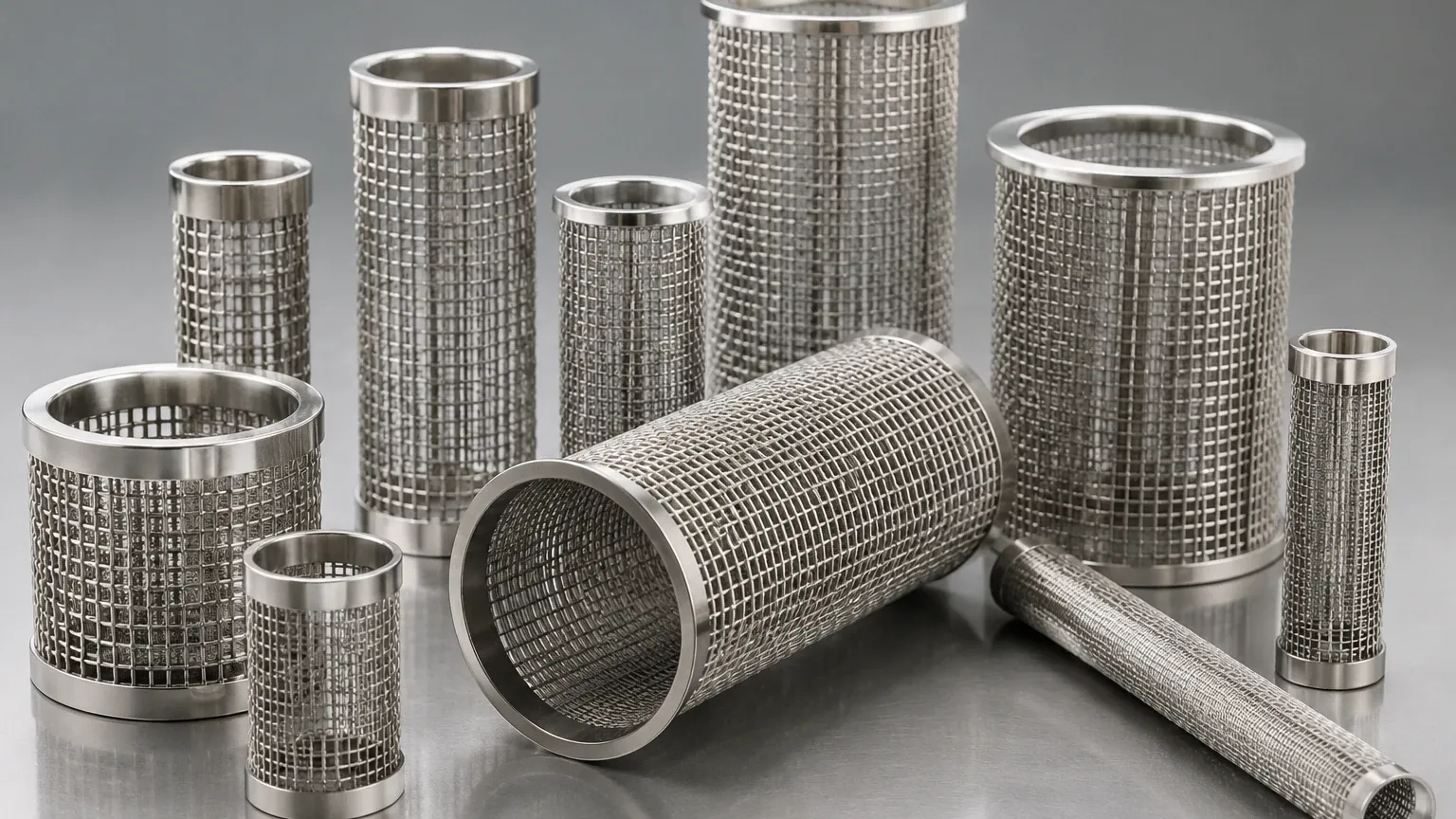
The geometry of the filter is as important as the mesh itself. Wire Mesh Filter Cylinders & Tubes are designed to maximize the effective filtration area (EFA) while fitting within the tight spatial constraints of industrial machinery.
Single-Layer vs. Multi-Layer Construction
For low-pressure applications, a single layer of stainless steel mesh may suffice. However, in demanding industrial settings, multi-layer sintered or reinforced structures are preferred. These designs often include:
1. The Control Layer: The fine mesh that determines the micron rating.
2. The Support Layer: A coarser, heavier mesh or perforated metal core that provides structural rigidity against collapsing under differential pressure.
3. The Drainage Layer: Ensures even fluid distribution across the filter surface, preventing localized clogging.
Pleated vs. Cylindrical Geometries
While a standard smooth cylinder is easy to clean, pleating the wire mesh can increase the surface area by 3 to 5 times within the same footprint. For a 3/4-inch diameter filter, pleating is a vital technique to extend the service life and reduce the frequency of maintenance cycles in high-contaminant loads.
3. Engineering Considerations for Selection
When specifying 3 4 wire mesh filters, engineers must evaluate several variables to ensure the component does not become a bottleneck or a point of failure.
Pressure Drop (ΔP)
The initial pressure drop across a clean filter is a function of fluid viscosity, flow velocity, and the mesh's open area. A common engineering mistake is selecting a mesh that is too fine for the application, leading to a rapid increase in differential pressure. This not only consumes more pumping energy but can also cause "media migration" or structural failure if the bypass valve does not engage.
Temperature and Chemical Compatibility
Stainless steel filters are prized for their thermal stability. Unlike polymer-based filters, stainless steel Wire Mesh Filter Cylinders & Tubes can operate in environments exceeding 500°F (260°C). However, at these temperatures, the thermal expansion of the filter and its housing must be matched to prevent bypass leakage at the seals.
Flow Direction
Most industrial filter tubes are designed for outside-to-inside (O-I) flow. This allows contaminants to settle on the exterior of the cylinder, making it easier to inspect and clean. However, in certain backwashing systems, inside-to-outside (I-O) flow is utilized to flush particles away from the mesh surface during the cleaning cycle.
4. Applications in Demanding Industrial Sectors
The versatility of 3 4 wire mesh filters allows them to serve in a wide array of specialized sectors where reliability is non-negotiable.
Hydraulic and Lubrication Systems
In hydraulic circuits, even microscopic metal shavings can cause catastrophic failure of pumps and valves. 3/4-inch wire mesh strainers are frequently used as suction line filters to protect the pump from large debris or as high-pressure inline filters to maintain ISO fluid cleanliness codes.
Chemical and Petrochemical Processing
Corrosive catalysts and aggressive solvents require filtration media that will not degrade or leach contaminants. Stainless steel 316L wire mesh tubes are used to recover expensive catalysts and to ensure the purity of intermediate chemical products.
Food and Beverage Production
In this sector, cleanability is paramount. Stainless steel filters are inherently hygienic and can withstand Clean-in-Place (CIP) procedures involving caustic chemicals and high-pressure steam. They are used to filter particulate from syrups, oils, and process water, ensuring compliance with food safety standards.
5. Maintenance, Cleaning, and Total Cost of Ownership
One of the primary B2B advantages of stainless steel 3 4 wire mesh filters over disposable cartridges is their cleanability. While the initial capital expenditure (CAPEX) is higher, the long-term operational expenditure (OPEX) is significantly lower.
Cleaning Methods
* Ultrasonic Cleaning: Uses high-frequency sound waves to create cavitation bubbles that dislodge deeply embedded particles from the mesh pores.
* Backwashing: Reversing the flow of the fluid to push contaminants off the mesh surface.
* Chemical Cleaning: Using specific solvents or acids to dissolve organic or inorganic scaling without damaging the stainless steel substrate.
Determining Replacement Cycles
Despite being reusable, wire mesh filters eventually reach the end of their functional life. Engineers should monitor for:
* Permanent Pressure Drop: When a filter can no longer be cleaned back to its original baseline pressure.
* Mechanical Fatigue: Signs of wire breakage or seam separation due to repeated pressure pulsations.
* Pore Blinding: A condition where particles become permanently wedged in the mesh, reducing the effective flow area.
6. Customization and OEM Integration
For many industrial equipment manufacturers, standard off-the-shelf filters do not meet the specific requirements of a proprietary system. This is where the expertise of a manufacturer like Kaifil becomes essential. Customizing Wire Mesh Filter Cylinders & Tubes involves more than just changing dimensions.
Engineering Collaboration
OEMs often require specific end-cap configurations, such as threaded fittings, flanges, or O-ring grooves, to ensure a leak-proof interface with their machinery. Furthermore, the choice of welding technique—such as TIG welding or plasma welding—is critical to ensure that the seams are as strong as the mesh itself and free from burrs that could contaminate the fluid stream.
Quality Assurance
In critical applications, filters must undergo rigorous testing, including:
* Bubble Point Test: To verify the integrity of the mesh and ensure there are no oversized pores.
* Collapse Pressure Testing: To determine the maximum differential pressure the tube can withstand.
* Material Certification: Providing mill test reports (MTRs) to verify the chemical composition of the stainless steel used.
Conclusion
Selecting 3 4 wire mesh filters is a technical process that balances filtration efficiency, mechanical strength, and chemical resistance. By opting for high-quality stainless steel Wire Mesh Filter Cylinders & Tubes, industrial operations can achieve superior fluid purity while benefiting from the durability and reusability of metal media.
Whether protecting a high-pressure hydraulic pump or ensuring the clarity of a pharmaceutical grade chemical, the engineering behind the mesh determines the success of the process. For engineers looking to optimize their filtration systems, focusing on material grade, weave precision, and structural integrity is the path to reducing downtime and ensuring long-term system reliability.
