


5 Micron to Mesh
In industrial filtration, precision is the primary metric for performance. Engineers and procurement specialists often grapple with the nomenclature used to define filtration fineness, specifically the transition between microns and mesh counts. When a process requires a 5-micron rating, the selection process moves beyond standard square weaves into the realm of specialized Dutch weaves and multi-layered sintered structures.
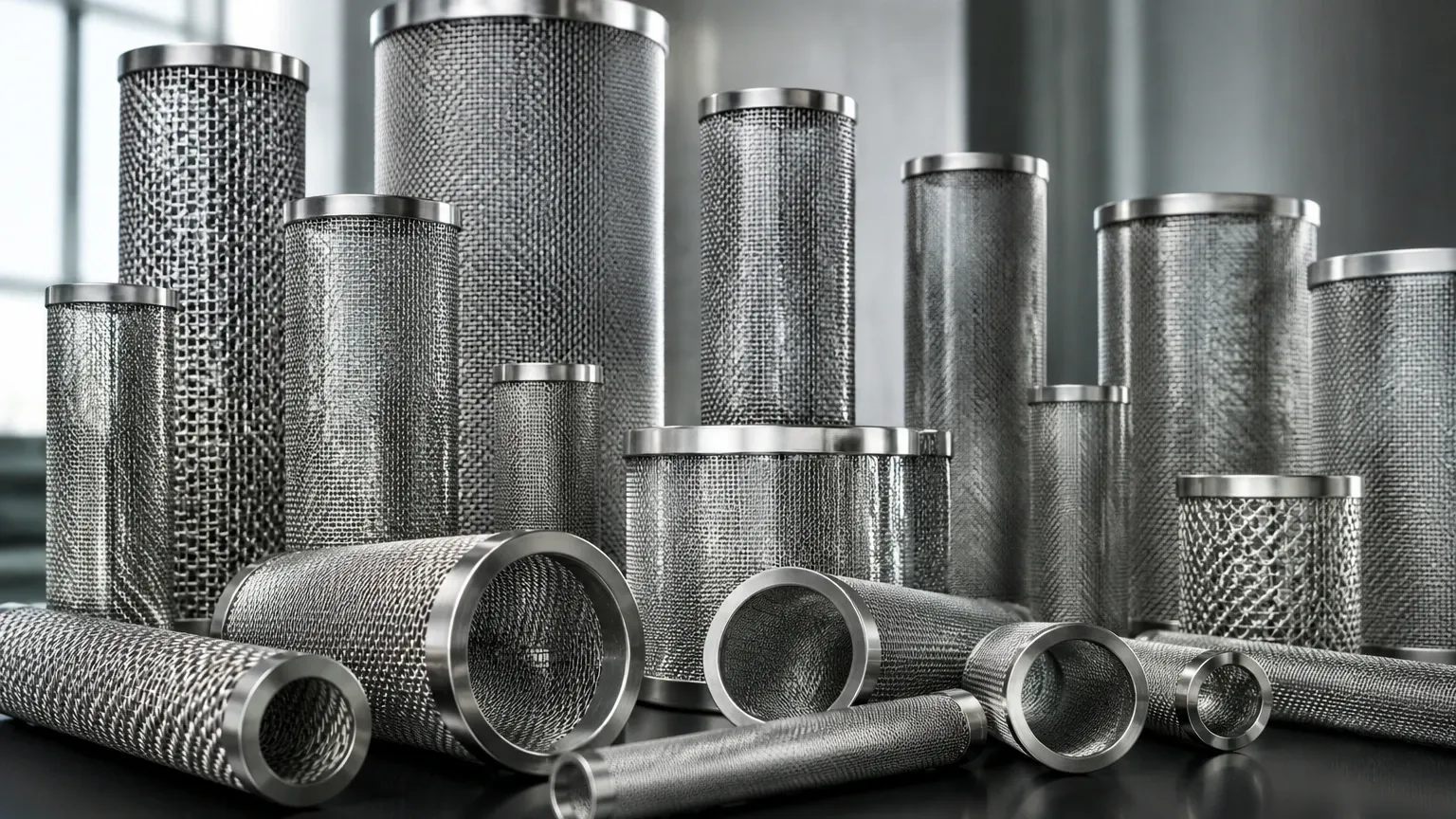
Understanding the conversion of 5 micron to mesh is not merely a mathematical exercise; it is a critical step in specifying the correct Wire Mesh Filter Cylinders & Tubes for demanding applications. This guide provides a technical overview of the relationship between these units, the engineering constraints of fine-mesh filtration, and the selection criteria necessary for optimizing industrial filtration systems.
Understanding the Conversion: From 5 Micron to Mesh
The terms "mesh" and "micron" describe the same physical property—the size of the openings in a filter medium—but they do so from different perspectives. "Mesh" refers to the number of openings per linear inch of the wire cloth. "Micron" (micrometer, μm) is a metric unit of length equal to one-millionth of a meter, representing the actual size of the particle the mesh is designed to retain.
The Inverse Relationship
As the mesh count increases, the size of the openings decreases. However, there is no universal linear formula to convert 5 micron to mesh because the aperture size is also dependent on the wire diameter. For relatively coarse filtration (above 40 microns), standard square mesh (Plain Weave) is common. For example, a 400-mesh screen typically has an aperture of approximately 37 microns.
The 5-Micron Threshold
Achieving a 5-micron rating with a single layer of standard square weave is physically impossible using traditional stainless steel wire drawing and weaving techniques. To reach the 5-micron level, manufacturers utilize Twilled Dutch Weave (TDW) or Plain Dutch Weave (PDW). In these configurations, the "mesh count" is expressed in two numbers (e.g., 325 x 2300).
In a 5-micron Twilled Dutch Weave, the warp wires and weft wires are driven tightly together, creating a tortuous path for the fluid. A common mesh specification for a 5-micron nominal rating is approximately 325 x 2300 mesh. Because the openings are triangular and microscopic, the traditional "open area" percentage used for coarse mesh is replaced by flow rate and pressure drop calculations.
Material Science and Structural Integrity of Filter Cylinders
When specifying Wire Mesh Filter Cylinders & Tubes for 5-micron applications, material selection is as vital as the filtration rating. The fine wires required for 5-micron filtration are delicate and must be supported by robust structures or manufactured from high-performance alloys.
Stainless Steel Grades
* Grade 304: The standard for general industrial use, offering good corrosion resistance and mechanical strength.
* Grade 316L: Preferred for chemical processing and marine environments due to the addition of molybdenum, which enhances resistance to pitting and chloride corrosion. The "L" (low carbon) designation is critical for filter cylinders that require extensive welding, as it prevents carbide precipitation during the manufacturing process.
* Specialty Alloys: For extreme environments involving high temperatures or highly acidic fluids, alloys such as Hastelloy, Inconel, or Monel may be utilized to ensure the longevity of the 5-micron mesh.
Structural Support and Sintering
A single layer of 5-micron Dutch weave lacks the mechanical strength to withstand high differential pressures. Consequently, these fine meshes are often integrated into multi-layer structures. Sintered wire mesh is a common solution, where the 5-micron filtration layer is diffusion-bonded to coarser support layers (such as 60 mesh or 100 mesh) and a perforated metal core. This process creates a monolithic structure that maintains its 5-micron rating even under high-pressure pulses or backwashing cycles.
Selecting the Right Filter for 5-Micron Applications
Engineers must distinguish between "Nominal" and "Absolute" ratings when discussing 5 micron to mesh conversions. A nominal rating indicates the filter can trap a large percentage of particles of that size, while an absolute rating (often validated via the Glass Bead Test or Multi-pass Test) implies that 99.9% or more of particles at that size are retained.
Fluid Characteristics and Viscosity
The flow resistance of a 5-micron mesh is significantly higher than that of a 100-micron mesh. If the fluid has a high viscosity (such as heavy oils or polymers), the pressure drop (ΔP) across the filter will increase rapidly. Designers must calculate the clean pressure drop to ensure the system pump can handle the resistance without cavitating or triggering a bypass valve prematurely.
Particle Loading and Surface Area
Fine mesh filters are susceptible to "blinding" or surface clogging if the fluid contains a high concentration of deformable or gelatinous particles. To mitigate this, Wire Mesh Filter Cylinders & Tubes can be designed with pleated geometries. Pleating increases the effective filtration surface area by 3 to 5 times compared to a standard cylindrical design, thereby extending the time between cleaning cycles and reducing the velocity of the fluid through the mesh (flux rate).
Installation and Operational Constraints in Industrial Systems
Integrating a 5-micron filter into an existing industrial circuit requires careful attention to the mechanical interface. Even the highest quality 5-micron mesh will fail to perform if the bypass seals are inadequate.
Sealing Mechanisms
For high-precision filtration, the seal between the filter cylinder and the housing is a common failure point. Engineers should specify:
* O-Rings: Typically Viton, EPDM, or PTFE, depending on chemical compatibility.
* Metal Gaskets: Used in high-temperature applications where elastomers would degrade.
* Welded End Caps: For permanent installations, welding the mesh directly to the flange ensures zero-bypass performance.
Flow Direction
Most Wire Mesh Filter Cylinders & Tubes are designed for outside-in flow, where the contaminant is trapped on the exterior surface. This allows for easier visual inspection and manual cleaning. However, in certain hydraulic or specialized chemical reactors, inside-out flow is required to prevent the collapse of the mesh under pressure. In these cases, internal support cages or perforated tubes are mandatory to prevent the 5-micron mesh from deforming.
Maintenance, Cleaning, and Replacement Cycles
One of the primary advantages of stainless steel wire mesh over disposable polymer filters is cleanability. However, cleaning a 5-micron mesh requires more sophisticated methods than simple rinsing.
Determining Replacement Cycles
The replacement or cleaning cycle is typically dictated by the terminal pressure drop. For most industrial systems, a differential pressure of 15-25 PSI indicates that the filter is loaded and requires attention. Continuous operation beyond the rated terminal ΔP can lead to "media migration" or structural failure of the mesh.
Cleaning Techniques
* Ultrasonic Cleaning: This is the most effective method for 5-micron mesh. High-frequency sound waves create cavitation bubbles that dislodge microscopic particles from deep within the Dutch weave.
* Backwashing: Automated systems use a reverse flow of clean fluid or compressed air to blow particles off the surface. This is effective for surface-loading contaminants but may not remove particles deeply embedded in a twilled weave.
* Chemical Cleaning: Soaking the filter in specialized solvents or acids can dissolve organic or mineral scales that mechanical cleaning cannot reach.
Customization and OEM Procurement for International Buyers
When sourcing Wire Mesh Filter Cylinders & Tubes for a 5-micron application, providing a manufacturer with a generic "5 micron" requirement is often insufficient. To ensure the component meets the technical demands of the project, international buyers should confirm the following data points with their supplier:
1. Micron Rating Type: Is the 5-micron requirement Nominal or Absolute?
2. Mesh Configuration: Will the filter utilize Twilled Dutch Weave or a Sintered Multi-layer structure?
3. Operating Environment: What is the maximum operating temperature and the chemical composition of the fluid?
4. Pressure Parameters: What is the maximum working pressure and the allowable clean pressure drop?
5. Dimensional Tolerances: For OEM applications, precise tolerances on the diameter and length of the cylinder are required to ensure a proper fit within the housing.
By focusing on these technical boundaries, engineers can move beyond the simplified 5 micron to mesh conversion and develop a filtration solution that balances precision, durability, and cost-effectiveness. Whether for pharmaceutical processing, high-pressure hydraulics, or fine chemical production, the correct specification of wire mesh components is the foundation of process reliability.
