


In the field of industrial filtration, the specification of wire mesh requires a precise understanding of the relationship between mesh count and metric dimensions. When engineers discuss 6 mesh mm configurations, they are typically navigating the transition between standard US mesh sizes and the metric aperture requirements necessary for coarse filtration or structural support in Wire Mesh Filter Cylinders & Tubes. 6 mesh represents a relatively coarse grade of wire cloth, characterized by six openings per linear inch, which translates to specific physical properties that dictate its performance in hydraulic, chemical, and water treatment systems.
This guide examines the technical parameters of 6 mesh stainless steel components, focusing on the engineering calculations, material selection, and structural considerations essential for procurement and system integration.
Technical Specifications of 6 Mesh Configurations
To accurately specify a filter component, an engineer must look beyond the simple mesh count. The term "6 mesh" defines the frequency of the weave, but the actual filtration capability—the aperture—is determined by the diameter of the wire used.
The Relationship Between Mesh and Millimeters
In a 6 mesh specification, the distance from the center of one wire to the center of the next (the pitch) is approximately 4.23 mm (25.4 mm divided by 6). However, the clear opening, or aperture, is the pitch minus the wire diameter.
Common wire diameters for 6 mesh industrial screens include:
* 0.90 mm (0.035"): Resulting in an aperture of approximately 3.33 mm.
* 1.20 mm (0.047"): Resulting in an aperture of approximately 3.03 mm.
* 1.60 mm (0.063"): Resulting in an aperture of approximately 2.63 mm.
When evaluating 6 mesh mm requirements, the percentage of open area is a critical metric. A thinner wire increases the open area, reducing pressure drop across the filter, but it also reduces the mechanical strength and the lifespan of the cylinder under high-pressure pulses. Conversely, a thicker wire provides a robust framework suitable for heavy-duty debris recovery but restricts flow velocity.
Engineering Wire Mesh Filter Cylinders & Tubes
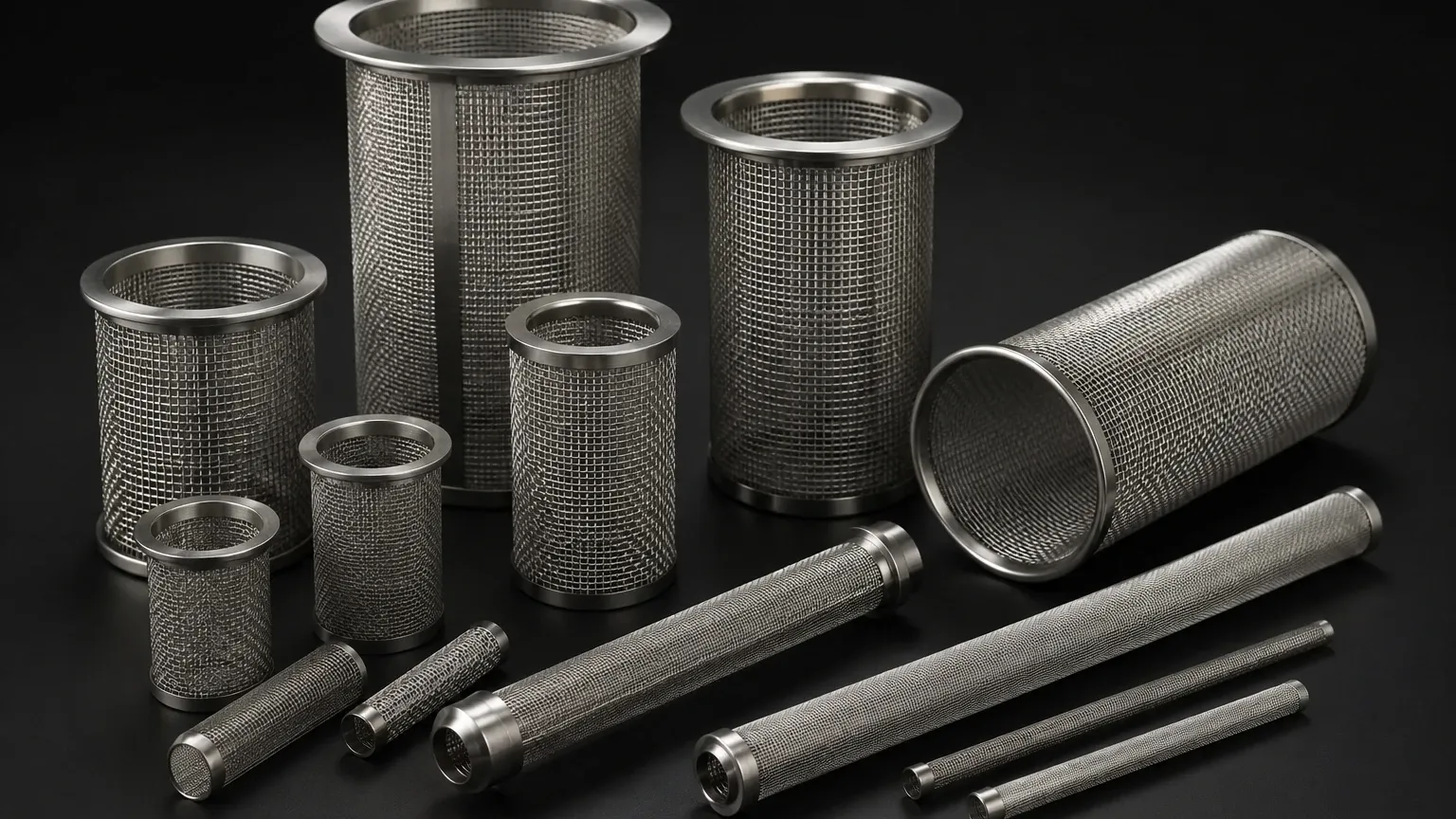
Converting flat 6 mesh cloth into functional Wire Mesh Filter Cylinders & Tubes involves complex fabrication processes that must maintain the integrity of the aperture while ensuring the structural stability of the final component. These cylinders are often used as primary strainers or as internal support cores for finer mesh layers.
Structural Integrity and Reinforcement
Because 6 mesh is relatively coarse, the wire used is typically thick enough to provide some inherent rigidity. However, in high-flow industrial applications, additional reinforcement may be required. This can include:
1. Perforated Metal Backing: A perforated stainless steel tube provides the primary mechanical strength, while the 6 mesh layer is wrapped around it to act as the filtration media.
2. Internal/External Ribbing: For long tubes, longitudinal or circumferential ribs prevent the mesh from collapsing under vacuum or bursting under internal pressure.
3. Multi-Layer Sintering: In specialized cases, the 6 mesh is sintered with other layers to create a composite plate that is then rolled and welded into a cylinder. This prevents wire migration and ensures a fixed pore size.
Welding and Seam Integrity
The longitudinal seam of a filter tube is its most vulnerable point. For 6 mesh stainless steel, TIG (Tungsten Inert Gas) welding or plasma welding is preferred. These methods provide a clean, continuous fusion that is as strong as the parent material. Spot welding may be used for temporary positioning or for overlapping seams where high-pressure resistance is not the primary concern.
Material Selection for Industrial Filtration
Choosing the correct alloy is as important as the mesh size. Most industrial Wire Mesh Filter Cylinders & Tubes are fabricated from austenitic stainless steel due to its balance of corrosion resistance and formability.
Grade 304 Stainless Steel
304 is the standard industrial grade, providing excellent resistance to atmospheric corrosion and many organic and inorganic chemicals. It is frequently used in food and beverage processing where sanitation is required but chloride exposure is limited.
Grade 316L Stainless Steel
For more demanding environments, such as marine applications, chemical processing, or pharmaceutical manufacturing, 316L (low carbon) is the preferred choice. The addition of molybdenum enhances resistance to pitting and crevice corrosion in chloride-rich environments. The "L" designation ensures that the material remains resistant to intergranular corrosion after welding, which is vital for the longevity of the filter seams.
Specialty Alloys
In high-temperature or highly acidic environments, engineers may specify Duplex stainless steel or Monel. These materials are selected when standard 300-series steels would suffer from stress corrosion cracking or rapid thinning.
Flow Dynamics and Pressure Drop Considerations
In B2B industrial procurement, the performance of a filter is measured by its impact on the overall system's efficiency. When integrating a 6 mesh mm component, engineers must calculate the clean pressure drop ($ΔP$).
Calculating Open Area
The formula for open area percentage ($OA$) is:
$$OA = (A / (A + d))^2 \times 100$$
Where $A$ is the aperture and $d$ is the wire diameter.
For a 6 mesh screen with a 0.9 mm wire and a 3.33 mm aperture, the open area is approximately 62%. This high open area makes it an excellent choice for intake screens or high-volume water filtration where the goal is to remove large particulates (such as gravel, scale, or biological debris) without significantly taxing the pump system.
Velocity and Turbulence
The interstitial velocity—the speed at which the fluid passes through the mesh openings—must be controlled. If the velocity is too high, it can lead to "wire drawing" or erosion of the mesh, especially if the fluid contains abrasive particles. For 6 mesh cylinders, maintaining a laminar flow profile where possible helps extend the service life of the component.
Industrial Applications for 6 Mesh Components
While finer meshes are used for polishing fluids, 6 mesh serves as the "first line of defense" in many industrial processes.
* Cooling Water Intake: Power plants and manufacturing facilities use large 6 mesh tubes to prevent fish, leaves, and large debris from entering heat exchangers.
* Chemical Pre-filtration: Protecting expensive downstream catalysts or high-pressure pumps from large scale or undissolved solids.
* Food Processing: Straining large particles in bulk ingredient handling, such as separating pulp or seeds in juice production.
* Hydraulic Suction Filters: Preventing large metal fragments or contaminants from entering the hydraulic pump from the reservoir.
Procurement Guide: Confirming Specifications
When sourcing Wire Mesh Filter Cylinders & Tubes for international projects, buyers must provide a comprehensive data sheet to ensure the component meets the application's demands. Ambiguity in the "6 mesh mm" specification can lead to significant operational failures.
Essential Information for RFQs
1. Exact Aperture or Wire Diameter: Do not simply state "6 mesh." Specify the required wire diameter or the target aperture in millimeters to ensure the flow and filtration levels are met.
2. Dimensional Tolerances: Define the acceptable variance in cylinder diameter and length. For slip-fit installations, tight tolerances (e.g., +/- 0.5 mm) are often necessary.
3. End Fitting Configuration: Specify if the cylinder requires open ends, closed ends with end caps, flanged connections, or threaded fittings. End caps should be welded, not just crimped, for industrial durability.
4. Material Certification: Request Mill Test Reports (MTRs) to verify the chemical composition of the stainless steel, particularly for 316L applications.
5. Cleaning Requirements: Indicate if the filters need to be ultrasonically cleaned or passivated before shipping, especially for pharmaceutical or food-grade applications.
Maintenance and Replacement Cycles
The durability of 6 mesh stainless steel allows for repeated cleaning, which lowers the total cost of ownership compared to disposable filter elements. However, a replacement schedule must be established based on the following factors:
* Mechanical Wear: Regular inspection for broken wires or thinning due to abrasion.
* Deformation: If the cylinder shows signs of "necking" or bulging, it indicates that the differential pressure has exceeded the structural limits of the mesh.
* Permanent Fouling: In some chemical applications, scales may form that cannot be removed by backwashing or chemical cleaning, necessitating a full replacement of the tube.
By focusing on the technical realities of 6 mesh mm specifications and the structural requirements of Wire Mesh Filter Cylinders & Tubes, engineering teams can ensure their filtration systems operate with maximum reliability and minimal downtime. Precise material selection, combined with rigorous fabrication standards, remains the cornerstone of effective industrial fluid management.
