


7 Mesh Filter
In industrial filtration, the selection of the correct mesh size is a critical engineering decision that directly impacts system efficiency, equipment longevity, and operational costs. A 7 mesh filter occupies a specific niche in the filtration spectrum, primarily serving as a robust coarse filter or a high-strength pre-filtration stage. While finer meshes are used for clarifying fluids, the 7 mesh specification is engineered for high-flow environments where large particulate matter must be removed without inducing significant pressure drops.
For engineers and procurement professionals, understanding the technical nuances of 7 mesh—from its physical aperture dimensions to its structural performance in Wire Mesh Filter Cylinders & Tubes—is essential for optimizing industrial processes. This guide provides a technical deep dive into the specifications, applications, and selection criteria for 7 mesh filtration solutions.
Technical Specifications of 7 Mesh Filters
The term "mesh" refers to the number of openings per linear inch of the wire cloth. A 7 mesh filter contains seven openings and seven wires within one inch (25.4 mm). However, the mesh count alone does not define the filtration capability; the wire diameter and the resulting aperture size are the primary variables that dictate performance.
Aperture and Wire Diameter
In a standard 7 mesh configuration, the wire diameter typically ranges from 0.028 inches (0.71 mm) to 0.047 inches (1.20 mm), depending on the required structural strength.
* Aperture Calculation: If we use a standard wire diameter of 0.035 inches (0.89 mm), the calculation for the opening size is as follows: (1 inch / 7) – 0.035 inches = 0.1079 inches.
* Metric Conversion: This results in an aperture of approximately 2.74 mm (2740 microns).
Open Area Percentage
The open area is a critical metric for determining flow capacity and the rate of pressure buildup. For a 7 mesh filter with 0.035-inch wire, the open area is approximately 57%. This high percentage of open area allows for significant fluid throughput with minimal resistance, making it ideal for high-volume intake systems and heavy-duty industrial strainers.
Structural Design: Wire Mesh Filter Cylinders & Tubes
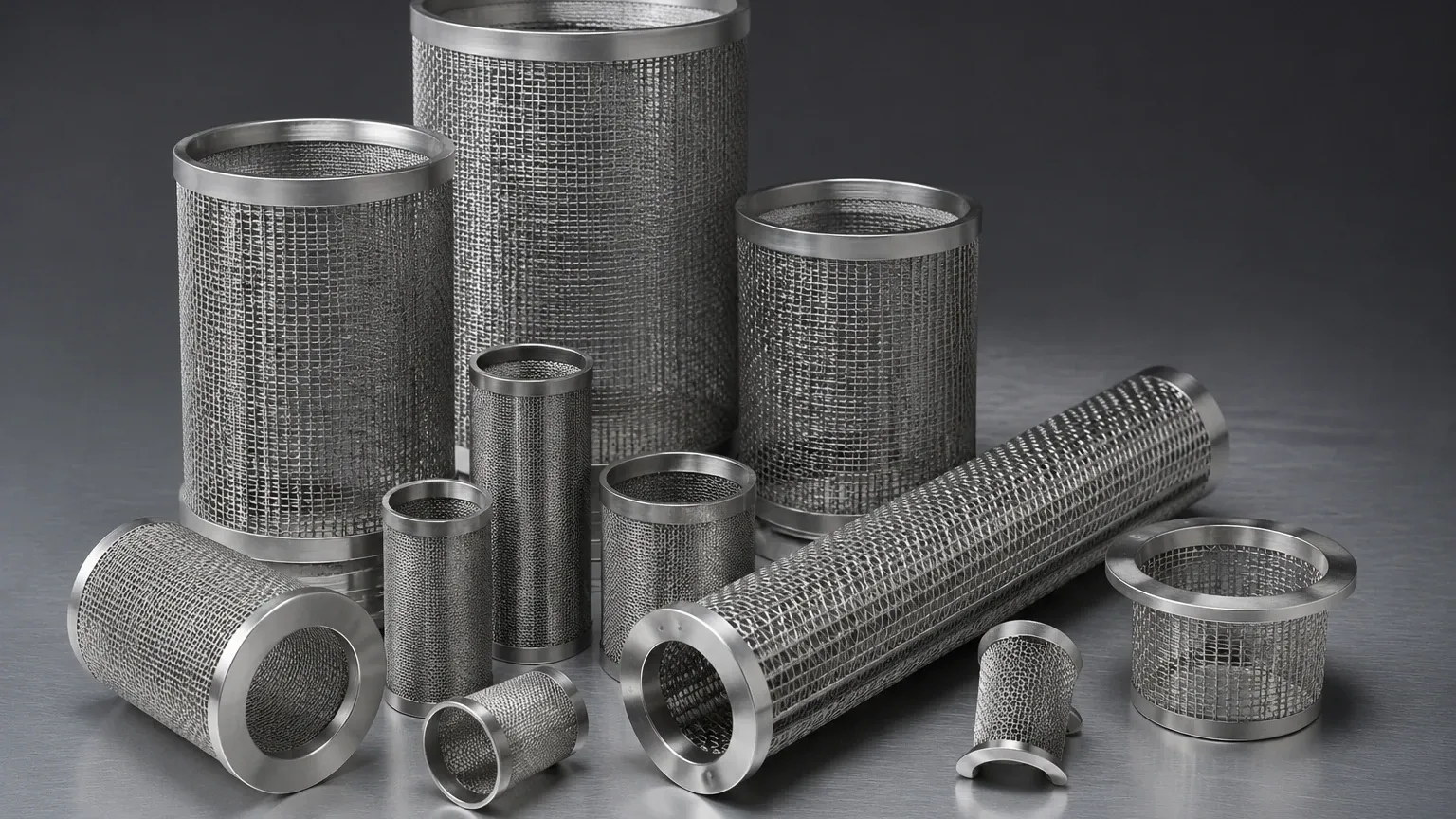
When a 7 mesh filter is integrated into an industrial system, it is rarely used as a flat sheet. Instead, it is often fabricated into Wire Mesh Filter Cylinders & Tubes to maximize surface area and structural rigidity.
Reinforcement and Support
Because 7 mesh is relatively coarse, the wires are thicker and provide inherent stability. However, in high-pressure hydraulic or chemical processing applications, the mesh is often supported by a perforated metal core or an external cage. This multi-layer construction ensures that the filter media does not deform under the mechanical stress of high differential pressures.
Fabrication Techniques
* Seam Welding: For cylindrical filters, longitudinal seams are typically joined using TIG (Tungsten Inert Gas) or plasma welding. This ensures a leak-proof bond that maintains the integrity of the filtration rating across the entire surface.
* End Caps and Fittings: Custom end caps—ranging from NPT threaded fittings to flange mounts—are welded to the tubes to facilitate easy installation into existing piping manifolds.
Material Selection for Industrial Environments
The performance of a 7 mesh filter is heavily dependent on the alloy used in its construction. Since these filters are often exposed to abrasive particles and corrosive fluids, material selection is a primary engineering constraint.
Stainless Steel 304
SS304 is the most common material for 7 mesh filters due to its excellent balance of cost and corrosion resistance. It is suitable for most water treatment, food processing, and general industrial applications where extreme chemical exposure is not a factor.
Stainless Steel 316L
For more demanding environments, such as marine applications, pharmaceutical processing, or chemical handling, SS316L is the preferred choice. The addition of molybdenum provides enhanced resistance to pitting and crevice corrosion, especially in chloride-rich environments. The "L" (Low Carbon) designation ensures that the material remains resistant to intergranular corrosion after welding, which is vital for the longevity of Wire Mesh Filter Cylinders & Tubes.
Exotic Alloys
In specialized cases involving high temperatures or highly acidic media, alloys such as Monel, Inconel, or Hastelloy may be utilized. These materials maintain their mechanical properties at temperatures exceeding 1000°F (537°C) and resist oxidation in aggressive chemical baths.
Primary Applications of 7 Mesh Filtration
Due to its coarse aperture (approx. 2.7mm), the 7 mesh filter is not intended for fine clarification. Instead, it serves as a critical protective component in various industrial sectors.
1. Pump and Valve Protection
In water intake systems from rivers or reservoirs, a 7 mesh filter acts as a primary screen to prevent large debris, stones, and organic matter from entering the pump housing. This prevents mechanical damage to impellers and ensures that downstream valves do not become clogged or stuck.
2. Pre-filtration for Fine Media
In complex filtration trains, 7 mesh is used as the first stage. By removing large particulates, it reduces the solids loading on more expensive, finer secondary filters (such as 100 mesh or pleated cartridges). This extends the service life of the fine media and reduces the frequency of system shutdowns for cleaning.
3. Food and Beverage Processing
In the processing of bulk food products, 7 mesh screens are used to separate larger solids from liquids, such as removing skins or seeds during juice extraction or protecting heat exchangers from particulate fouling in dairy production.
4. Resin and Catalyst Recovery
In chemical reactors, 7 mesh cylinders are often used to retain catalyst beads or ion-exchange resins while allowing the liquid product to flow through. The robust nature of the 7 mesh ensures it can withstand the weight and abrasive nature of the resin bed.
Engineering Considerations for Selection
When specifying a 7 mesh filter, engineers must look beyond the mesh count and consider the total cost of ownership and operational reliability.
Pressure Drop (Delta P)
The pressure drop across a clean 7 mesh filter is typically very low. However, as particles accumulate, the effective open area decreases, and Delta P increases. Engineers must calculate the maximum allowable pressure drop before the filter requires cleaning. If the system operates near the mechanical limit of the mesh, a reinforced support structure is mandatory.
Flow Velocity
High fluid velocities can lead to "wire drawing" or erosion of the mesh over time, especially if the fluid contains abrasive sand or metal shavings. Selecting a thicker wire diameter for the 7 mesh can mitigate this risk, although it will slightly reduce the open area.
Customization Requirements
Standard sizes often do not fit specialized machinery. When sourcing Wire Mesh Filter Cylinders & Tubes, buyers should confirm the manufacturer's ability to provide custom lengths, diameters, and mounting configurations. Precision in the outer diameter (OD) and inner diameter (ID) is crucial for ensuring a proper seal within the filter housing.
Maintenance and Cleaning Protocols
One of the primary advantages of stainless steel 7 mesh filters is their cleanability. Unlike disposable synthetic filters, metal mesh can be refurbished multiple times.
* Backwashing: In automated systems, reversing the flow of the fluid can dislodge particles trapped on the surface of the mesh. The large openings of the 7 mesh make backwashing highly effective.
* Ultrasonic Cleaning: For stubborn contaminants or biological films, ultrasonic baths can be used to vibrate particles loose from the wire intersections without damaging the mesh structure.
* Chemical Cleaning: Stainless steel filters can be cleaned with caustic or acidic solutions to remove scale or organic buildup, provided the alloy is compatible with the cleaning agent.
Conclusion for International Buyers
Selecting a 7 mesh filter requires a balance of material science and mechanical engineering. For international procurement teams, the focus should be on verifying the quality of the wire cloth and the precision of the fabrication process.
When requesting a quote for 7 mesh filter components, ensure you provide the following data points to the manufacturer:
1. Exact Fluid Composition: To determine the correct alloy (e.g., SS304 vs. SS316L).
2. Flow Rate and Operating Pressure: To determine if the filter requires a reinforced core.
3. Particle Characteristics: The size and nature (abrasive, sticky, or fibrous) of the solids being removed.
4. Dimensional Constraints: Precise measurements for Wire Mesh Filter Cylinders & Tubes to ensure compatibility with existing housings.
By focusing on these technical parameters, industrial operators can ensure they receive a filtration solution that provides reliable performance, minimizes downtime, and protects critical downstream equipment.
