


Mesh Tube Filter
In industrial filtration, the efficiency of a system often depends on the structural integrity and precision of its core components. The mesh tube filter, a fundamental element in liquid and gas separation, provides a versatile solution for high-pressure and high-temperature environments. Often referred to within the industry as Wire Mesh Filter Cylinders & Tubes, these components are engineered to provide precise micron ratings while maintaining the mechanical strength necessary to withstand rigorous operational cycles. For engineers and procurement specialists, selecting the correct configuration requires an understanding of weave types, material properties, and the specific demands of the application environment.
Anatomy and Construction of a Mesh Tube Filter
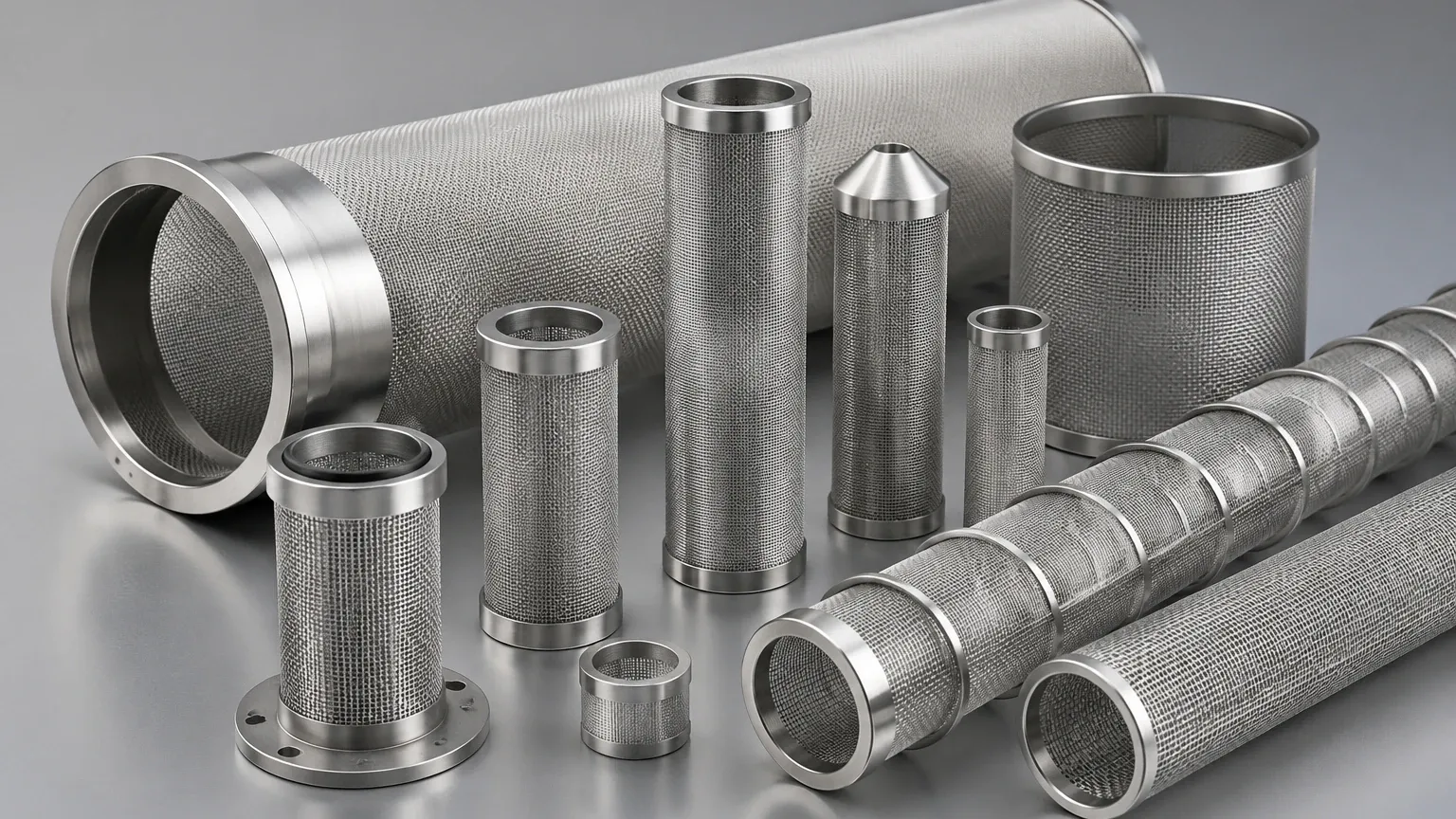
A mesh tube filter is typically constructed from one or more layers of woven wire cloth, formed into a cylindrical shape and secured through advanced welding techniques. The construction can range from a simple single-layer mesh for basic straining to complex multi-layer sintered structures for high-precision filtration.
Single-Layer vs. Multi-Layer Construction
Single-layer tubes are often used in low-pressure applications or as primary strainers where the goal is to remove large particulates. However, in more demanding industrial settings, multi-layer designs are preferred. These may include a fine filtration layer protected by coarser mesh layers on both sides to provide mechanical support and prevent the fine mesh from deforming under pressure.
Support Cores and Outer Guards
For applications involving high differential pressure, the mesh tube filter is often reinforced with an internal perforated metal core or an external cage. This reinforcement ensures that the mesh remains stable and does not collapse or burst. The choice between an internal core and an external guard depends on the flow direction—whether the fluid moves from the inside out or the outside in.
Material Engineering: Selecting the Right Alloy
The performance of a mesh tube filter is heavily dictated by its material composition. Since these filters are frequently exposed to corrosive chemicals, extreme temperatures, and high-pressure steam for sterilization, stainless steel is the industry standard.
* Stainless Steel 304: This is the most common material used for general-purpose industrial filtration. It offers good corrosion resistance and is cost-effective for applications involving water, mild chemicals, and food products.
* Stainless Steel 316L: For more aggressive environments, 316L is the preferred choice. The addition of molybdenum enhances its resistance to pitting and crevice corrosion, particularly in chloride-rich environments. The "L" denotes low carbon content, which improves weldability and prevents intergranular corrosion in the heat-affected zones of the filter seams.
* Specialized Alloys: In extreme cases, such as highly acidic chemical processing or high-temperature aerospace applications, alloys like Inconel, Monel, or Hastelloy may be employed to ensure the longevity of the mesh tube filter.
Weave Patterns and Their Impact on Filtration
The weave pattern of the wire cloth determines the filtration accuracy, flow resistance, and cleaning characteristics of the mesh tube filter. Engineers must choose the weave that best balances these three factors.
Plain Square Weave
This is the simplest weave, where each warp wire passes over and under each shute wire. It provides high flow rates and is easy to clean, making it ideal for coarse filtration and straining. However, it lacks the density required for fine micron ratings.
Dutch Weave (Plain and Twilled)
Dutch weaves use different diameters for the warp and shute wires, resulting in a much denser mesh.
* Plain Dutch Weave: Offers a high strength-to-micron ratio and is excellent for high-pressure filtration.
* Twilled Dutch Weave: Allows for the smallest pore sizes (down to 1–5 microns) by passing wires over and under two wires at a time. This creates a complex, tortuous path for particles, providing superior filtration efficiency for fine contaminants.
Sintered Wire Mesh
For the most demanding applications, individual layers of wire mesh are sintered—bonded together using heat and pressure without melting. This process creates a monolithic structure where the wires cannot shift, ensuring a consistent micron rating and exceptional mechanical strength. Sintered mesh tube filters are highly resistant to abrasion and can be backwashed repeatedly without losing their shape.
Technical Performance Metrics
When evaluating a mesh tube filter for a specific system, several technical parameters must be quantified to ensure compatibility and efficiency.
Micron Rating: Absolute vs. Nominal
It is critical to distinguish between nominal and absolute micron ratings. A nominal rating refers to the ability of the filter to retain a major percentage of particles of a certain size. In contrast, an absolute rating indicates the diameter of the largest spherical particle that can pass through the mesh. For critical pharmaceutical or chemical processes, absolute-rated Wire Mesh Filter Cylinders & Tubes are necessary to guarantee product purity.
Pressure Drop and Flow Rate
The pressure drop (delta P) across a filter is the difference in pressure between the upstream and downstream sides. A well-designed mesh tube filter minimizes this drop to reduce energy consumption and pump wear. The flow rate is influenced by the open area of the mesh; a higher open area allows for more fluid to pass through but may compromise the structural strength if not properly supported.
Dirt Holding Capacity
This metric refers to the amount of contaminant a filter can trap before the pressure drop reaches a critical level, signaling the need for cleaning or replacement. Multi-layer designs often provide a higher dirt-holding capacity by utilizing depth filtration principles within the mesh structure.
Customization and OEM Integration
Industrial filtration is rarely a one-size-fits-all field. Customization is often required to integrate a mesh tube filter into existing housing or to meet unique process requirements. Key customization factors include:
* End Fittings: Options include Double Open End (DOE), Single Open End (SOE) with various O-ring configurations (such as 222 or 226 connectors), threaded NPT/BSP fittings, or custom flanges.
* Dimensions: Precise control over the length, inner diameter (ID), and outer diameter (OD) is essential for ensuring a leak-proof seal within the filter housing.
* Seam Construction: High-quality filters utilize plasma or TIG welding to create a butt weld seam that is as strong as the parent material and free of burrs or gaps that could bypass contaminants.
Maintenance, Cleaning, and Total Cost of Ownership
One of the primary advantages of a stainless steel mesh tube filter over disposable polymer filters is its cleanability. While the initial investment in metal filtration is higher, the total cost of ownership is often lower due to the extended service life.
Cleaning Methods
* Backwashing: Reversing the flow of fluid through the filter to dislodge accumulated particles. This is effective for surface-loading meshes.
* Ultrasonic Cleaning: Using high-frequency sound waves in a cleaning solution to remove fine particles trapped deep within the mesh pores. This is the most effective method for Dutch weaves and sintered structures.
* Chemical Cleaning: Using acids, alkalis, or solvents to dissolve specific types of contaminants, such as organic buildup or mineral scale, followed by thorough rinsing.
Replacement Cycles
While reusable, mesh filters do have a finite lifespan. Fatigue from pressure pulsations or gradual abrasion from hard particles will eventually necessitate replacement. Regular inspection for wire displacement, seam failure, or permanent blinding (irreversible clogging) is a vital part of industrial maintenance protocols.
Industry-Specific Applications
The versatility of the mesh tube filter makes it indispensable across various sectors:
* Chemical Processing: Used for catalyst recovery, polymer filtration, and protecting downstream equipment from corrosive particulates.
* Food and Beverage: Employed in the filtration of syrups, juices, and oils. These filters must meet FDA compliance standards for food-contact materials, requiring smooth surfaces and hygienic welds.
* Pharmaceuticals: Used in the production of Active Pharmaceutical Ingredients (APIs) and sterile air filtration, where high-precision micron ratings and steam-sterilizability are mandatory.
* Hydraulic Systems: Protecting sensitive valves and pumps from metal shavings and other contaminants in high-pressure oil circuits.
Procurement Checklist for Engineers
Before finalizing a purchase or requesting a quote for a mesh tube filter, engineers should confirm the following data points to ensure the product meets application requirements:
1. Fluid Characteristics: Viscosity, temperature, and chemical compatibility with the filter material.
2. Contaminant Profile: Particle size distribution, concentration, and the nature of the solids (deformable vs. hard).
3. Operating Pressure: Maximum operating pressure and potential for pressure spikes.
4. Flow Requirements: Minimum and maximum flow rates.
5. Housing Compatibility: Exact dimensions and end-cap configuration required for a secure fit.
By focusing on these technical boundaries, organizations can procure filtration components that optimize process efficiency and minimize downtime. For detailed specifications and engineering support regarding custom configurations, technical teams are encouraged to Review product options and application support to find the most effective solution for their specific filtration challenges.
