


Engineering Guide to Stainless Steel Mesh Filter Tubes and Cylinders
In industrial process engineering, the efficiency of fluid and gas separation systems depends heavily on the mechanical integrity and filtration precision of the internal components. Among the most versatile of these components is the stainless steel mesh filter tube, a cylindrical structure engineered to withstand high differential pressures, corrosive environments, and extreme temperatures. These filters serve as critical barriers in hydraulic systems, chemical processing plants, and food production lines, where particulate contamination can lead to equipment failure or product spoilage.
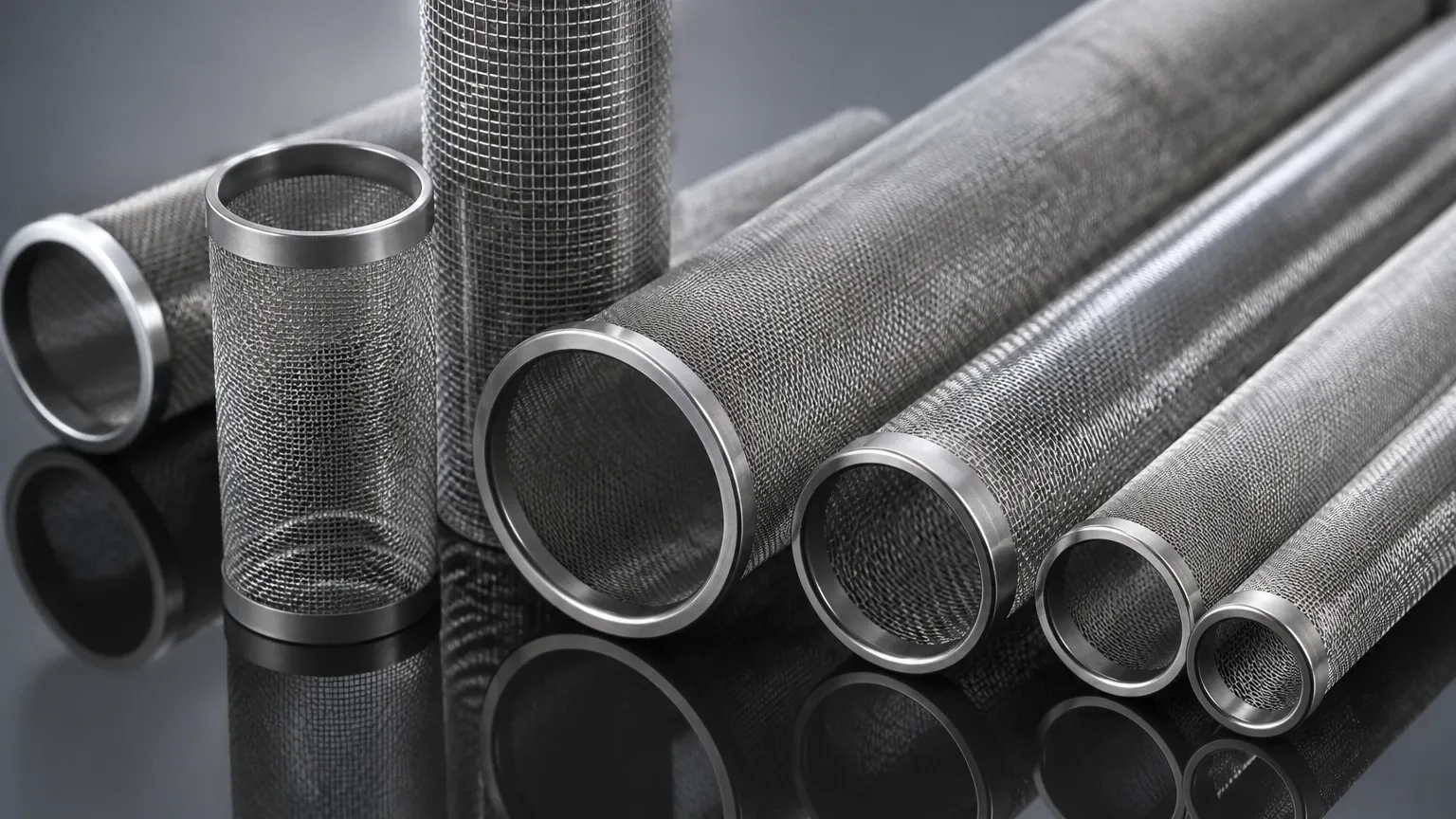
Selecting the appropriate Wire Mesh Filter Cylinders & Tubes requires an understanding of weave types, material metallurgy, and structural reinforcement methods. This guide examines the technical parameters that engineers must consider when specifying these components for demanding industrial applications.
Engineering Fundamentals of Wire Mesh Filter Cylinders & Tubes
The primary function of a mesh filter cylinder is to provide a consistent pore size for the retention of solids while maintaining a low pressure drop across the media. Unlike disposable depth filters, a stainless steel mesh filter tube utilizes surface filtration. This means particles are trapped on the surface of the wire weave, making the filter easier to clean through backwashing or ultrasonic methods.
Industrial cylinders are typically constructed using one of three methods:
1. Single-layer mesh: Used for low-pressure applications or as a secondary strainer.
2. Multi-layer sintered mesh: Multiple layers of wire cloth are bonded together through a heat-treatment process (sintering), creating a rigid, high-strength filter medium.
3. Mesh with perforated support: A thin layer of fine mesh is wrapped around or inserted into a heavy-duty perforated metal tube to provide mechanical support against high-flow velocities.
Material Selection: Why Stainless Steel is the Standard
Material choice is the first boundary in filter design. While various alloys exist, stainless steel remains the industry standard due to its balance of mechanical strength and chemical resistance.
* AISI 304: The most common grade, suitable for water filtration and general industrial use where high-level corrosion resistance is not required.
* AISI 316L: Contains molybdenum, which provides superior resistance to chlorides and acids. This is the preferred material for pharmaceutical, marine, and chemical processing applications.
* Specialty Alloys: For highly aggressive environments, materials like Hastelloy or 904L may be used, though 316L satisfies the majority of B2B industrial requirements.
Engineers must also consider the thermal expansion coefficients of the material, especially in high-temperature steam filtration or cryogenic applications, to ensure the filter housing and the tube maintain a leak-proof seal.
Weave Types and Filtration Precision
The performance of a stainless steel mesh filter tube is determined by the weave pattern of the wire cloth. The weave dictates the micron rating (filtration fineness) and the open area percentage, which directly impacts flow rate.
Plain Weave and Twill Weave
Plain weave is the simplest form, where wires cross over and under each other. It provides a high open area but is limited in how fine the filtration can go. Twill weave allows for thicker wires in a given mesh count, offering greater durability for medium-range filtration tasks.
Dutch Weave (Plain and Twill)
Dutch weaves utilize different diameters for the warp and shute wires. This results in a much denser structure with smaller triangular openings. Plain Dutch weave is excellent for high-pressure filtration, while Twill Dutch weave allows for the finest micron ratings (down to 5–10 microns) by overlapping multiple wires in a dense matrix.
Reverse Dutch Weave
In this configuration, the positions of the thick and thin wires are reversed. This creates a filter media that is exceptionally strong and easy to clean, often used in continuous polymer filtration or high-pressure sand control applications.
Structural Reinforcement for High-Pressure Applications
A common failure point in industrial filtration is the mechanical collapse of the filter media due to excessive differential pressure ($ΔP$). To prevent this, Wire Mesh Filter Cylinders & Tubes are often engineered with structural reinforcements.
* Internal Support Cores: A perforated stainless steel tube or a heavy-duty spring core is placed inside the mesh cylinder. This is essential for "outside-in" flow directions, where the fluid pressure pushes the mesh toward the center.
* External Cages: For "inside-out" flow, an external perforated cage prevents the mesh from expanding and bursting.
* Sintering: By diffusion-bonding the mesh layers, the individual wires are locked in place. This prevents "pore migration," where the openings in the mesh stretch under pressure, allowing oversized contaminants to pass through.
Customization and OEM Integration
Industrial applications rarely follow a one-size-fits-all approach. Customization is a critical factor for engineers who need to integrate filtration components into existing machinery. When specifying a custom stainless steel mesh filter tube, the following dimensions and features must be defined:
1. End Fittings: Options include threaded connectors (NPT/BSP), flanged ends, DOE (Double Open End) with gaskets, or SOE (Single Open End) with various O-ring configurations (e.g., 222 or 226 fittings).
2. Seam Welding: High-quality tubes utilize longitudinal plasma or TIG welding. This ensures that the seam is as strong as the parent material and maintains a consistent diameter for easy installation.
3. Pleating: To increase the surface area within the same footprint, the mesh can be pleated. A pleated stainless steel mesh filter tube can offer up to 2–3 times the filtration area of a smooth cylinder, significantly extending the time between cleaning cycles.
Maintenance, Cleaning, and the Lifecycle of the Filter
One of the primary B2B advantages of stainless steel media over polymer or paper alternatives is the total cost of ownership (TCO). While the initial investment is higher, the ability to regenerate the filter through cleaning makes it more cost-effective over time.
Cleaning Protocols
* Backwashing: Reversing the flow of the fluid to dislodge surface cake.
* Ultrasonic Cleaning: Using high-frequency sound waves in a solvent bath to remove fine particles trapped deep within the weave (especially effective for Dutch weaves).
* Chemical Cleaning: Using mild acids or bases to dissolve organic or mineral scaling, provided the chemical is compatible with the stainless steel grade.
Replacement Indicators
Engineers should monitor the "terminal pressure drop." Once the $ΔP$ reaches a predetermined limit (often 20–30 psi depending on the system), the filter must be cleaned. If the pressure drop remains high after a thorough cleaning, it indicates that the mesh has become permanently fouled or mechanically deformed, and the tube must be replaced.
Technical Specifications for Procurement
When contacting a manufacturer for Wire Mesh Filter Cylinders & Tubes, purchasing teams and engineers should have a technical data sheet ready. This ensures the quoted product will meet the operational demands of the site.
| Parameter | Description/Options |
| :— | :— |
| Micron Rating | Absolute or Nominal (e.g., 20μm, 50μm, 100μm) |
| Flow Direction | Outside-to-Inside or Inside-to-Outside |
| Operating Temp | Maximum and minimum process temperatures |
| Fluid Chemistry | pH levels, presence of chlorides, or oxidizing agents |
| Mechanical Load | Maximum expected differential pressure (ΔP) |
| Dimensions | Outer Diameter (OD), Inner Diameter (ID), and Overall Length |
Conclusion
The stainless steel mesh filter tube is a foundational component in modern industrial engineering, providing the precision required for high-purity processes and the durability needed for heavy-duty applications. By selecting the correct weave pattern, material grade, and structural reinforcement, facilities can optimize their filtration performance, protect downstream equipment, and reduce long-term operational costs. Whether used in simple strainers or complex hydraulic systems, the engineering integrity of the wire mesh cylinder remains a key determinant of process reliability.
