


Engineering Guide to Wire Mesh Type Filters for Industrial Applications
In industrial process engineering, the selection of filtration media is a critical decision that impacts system efficiency, product purity, and long-term operational costs. Among the various technologies available, the wire mesh type filter remains a cornerstone for liquid and gas separation due to its mechanical strength, thermal stability, and precise pore geometry. Unlike disposable polymer filters, stainless steel wire mesh components offer a reusable and highly customizable solution for demanding environments.
For engineers and procurement professionals, understanding the technical nuances of these components is essential. This guide explores the operating principles, design variations, and selection criteria for industrial filtration, with a specific focus on the integration of Wire Mesh Filter Cylinders & Tubes into complex systems.
Understanding the Mechanics of the Wire Mesh Type Filter
The primary function of a wire mesh type filter is surface filtration. Unlike depth filtration, where particles are trapped within a thick matrix of fibers, surface filtration occurs on a single plane or a series of closely bonded layers. This mechanism ensures that particles larger than the mesh opening are retained on the upstream side of the filter medium.
Surface Filtration vs. Depth Filtration
In industrial applications, surface filtration with wire mesh provides several advantages:
* Predictable Performance: The geometric regularity of woven wire mesh allows for precise control over the maximum particle size that can pass through the media.
* Ease of Cleaning: Because the contaminants are collected on the surface, they can be removed relatively easily through backwashing, ultrasonic cleaning, or chemical treatment.
* Low Pressure Drop: The high open-area ratio of many mesh weaves allows for high flow rates with minimal resistance, reducing energy consumption in pumping systems.
The Role of Weave Patterns
The performance of a wire mesh type filter is largely determined by its weave pattern. Common industrial weaves include plain weave, twill weave, and various dutch weaves (plain dutch, twill dutch, and reverse dutch). Plain weaves offer the highest flow rates but are limited in how fine they can filter. Dutch weaves, characterized by a higher density of shute wires, provide much finer filtration ratings and greater mechanical strength, making them ideal for high-pressure hydraulic and chemical processes.
Material Selection and Chemical Compatibility
Industrial filtration often involves exposure to corrosive fluids, extreme temperatures, and high pressures. Consequently, material selection is the first boundary condition in the engineering process. Kaifil specializes in stainless steel solutions, which are preferred for their versatility and durability.
Stainless Steel Grades
1. AISI 304: The standard grade for general industrial use. It offers good corrosion resistance and is suitable for most food and beverage applications where high-acid or high-salt concentrations are not present.
2. AISI 316L: Containing molybdenum, 316L provides superior resistance to chlorides and acids. It is the industry standard for pharmaceutical and chemical processing where hygiene and corrosion resistance are paramount.
3. Specialty Alloys: For extreme environments involving high-temperature oxidation or highly aggressive chemicals, alloys such as Monel, Inconel, or Hastelloy may be utilized in the mesh construction.
Thermal and Mechanical Limits
Stainless steel wire mesh maintains its structural integrity at temperatures far exceeding those of synthetic filters. While polymer-based filters may fail or off-gas at temperatures above 100°C, stainless steel components can operate effectively at several hundred degrees Celsius, depending on the alloy and the structural design of the filter housing.
Technical Specifications: Micron Ratings and Mesh Geometry
When specifying a wire mesh type filter, engineers must distinguish between nominal and absolute filtration ratings. This distinction is vital for ensuring that the filter meets the required purity standards of the process.
Absolute vs. Nominal Ratings
* Absolute Rating: This refers to the diameter of the largest hard spherical particle that will pass through the filter under specified test conditions. In high-precision applications like pharmaceutical manufacturing, an absolute rating is required to guarantee the removal of specific contaminants.
* Nominal Rating: This is an indicative value representing the filter's ability to retain a majority of particles of a certain size. It is less precise than an absolute rating and is typically used for pre-filtration or less critical separation tasks.
Mesh Count and Wire Diameter
The "mesh count" refers to the number of openings per linear inch. However, mesh count alone does not define filtration accuracy. The wire diameter must also be considered, as it determines both the size of the aperture and the overall strength of the mesh. A thicker wire increases the filter's resistance to pressure but decreases the total open area, which may necessitate a larger filter surface to maintain the desired flow rate.
Structural Design: Wire Mesh Filter Cylinders & Tubes
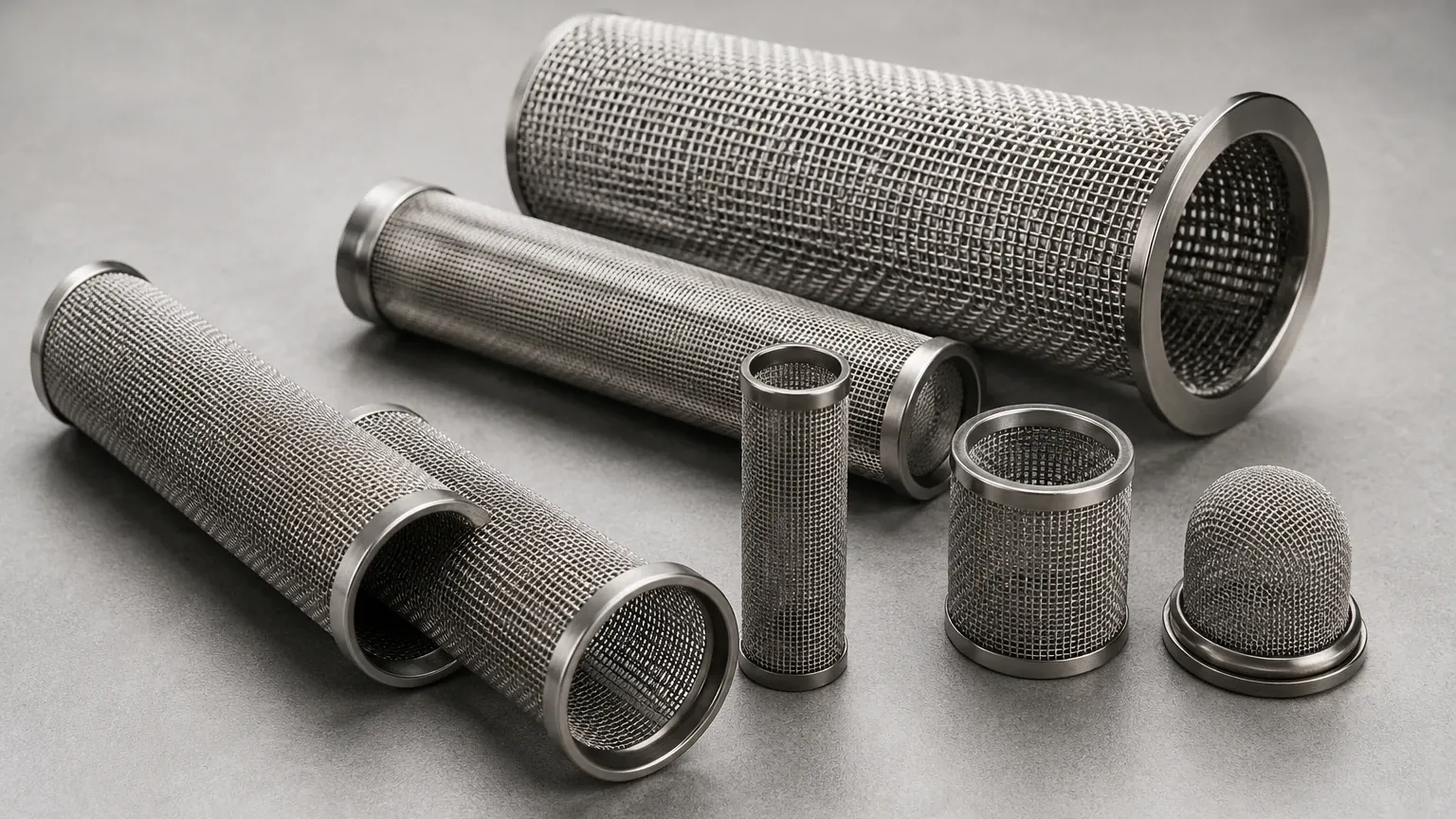
While the mesh provides the filtration capability, the structural configuration determines how the filter is integrated into the industrial system. Wire Mesh Filter Cylinders & Tubes are among the most common geometries used in industrial housings.
Single-Layer vs. Multi-Layer Construction
For low-pressure applications, a single layer of wire mesh may suffice. However, in many industrial settings, the mesh requires reinforcement to prevent deformation under high differential pressure.
* Sintered Multi-Layer Mesh: This involves bonding multiple layers of mesh together using heat and pressure. The result is a porous plate or tube that combines fine filtration layers with heavy-duty support layers, creating a rigid structure that does not require an internal support core.
* Perforated Metal Support: In many cylindrical designs, the wire mesh is wrapped around or placed inside a perforated metal tube. This provides the necessary mechanical strength to withstand high flow velocities and pressure surges.
Pleated Designs
To increase the effective filtration area within a fixed footprint, the wire mesh can be pleated. Pleating a wire mesh type filter significantly increases the dirt-holding capacity and extends the service life between cleaning cycles, which is particularly beneficial in continuous process industries.
Installation Constraints and Sealing Mechanisms
The effectiveness of even the highest-quality filter is compromised if the installation allows for fluid bypass. Proper sealing and mechanical integration are critical components of the filter design.
Connection Interfaces
Filter cylinders and tubes must interface securely with the filter housing. Common connection types include:
* Threaded Fittings (NPT/BSP): Used for smaller filters or where high-pressure integrity is required.
* Flanges: Standard for large-scale industrial piping, providing a robust and leak-proof connection.
* DOE (Double Open End) and SOE (Single Open End): These configurations often use gaskets or O-rings (made of Viton, EPDM, or PTFE) to create a compression seal against the housing seats.
Alignment and Support
In long cylindrical filters, internal or external supports are necessary to prevent vibration and mechanical fatigue. Engineers must ensure that the filter is correctly aligned within the housing to prevent uneven loading of the mesh surface, which can lead to premature failure or localized "blinding" of the filter media.
Operational Risks and Maintenance Protocols
Implementing a wire mesh filtration system requires a proactive approach to maintenance to avoid process downtime and equipment damage.
Managing Pressure Drop
The differential pressure (ΔP) across the filter is the primary indicator of its condition. As contaminants accumulate, ΔP increases. If the pressure exceeds the structural limits of the mesh, the filter may collapse or "burst," allowing unfiltered fluid to pass downstream. Automated monitoring systems are recommended to trigger cleaning cycles or system shutdowns when ΔP reaches a predetermined threshold.
Cleaning and Regeneration
One of the greatest total cost of ownership (TCO) advantages of stainless steel filters is their cleanability. Depending on the contaminant, filters can be cleaned via:
* Backwashing: Reversing the flow of fluid to dislodge surface particles.
* Ultrasonic Cleaning: Using high-frequency sound waves in a solvent bath to remove fine particles trapped deep within the mesh pores.
* Chemical Cleaning: Using acids or alkalis to dissolve organic or mineral deposits, provided the chemicals are compatible with the stainless steel grade.
Mechanical Fatigue
Repeated cleaning cycles and pressure fluctuations can eventually lead to work hardening and cracking of the wire mesh. Regular visual inspections and integrity testing (such as bubble point testing) are necessary to ensure the filter remains within specification.
Procurement Checklist for International Buyers
When sourcing custom filtration components from a manufacturer like Kaifil, providing detailed specifications ensures that the final product meets the application's demands. Buyers should confirm the following parameters:
1. Fluid Characteristics: What is the chemical composition, viscosity, and temperature of the fluid being filtered?
2. Contaminant Profile: What is the nature of the solids (hard, soft, fibrous)? What is the particle size distribution?
3. Flow Requirements: What is the minimum and maximum flow rate? What is the maximum allowable initial pressure drop?
4. Dimensional Tolerances: For custom Wire Mesh Filter Cylinders & Tubes, precise length, diameter, and wall thickness are required to ensure fitment in existing housings.
5. Certification Needs: Does the application require compliance with FDA, 3A, or ISO standards? Is material traceability (MTR) required?
By addressing these technical details during the design and procurement phase, engineers can optimize their filtration processes, reduce waste, and ensure the long-term reliability of their industrial systems. The wire mesh type filter remains an indispensable tool for achieving high-precision separation across the global industrial landscape.
