


In industrial processing, the efficiency of a filtration system is often determined not just by the media used, but by the physical configuration and ease of maintenance of the filter components. Among the various geometries available, Wire Mesh Filter Cylinders & Tubes represent a fundamental solution for liquid and gas filtration across diverse sectors, including chemical processing, food and beverage production, and hydraulic systems.
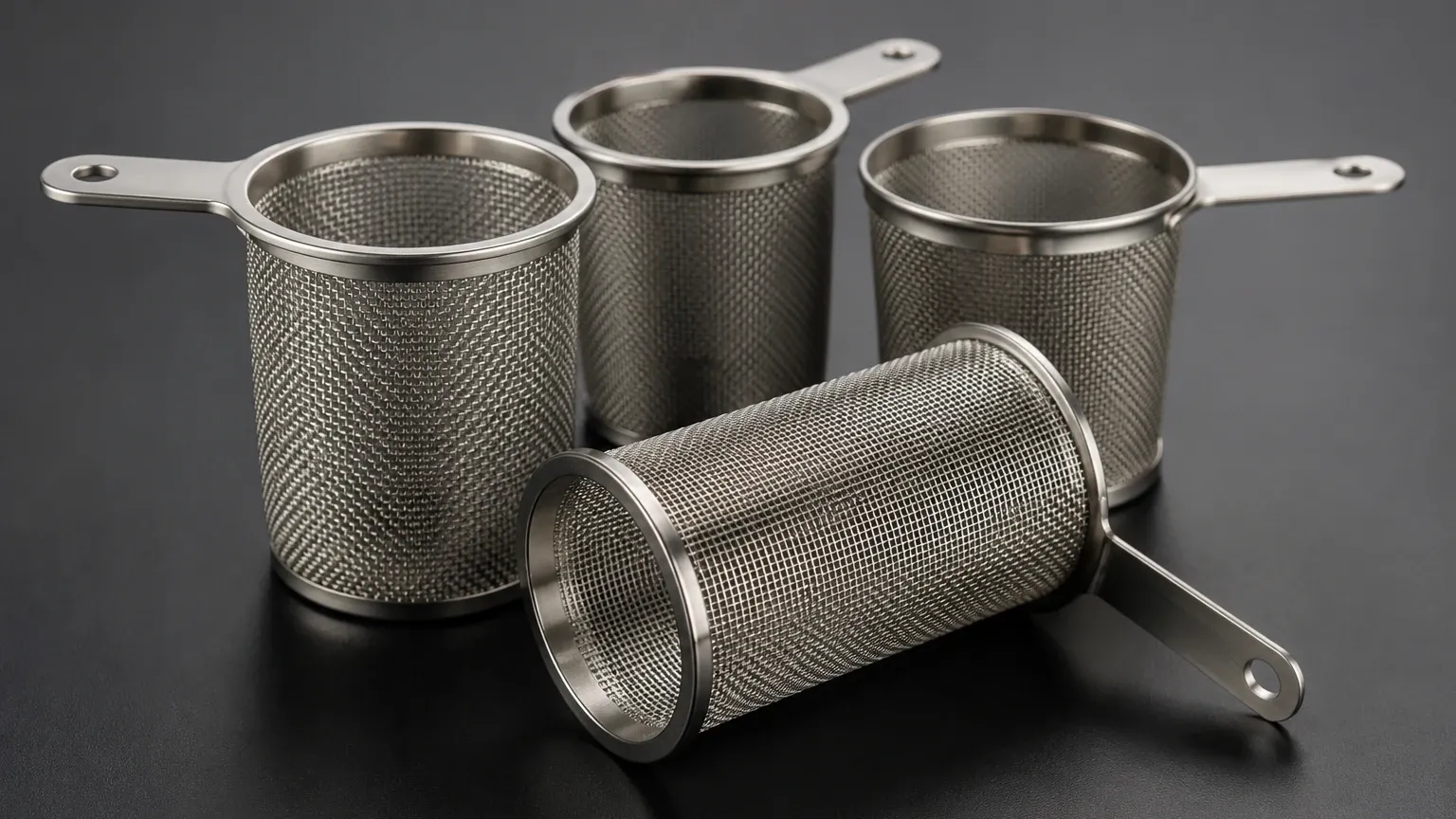
A specific variation that has gained significant traction in batch processing and manual maintenance environments is the stainless steel mesh filter with handle. This design integrates precision filtration capabilities with ergonomic features intended to reduce downtime and improve operator safety. This guide explores the technical specifications, engineering considerations, and selection criteria essential for procurement teams and engineers evaluating these components.
Understanding the Engineering of Wire Mesh Filter Cylinders & Tubes
Wire mesh filter cylinders are structural filtration elements constructed from woven wire cloth, often reinforced with perforated metal or internal supports to withstand differential pressures. The cylindrical shape is preferred in industrial engineering because it provides a high surface-area-to-volume ratio, allowing for high flow rates within a relatively compact footprint.
The performance of these cylinders is dictated by the weave type and the wire diameter. Common weaves include plain weave, twill weave, and Dutch weave. Plain weave offers high transparency and low pressure drop, making it suitable for coarse filtration. In contrast, Dutch weave provides a much finer pore structure and higher mechanical strength, ideal for high-pressure applications where precision is paramount. When these materials are formed into tubes or cylinders, the longitudinal seam is typically joined using advanced welding techniques such as TIG (Tungsten Inert Gas) or plasma welding to ensure a leak-proof and structurally sound bond that maintains the integrity of the micron rating.
Material Selection and Structural Integrity
The choice of material is the first critical decision in the engineering process. For the vast majority of industrial applications, stainless steel is the standard due to its mechanical strength and resistance to environmental degradation.
* AISI 304 Stainless Steel: This is the most common grade, offering excellent strength and basic corrosion resistance. It is suitable for water treatment, food processing, and general industrial use where aggressive chemicals are not present.
* AISI 316L Stainless Steel: Containing molybdenum, 316L provides superior resistance to chlorides and acids. This is the preferred material for marine environments, pharmaceutical manufacturing, and chemical processing plants where the filter will be exposed to corrosive cleaning agents or aggressive process fluids.
Beyond the alloy, the structural integrity of a stainless steel mesh filter with handle depends on the support layers. In high-viscosity or high-pressure systems, a single layer of fine mesh may collapse. Engineers often specify a multi-layer construction where a fine filtration mesh is sandwiched between coarser support meshes or encased in a perforated stainless steel cage. This "pleated" or "layered" approach ensures that the filter maintains its shape under the stresses of fluid dynamics.
The Functional Importance of the Stainless Steel Mesh Filter with Handle
While the mesh performs the actual separation, the inclusion of a handle is a functional design choice that addresses operational logistics. In many industrial settings, filters are housed in basket strainers or housing units that require frequent manual removal for cleaning or inspection.
A stainless steel mesh filter with handle offers several distinct advantages:
1. Operator Safety: In applications involving high temperatures or caustic fluids, a handle allows operators to extract the filter element without coming into direct contact with the filter body or the residual process fluid.
2. Ease of Maintenance: In batch processing, where the filter must be cleaned between runs, a handle facilitates rapid removal and re-installation. This reduces the "Mean Time to Repair" (MTTR) and minimizes production bottlenecks.
3. Prevention of Damage: Without a handle, operators may use improvised tools (like pliers or screwdrivers) to pry a stuck filter out of its housing. This often results in the deformation of the mesh or the end caps, compromising the filtration accuracy. Integrated handles ensure that the extraction force is applied evenly to the structural frame of the cylinder.
Handles can be designed as fixed bars, folding bails, or ergonomic grips, depending on the headspace available within the filter housing.
Filtration Performance: Micron Ratings and Flow Dynamics
When selecting Wire Mesh Filter Cylinders & Tubes, engineers must balance filtration fineness with flow requirements. The "micron rating" indicates the size of particles the mesh is designed to intercept. This is categorized into two types:
* Absolute Rating: The diameter of the largest hard spherical particle that will pass through the filter under specified test conditions. This is critical for pharmaceutical and high-purity chemical applications.
* Nominal Rating: An arbitrary micron value assigned by the manufacturer based on the weight percentage of particles of a certain size that the filter can retain. This is more common in general industrial applications.
Flow dynamics are equally important. Every filter introduces a pressure drop ($ΔP$) into the system. As the filter captures contaminants, the $ΔP$ increases. If the initial pressure drop is too high due to an undersized filter or a mesh that is too fine for the application, the system's pump efficiency will decrease, and the cleaning cycle will become prohibitively frequent. Engineers must calculate the "Effective Filtration Area" (EFA) to ensure that the fluid velocity through the mesh pores remains within acceptable limits to prevent particle "breakthrough" or mesh deformation.
Selection Criteria for Industrial Applications
Choosing the right stainless steel mesh filter with handle requires a comprehensive understanding of the operating environment. International buyers and engineers should confirm the following parameters before finalizing a specification:
1. Fluid Characteristics: What is the viscosity, pH level, and temperature of the fluid? High-viscosity fluids require larger pore sizes or increased surface area to maintain flow.
2. Contaminant Profile: What is the nature of the solids being removed? Are they hard, abrasive particles or soft, deformable gels? This determines whether a surface filtration mesh or a depth-loading sintered mesh is required.
3. Operating Pressure: What is the maximum system pressure and the maximum allowable differential pressure before cleaning is required? This dictates the need for internal reinforcement or perforated metal cores.
4. Cleaning Protocol: Will the filter be cleaned via backwashing, ultrasonic baths, or manual scrubbing? The design must be robust enough to withstand the chosen cleaning method repeatedly without loss of integrity.
Customization: Tailoring Filters to Specific Process Requirements
One of the primary advantages of working with specialized manufacturers like Kaifil is the ability to customize the filter geometry. Standard off-the-shelf cylinders often fail to meet the exact constraints of legacy equipment or unique process flows.
Customization options for a stainless steel mesh filter with handle include:
* End Cap Configurations: Filters can be fitted with threaded NPT/BSP connections, flange mounts, or O-ring seals (such as Viton or EPDM) to ensure a bypass-free installation.
* Variable Handle Designs: For housings with limited vertical clearance, a folding handle or a recessed grip can be engineered.
* Reinforcement Layers: For high-vacuum or high-pressure applications, the mesh can be sintered to a perforated support tube, creating a monolithic structure that is virtually immune to media migration or pleat bunching.
* Dimensions: Custom lengths and diameters can be manufactured to fit existing strainer baskets, eliminating the need for expensive housing modifications.
Maintenance, Cleaning, and Total Cost of Ownership
The total cost of ownership (TCO) for a stainless steel filter is often lower than that of disposable polymer cartridges, despite the higher initial investment. This is due to the cleanability and durability of the metal media.
To maximize the lifespan of a stainless steel mesh filter with handle, a structured maintenance program is necessary. Common cleaning methods include:
* Ultrasonic Cleaning: High-frequency sound waves create cavitation bubbles that dislodge fine particles from deep within the mesh weave. This is the most effective method for fine Dutch weave filters.
* Backwashing: Reversing the flow of clean fluid through the filter to push contaminants out of the mesh. This is often automated in continuous systems.
* Chemical Cleaning: Soaking the filter in compatible solvents or acids to dissolve organic or mineral scale. This requires careful material compatibility checks to ensure the stainless steel and the welds are not compromised.
A filter should be replaced if there is visible mechanical damage, such as broken wires or warped end caps, or if the "clean" pressure drop remains significantly higher than the original specification, indicating that the mesh pores have become permanently blinded.
Conclusion
Selecting the appropriate Wire Mesh Filter Cylinders & Tubes is a critical engineering decision that impacts the purity of the final product and the efficiency of the entire production line. The stainless steel mesh filter with handle stands out as a versatile and operator-friendly solution for demanding industrial environments. By focusing on material grade, weave precision, and structural reinforcement, and by leveraging the customization capabilities of an experienced manufacturer, engineering teams can ensure long-term filtration reliability and optimized operational performance.
