


Engineering Guide to Metal Mesh Washable Filters in Industrial Systems
In modern industrial processing, the efficiency of filtration systems directly impacts product quality, equipment longevity, and operational costs. While disposable filter media—such as polymer membranes or depth-style cartridges—are common, many high-demand applications require a more robust, sustainable, and cost-effective solution. The metal mesh washable filter has emerged as a critical component for engineers seeking to balance high-precision filtration with the durability required for harsh environments.
Unlike single-use alternatives, these filters leverage the mechanical properties of stainless steel and specialized alloys to provide consistent performance over multiple cleaning cycles. This article examines the engineering principles, material considerations, and selection criteria for integrating Wire Mesh Filter Cylinders & Tubes into industrial workflows, providing a technical framework for procurement and maintenance teams.
1. Fundamentals of Metal Mesh Filtration Technology
At its core, a metal mesh washable filter operates on the principle of surface filtration. Unlike depth filters that trap particles within a thick matrix of fibers, wire mesh captures contaminants on the surface of the screen. This mechanism is governed by the geometric precision of the weave, which determines the "pore size" or micron rating.
Surface vs. Depth Filtration
In industrial applications, the choice between surface and depth filtration depends on the particle size distribution and the nature of the fluid. Surface filtration using wire mesh offers a distinct advantage: the particles are blocked at the interface, making it significantly easier to remove them during a cleaning cycle. Because the contaminants do not become deeply embedded in the media, the pressure drop (ΔP) can be restored to near-original levels through backwashing or ultrasonic cleaning.
Geometric Precision and Micron Ratings
Wire mesh filters are manufactured with high degrees of accuracy. The micron rating—the size of the smallest particle the mesh can reliably intercept—is a function of the wire diameter and the density of the weave. In B2B procurement, it is essential to distinguish between nominal and absolute ratings. A metal mesh filter often provides an absolute rating, meaning that 100% of particles larger than the specified micron size are retained, provided the structural integrity of the mesh is maintained.
2. Structural Design: Wire Mesh Filter Cylinders & Tubes
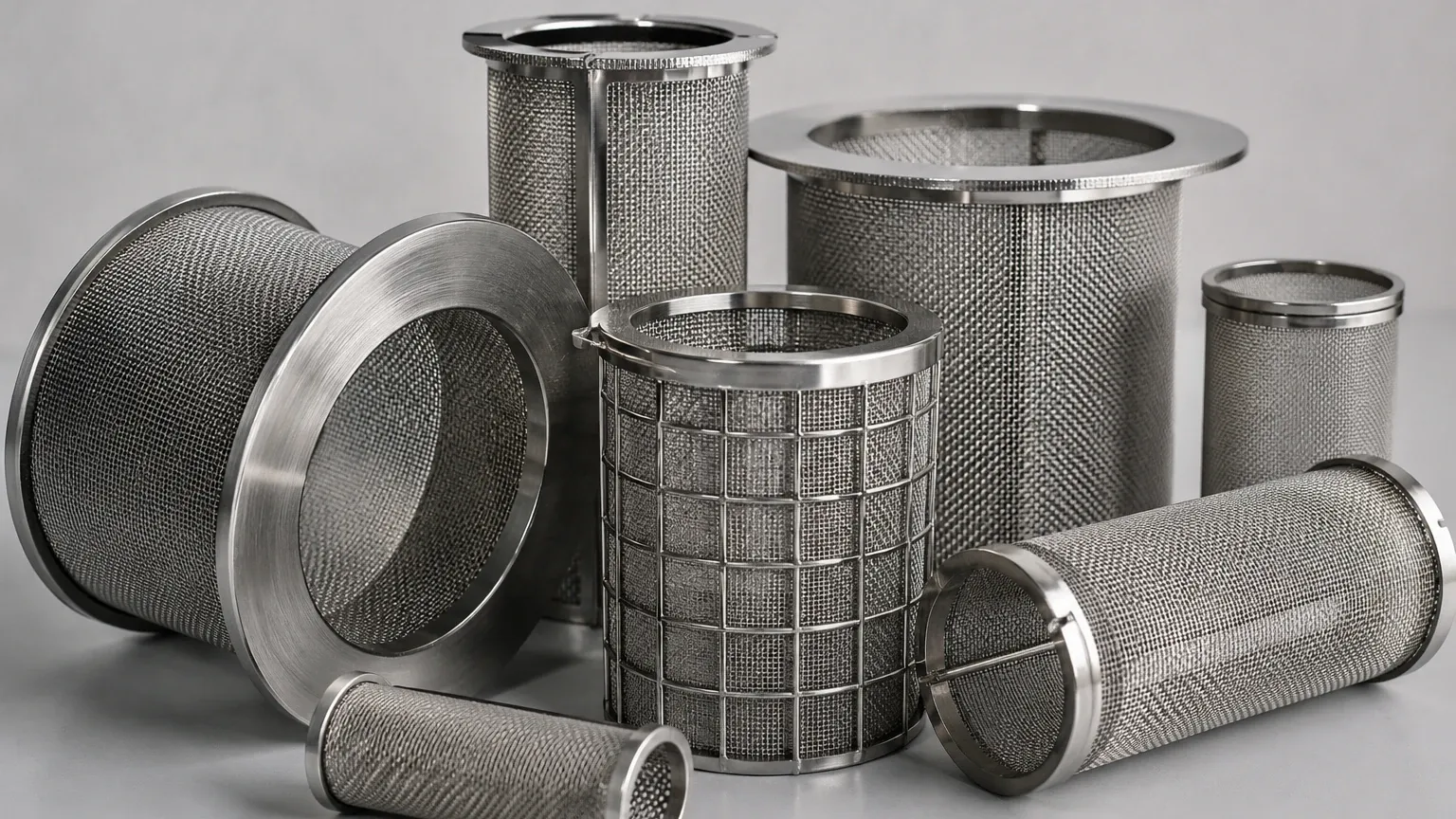
The physical configuration of the filter media is as important as the mesh itself. In most industrial liquid and gas systems, the media is formed into Wire Mesh Filter Cylinders & Tubes to maximize surface area and structural rigidity.
Cylindrical Geometry and Pressure Resistance
The cylindrical shape is inherently strong, allowing the filter to withstand significant differential pressures. In high-pressure hydraulic or chemical processing systems, the filter must resist collapsing (inward flow) or bursting (outward flow). To enhance this resistance, engineers often specify multi-layer constructions. This may include:
* The Filtration Layer: The fine mesh that dictates the micron rating.
* Support Layers: Coarser mesh layers that provide mechanical strength to the fine mesh without significantly impeding flow.
* The Perforated Core: A heavy-duty internal metal tube that prevents the mesh from collapsing under high ΔP.
* Outer Shrouds: Protective layers that shield the fine mesh from mechanical damage during installation or high-velocity fluid impingement.
Welding and Assembly Techniques
For a metal mesh washable filter to be truly reliable, the assembly method must be as robust as the material. Plasma welding, TIG welding, and resistance welding are commonly used to join the mesh seams and attach end caps. These methods ensure that there are no bypass paths for contaminants and that the filter can withstand thermal expansion and contraction in high-temperature applications.
3. Material Selection for Industrial Environments
The performance of a metal mesh washable filter is heavily dictated by the metallurgy of the wire. Stainless steel is the industry standard due to its balance of corrosion resistance, mechanical strength, and cost.
Stainless Steel 304 vs. 316L
* AISI 304: Suitable for general industrial use, water treatment, and food processing where moderate corrosion resistance is required.
* AISI 316L: The "L" denotes low carbon, which improves weldability and resistance to intergranular corrosion. 316L contains molybdenum, making it the preferred choice for pharmaceutical, chemical, and marine applications where exposure to chlorides or acidic environments is common.
Specialty Alloys
In extreme cases, such as highly acidic chemical processing or high-temperature aerospace applications, specialty alloys like Monel, Inconel, or Hastelloy may be used. These materials offer superior resistance to oxidation and chemical attack at temperatures exceeding 500°C, where standard stainless steels might fail.
4. The Mechanics of Washability and Reusability
The primary value proposition of a metal mesh washable filter is its ability to be cleaned and returned to service. This capability significantly reduces the Total Cost of Ownership (TCO) by eliminating the recurring expense of purchasing and disposing of polymer cartridges.
Cleaning Methodologies
Depending on the type of contaminant, several industrial cleaning methods can be employed:
1. Backwashing/Backpulsing: Reversing the flow of the fluid to dislodge surface-accumulated particles. This is often automated in continuous process systems.
2. Ultrasonic Cleaning: Using high-frequency sound waves in a cleaning solvent to create cavitation bubbles. These bubbles implode on the mesh surface, stripping away microscopic particles and oils that backwashing might miss.
3. Chemical Soaking: Utilizing acids, alkalis, or specialized surfactants to dissolve organic or inorganic scaling. This is common in the food and beverage industry for removing protein or mineral deposits.
4. Burn-off/Pyrolysis: In applications involving polymers or heavy resins, the filter may be heated in a controlled oven to carbonize and remove organic matter.
Integrity Testing
After a cleaning cycle, it is vital to verify that the filter still meets its performance specifications. The Bubble Point Test is the standard engineering method for this. By submerging the filter in a liquid and applying air pressure, engineers can determine the pressure at which the first bubble escapes. This pressure correlates directly to the largest pore size, allowing the user to confirm that the mesh has not been damaged or stretched during the cleaning process.
5. Application-Specific Engineering Considerations
When selecting Wire Mesh Filter Cylinders & Tubes, engineers must account for the specific variables of their operating environment. A filter designed for water treatment may fail prematurely if applied to a high-viscosity hydraulic oil system.
Viscosity and Flow Rate
High-viscosity fluids exert greater force on the filter media. To maintain a manageable pressure drop, the surface area of the filter must be increased, or a coarser mesh must be selected. Engineers use the Darcy-Weisbach equation and specialized flow coefficient (Cv) data to calculate the required dimensions for Wire Mesh Filter Cylinders & Tubes based on the target flow rate.
Particle Loading and Cake Formation
In some processes, the accumulation of particles on the mesh surface—known as "filter cake"—actually improves filtration efficiency by acting as a secondary filter medium. However, if the cake becomes too thick, the pressure drop will spike. Understanding the particle loading (ppm or mg/L) helps in determining the optimal cleaning frequency and the necessary structural strength of the filter element.
Hygiene and Compliance
In the pharmaceutical and food industries, the metal mesh washable filter must meet stringent regulatory standards (such as FDA or 3-A Sanitary Standards). This requires smooth weld finishes, the absence of dead spaces where bacteria could proliferate, and materials that do not leach into the product stream.
6. Procurement Checklist: What Buyers Need to Confirm
For international buyers and procurement teams, specifying a custom filtration solution requires precise communication with the manufacturer. To ensure the metal mesh washable filter performs as expected, the following data points should be provided:
* Fluid Characteristics: Name of fluid, concentration, pH level, and viscosity at operating temperature.
* Operating Conditions: Normal and maximum flow rates, operating pressure, and maximum allowable pressure drop.
* Temperature Range: Constant operating temperature and potential thermal shocks during cleaning.
* Filtration Requirement: Absolute or nominal micron rating required.
* Mechanical Dimensions: Outer diameter (OD), inner diameter (ID), overall length (OAL), and end cap configuration (e.g., DOE, SOE, Threaded, Flanged).
* Cleaning Compatibility: Will the filter be cleaned in-place (CIP) or removed for external cleaning?
7. Conclusion: The Strategic Value of Metal Mesh
Integrating a metal mesh washable filter into an industrial system is an investment in long-term reliability. While the initial capital expenditure (CAPEX) for stainless steel Wire Mesh Filter Cylinders & Tubes is higher than that of disposable plastic filters, the reduction in operational expenditure (OPEX) is substantial. By eliminating waste, reducing downtime associated with filter changes, and providing a predictable, high-precision filtration barrier, metal mesh solutions offer a superior technical and economic path for modern engineering challenges.
For engineers and purchasing managers, the key to success lies in understanding the interplay between material science, fluid dynamics, and mechanical design. By selecting a manufacturer capable of providing customized, high-quality Wire Mesh Filter Cylinders & Tubes, facilities can achieve optimized filtration performance that stands up to the most demanding industrial environments.
