


Stainless Steel Wire Mesh Oil Filter: An Engineering Guide to Selection and Application
In industrial lubrication and hydraulic systems, the integrity of the fluid is paramount to the longevity of the machinery. Contamination by particulate matter—ranging from metallic wear debris to environmental dust—can lead to catastrophic component failure, increased friction, and unplanned downtime. The stainless steel wire mesh oil filter has emerged as a critical component for engineers seeking a durable, cleanable, and high-performance solution for demanding oil filtration tasks. Unlike disposable cellulose or synthetic media, stainless steel mesh offers structural stability and chemical resistance that are essential in high-temperature or high-pressure environments.
This guide examines the technical specifications, engineering considerations, and selection criteria for Wire Mesh Filter Cylinders & Tubes used in industrial oil applications, providing procurement teams and engineers with the data needed to optimize their filtration systems.
1. Understanding the Engineering of Stainless Steel Wire Mesh
The performance of a stainless steel wire mesh oil filter is fundamentally determined by the weave type and the material grade. For industrial oil applications, the most common materials are AISI 304 and AISI 316L stainless steel. While 304 provides excellent general-purpose corrosion resistance, 316L is preferred for environments involving acidic additives or high-salinity conditions due to its molybdenum content.
Weave Structures and Filtration Efficiency
Industrial filters utilize several weave patterns to achieve specific micron ratings and flow characteristics:
* Plain Weave: The simplest structure where wires cross over and under each other. It provides high flow rates and is typically used for coarse filtration or as a support layer.
* Dutch Weave (Plain and Twilled): This weave uses larger diameter warp wires and smaller diameter shute wires. This creates a dense, tortuous path for the fluid, allowing for much finer filtration (down to 5–10 microns) while maintaining high mechanical strength.
* Twilled Weave: Each shute wire passes over and under two warp wires, allowing for heavier wire diameters in a given mesh count, which increases the pressure-bearing capacity of the filter.
By selecting the appropriate weave, engineers can balance the requirement for a low initial pressure drop with the necessity of capturing fine particulates that could damage sensitive hydraulic valves or bearings.
2. Design Configurations: Wire Mesh Filter Cylinders & Tubes
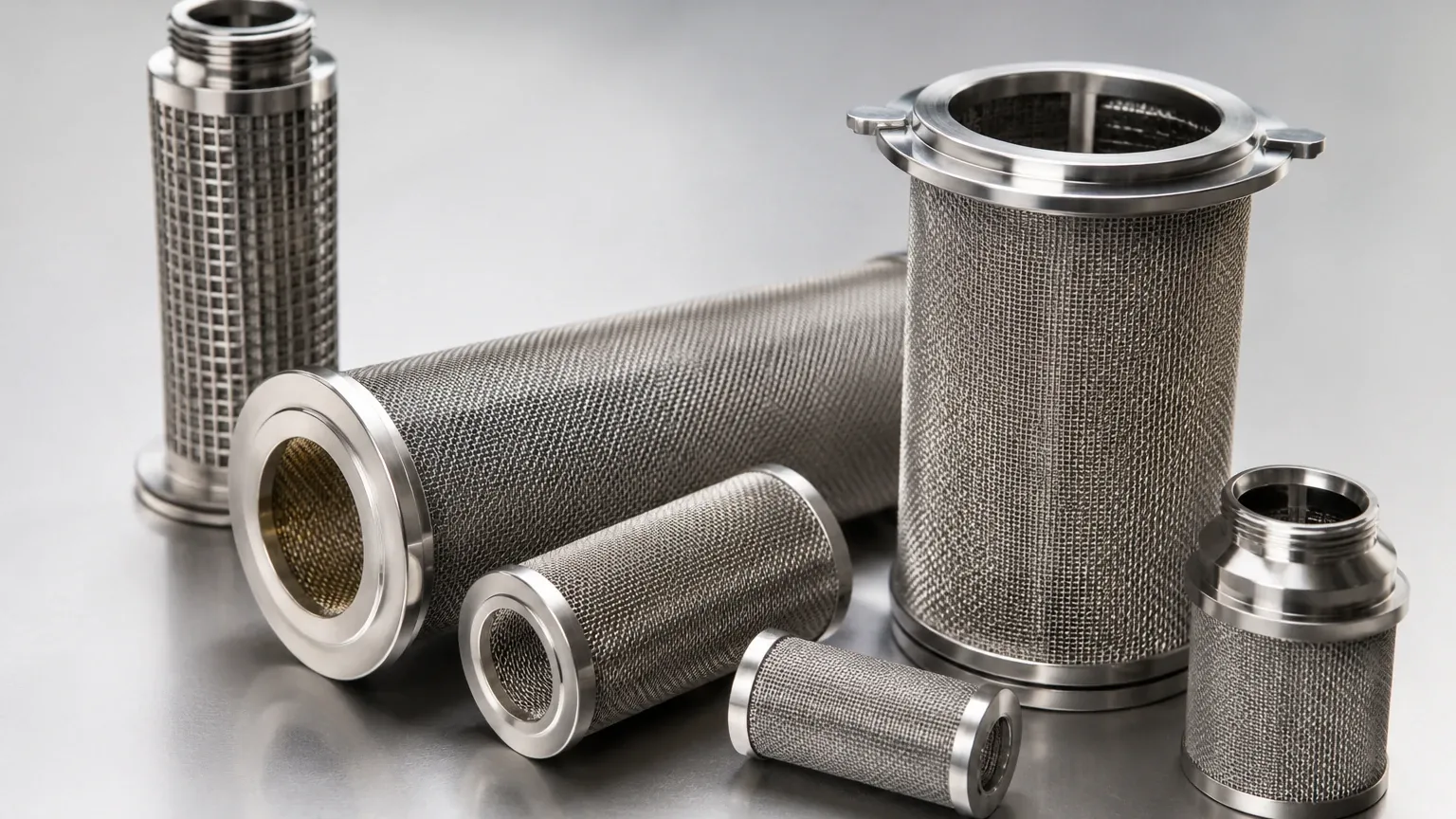
Most industrial oil filtration systems utilize Wire Mesh Filter Cylinders & Tubes as the primary geometry. The cylindrical shape is favored for its ability to withstand internal and external pressure differentials without deforming. Depending on the application, these components can be engineered in several ways:
Single-Layer vs. Multi-Layer Construction
Single-layer mesh cylinders are cost-effective for coarse straining. However, for precision oil filtration, multi-layer sintered or bonded mesh is often employed. In a multi-layer configuration, a fine filtration mesh is sandwiched between coarser support and drainage layers. This design prevents the fine mesh from migrating or deforming under high-viscosity flow or pressure surges.
Pleated vs. Cylindrical Designs
While a standard smooth cylinder is easy to clean, a pleated wire mesh filter significantly increases the available surface area within the same footprint. For oil systems with high flow rates or high dirt-loading requirements, pleating reduces the face velocity of the fluid through the mesh, which lowers the pressure drop and extends the time between cleaning cycles.
Structural Support
To prevent collapse in high-pressure hydraulic systems, these filter tubes are often reinforced with internal perforated metal cores or external cages. The engineering of these supports must account for the total open area to ensure they do not become a secondary source of flow restriction.
3. Performance Criteria for Oil Applications
When specifying a stainless steel wire mesh oil filter, several technical variables must be evaluated to ensure system compatibility.
Micron Rating: Absolute vs. Nominal
It is vital to distinguish between nominal and absolute micron ratings. A nominal rating refers to the ability of the filter to retain a majority of particles of a certain size, whereas an absolute rating (often determined via the Bubble Point Test) indicates the largest spherical particle that can pass through the mesh. For critical oil systems, such as those protecting high-speed turbine bearings, absolute-rated mesh is generally required.
Fluid Viscosity and Pressure Drop
Oil viscosity varies significantly with temperature. A filter that performs well at operating temperature may cause a massive pressure drop during a cold start. Engineers must calculate the "clean pressure drop" ($ΔP$) using the fluid's maximum viscosity and the filter's effective open area. Stainless steel mesh is advantageous here because its rigid structure can handle higher $ΔP$ than paper or fiberglass elements.
Chemical Compatibility
While stainless steel is generally inert in most mineral and synthetic oils, certain fire-resistant hydraulic fluids (such as phosphate esters) can be aggressive toward sealing materials. It is essential to ensure that the end caps, adhesives, or O-rings used in the filter assembly are compatible with the specific oil chemistry.
4. Maintenance and the Economics of Cleanability
One of the primary B2B advantages of the stainless steel wire mesh oil filter is its reusability. In large-scale industrial operations, the total cost of ownership (TCO) for permanent stainless steel elements is often lower than that of disposable filters when disposal costs and replacement frequency are considered.
Cleaning Procedures
Stainless steel filters can be restored to near-original performance through several methods:
* Backwashing: Reversing the flow of clean fluid through the filter to dislodge surface-bound particles.
* Ultrasonic Cleaning: Using high-frequency sound waves in a solvent bath to remove fine particulates lodged deep within the weave.
* Chemical Cleaning: Using specialized surfactants to dissolve varnishes or oxidized oil residues that have adhered to the wire surfaces.
Determining Replacement Cycles
While cleanable, wire mesh filters are not infinite. Repeated cleaning and mechanical stress can eventually lead to wire fatigue or pore enlargement. Monitoring the pressure differential across the filter is the standard method for determining when a cleaning cycle is required. If the "cleaned" pressure drop begins to rise over time, it indicates that the mesh is becoming permanently blinded and the element should be replaced.
5. Application Risks and Mitigation
Designing a filtration system requires an understanding of potential failure modes. In oil systems, the most common risks include:
* Media Migration: In low-quality filters, individual wires may break and enter the downstream flow. High-quality manufacturers like Kaifil mitigate this through precision welding and sintering processes that lock the wires in place.
* Bypass Leakage: If the filter tube is not seated correctly within the housing, oil will take the path of least resistance, bypassing the filtration media entirely. Precision-machined end caps and high-quality gaskets are essential to maintain the integrity of the seal.
* Fatigue from Pressure Pulsations: In hydraulic systems, rapid valve actuation can cause pressure spikes. The filter must be engineered with sufficient mechanical strength to resist these pulsations without cracking the mesh or the longitudinal seam weld.
6. Procurement Checklist for International Buyers
When sourcing Wire Mesh Filter Cylinders & Tubes for oil filtration, international purchasing teams should confirm the following technical details with the manufacturer to ensure the product meets industrial standards:
1. Material Certification: Request Mill Test Reports (MTRs) to verify that the stainless steel grade (304, 316L, etc.) meets ASTM or ISO standards.
2. Micron Verification: Confirm whether the micron rating is nominal or absolute and request documentation on the testing methodology (e.g., ISO 16889 multi-pass test).
3. Dimensional Tolerances: For OEM replacements, ensure that the length, outer diameter (OD), and inner diameter (ID) are manufactured to tight tolerances to ensure a proper fit in existing housings.
4. Welding Integrity: Inquire about the welding methods used (e.g., TIG, Plasma, or Resistance welding). The longitudinal seam is often the weakest point of a filter tube; it must be as strong as the parent mesh.
5. Customization Options: Determine if the manufacturer can provide custom end-cap configurations, such as NPT threads, flange mounts, or specialized O-ring grooves (Viton, EPDM, or Buna-N).
Conclusion
The selection of a stainless steel wire mesh oil filter is a strategic decision that impacts the reliability and efficiency of industrial machinery. By understanding the nuances of weave patterns, structural design, and maintenance requirements, engineers can specify filtration solutions that provide superior protection against contamination.
Whether for hydraulic systems, turbine lubrication, or chemical processing, Wire Mesh Filter Cylinders & Tubes offer the durability and precision necessary for modern industrial standards. By focusing on high-quality materials and rigorous engineering specifications, B2B buyers can ensure long-term performance and a reduced total cost of ownership for their filtration infrastructure.
