


Engineering Guide to Metal Mesh Optical Filters in Industrial Applications
In the landscape of industrial instrumentation and sensor protection, the term "filter" often refers to the separation of solids from fluids. However, in high-precision engineering, a metal mesh optical filter serves a dual purpose: providing electromagnetic interference (EMI) shielding while maintaining the necessary optical transparency for sensors, cameras, and signal indicators. For engineers and procurement specialists, selecting the right mesh configuration is a balance of physics, material science, and mechanical structural integrity.
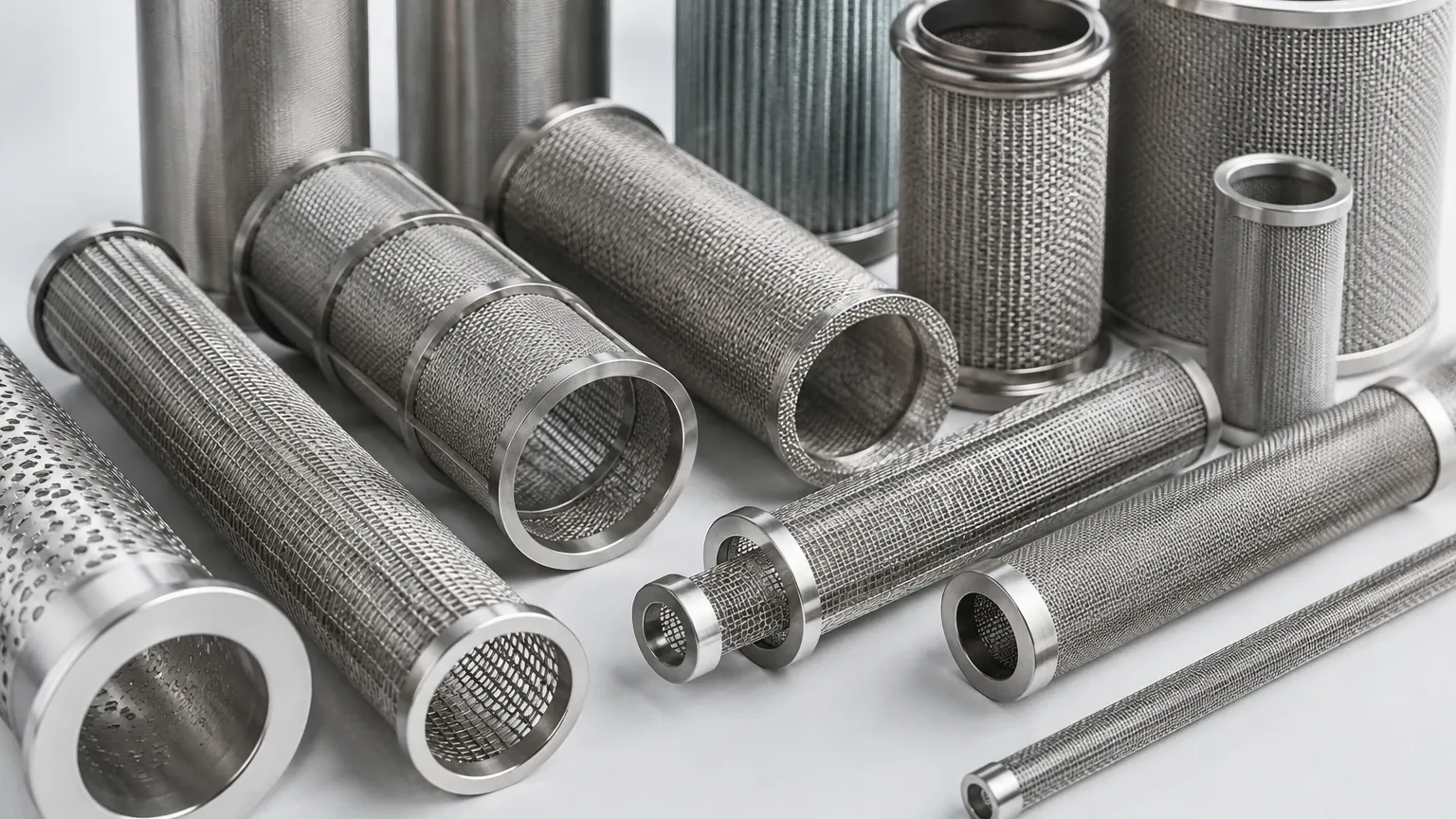
When these components are integrated into industrial housings, they often take the form of Wire Mesh Filter Cylinders & Tubes, which protect sensitive internal electronics from both physical contaminants and electromagnetic noise. This guide explores the technical parameters, selection criteria, and industrial application risks associated with metal mesh optical filtration.
1. Operating Principles: The Balance of Shielding and Transparency
The primary function of a metal mesh optical filter is to act as a Faraday cage. In industrial environments—where high-voltage equipment, motors, and wireless communication devices create significant electromagnetic noise—optical sensors can suffer from signal degradation.
The Faraday Cage Effect
A fine wire mesh, typically made of stainless steel or copper, is conductive. When electromagnetic waves hit the mesh, the electrons in the metal redistribute themselves to cancel the field's effects within the enclosure. For this to work effectively in an optical context, the openings in the mesh must be significantly smaller than the wavelength of the radiation being blocked, yet large enough to allow visible or infrared light to pass through with minimal attenuation.
Optical Transmission and Open Area
The efficiency of light transmission is directly proportional to the "percentage of open area" (POA). If a mesh has a 70% open area, it theoretically allows 70% of the light to pass. However, diffraction effects at the edges of the wires can influence the clarity of the image or the accuracy of a laser-based measurement system. Engineers must calculate the mesh count (wires per inch) and wire diameter to achieve the specific shielding effectiveness (measured in decibels, dB) required for the application without compromising the sensor’s functional range.
2. Engineering Selection Criteria for Industrial Mesh
Selecting a metal mesh optical filter requires a detailed understanding of the environment in which the instrument will operate. The following parameters are the baseline for any technical specification.
Mesh Count and Wire Diameter
Industrial mesh is defined by the number of wires per linear inch. A higher mesh count generally provides better EMI shielding at higher frequencies but reduces the open area.
* Fine Mesh (e.g., 100 to 500 mesh): Used for high-frequency shielding where optical clarity is secondary to signal integrity.
* Coarse Mesh (e.g., 20 to 80 mesh): Used where high light transmission is required and the interference frequencies are relatively low.
Material Selection: Stainless Steel vs. Specialized Alloys
* Stainless Steel (304/316L): The standard for industrial filtration due to its excellent corrosion resistance, mechanical strength, and durability. It is the preferred material for Wire Mesh Filter Cylinders & Tubes used in harsh chemical or outdoor environments.
* Copper and Brass: Offer superior electrical conductivity compared to stainless steel, providing higher shielding effectiveness. However, they are prone to oxidation and may require plating (such as nickel or blackened finishes) to maintain performance and reduce optical reflections.
* Blackened Mesh: To prevent "glare" or internal reflections that can interfere with optical sensors, the mesh is often chemically blackened. This is a critical specification for camera-based inspection systems.
3. Structural Configurations: Cylinders and Tubes
While flat mesh sheets are common for display screens, industrial sensors often require 360-degree protection or integration into cylindrical probe housings. This is where the manufacturing of Wire Mesh Filter Cylinders & Tubes becomes essential.
Seamless and Welded Constructions
For an optical filter to maintain its shielding integrity, the electrical continuity must be maintained across the entire structure. In cylindrical designs, the seam is the most vulnerable point. Precision welding techniques, such as plasma or laser welding, ensure that the mesh tube remains a continuous conductive path. Any gap in the seam can allow electromagnetic "leakage," rendering the filter ineffective at certain frequencies.
Support Structures
Fine mesh is delicate. In industrial settings where vibration or high-pressure washdowns occur, the optical mesh is often supported by a coarser, more rigid perforated metal tube or a heavier wire mesh internal frame. This "multi-layer" approach ensures that the fine metal mesh optical filter remains dimensionally stable and protected from mechanical deformation.
4. Installation Constraints and Integration
Installing a mesh optical filter is not as simple as placing it in front of a lens. Several mechanical and electrical factors must be addressed during the design phase.
Electrical Grounding
A metal mesh filter only works as an EMI shield if it is properly grounded to the equipment's chassis. If the mesh is isolated by rubber gaskets or non-conductive adhesives, it can actually act as an antenna, radiating noise into the sensor. Conductive gaskets or silver-loaded adhesives are typically required to ensure a low-impedance path to the ground.
Moire Patterns and Visual Interference
In applications involving digital displays or pixelated sensors (like CCD or CMOS cameras), the overlap of the mesh grid and the pixel grid can create "Moire patterns"—visual artifacts that look like wavy lines. To mitigate this, engineers often specify a "diagonal" mesh orientation (e.g., 45 degrees) or select a mesh count that does not resonate with the sensor's pixel pitch.
5. Application Risks and Environmental Factors
Industrial environments present unique challenges that can degrade the performance of an optical filter over time.
* Contamination and Blinding: In environments with oil mist, dust, or moisture, the small openings in a fine metal mesh can quickly become clogged. This "blinds" the optical sensor. Unlike fluid filters, which are expected to catch debris, an optical filter must remain clear. Selection of wire diameters that discourage droplet bridge formation is a key engineering consideration.
* Corrosion and Oxidation: Even stainless steel can suffer from surface oxidation in certain chemical atmospheres. If the surface of the wires becomes non-conductive, the shielding effectiveness drops significantly. Specifying high-grade alloys like 316L or specialized coatings is necessary for long-term reliability.
* Mechanical Vibration: Continuous vibration can cause work-hardening of the fine wires, leading to fatigue failure and breakage. This is particularly risky in cylindrical Wire Mesh Filter Cylinders & Tubes used on heavy machinery or engines.
6. Buyer’s Checklist: Confirming Specifications with Manufacturers
When sourcing a metal mesh optical filter for industrial level measurement or sensor protection, international buyers should confirm the following technical details with the manufacturer to ensure the component meets the application's demands:
1. Shielding Effectiveness (SE): What is the required attenuation (dB) at the specific target frequency (e.g., 100MHz, 1GHz, 10GHz)?
2. Visible Light Transmission (VLT): What is the minimum percentage of light that must pass through the filter?
3. Aperture Size: For laser-based systems, is the mesh opening size compatible with the beam diameter to prevent diffraction?
4. Surface Treatment: Is a blackened finish required to reduce reflections? If so, is the coating conductive?
5. Mechanical Interface: How will the mesh be bonded to the housing? Is there a requirement for a conductive flange or frame?
6. Environmental Resistance: Will the filter be exposed to salt spray, high humidity, or caustic cleaning agents? This dictates the grade of stainless steel or the type of plating required.
Conclusion
The integration of a metal mesh optical filter into industrial equipment is a sophisticated engineering task that bridges the gap between mechanical protection and electronic signal integrity. Whether the application involves protecting a laser level sensor in a chemical tank or shielding a high-speed camera on a production line, the choice of mesh—and its structural form as Wire Mesh Filter Cylinders & Tubes—is critical to the system's total cost of ownership and operational uptime. By focusing on technical parameters such as open area, mesh count, and electrical grounding, engineers can ensure that their instrumentation remains both accurate and resilient in the face of industrial interference.
