


Steel Mesh Oil Filter: Engineering Guide to High-Performance Industrial Filtration
In industrial engineering, the integrity of lubrication and hydraulic systems depends heavily on the efficiency of filtration components. A steel mesh oil filter serves as a critical barrier against particulate contamination, ensuring that machinery operates within designed tolerances. Unlike disposable cellulose or synthetic fiber filters, stainless steel mesh solutions offer a combination of thermal stability, chemical resistance, and mechanical strength required for demanding industrial environments.
For engineers and procurement specialists, selecting the correct filtration medium involves understanding the interplay between fluid viscosity, pressure differentials, and the specific geometry of the filter element. This guide explores the technical considerations for implementing Wire Mesh Filter Cylinders & Tubes in industrial oil systems, focusing on material science, structural design, and performance optimization.
The Role of Stainless Steel Mesh in Industrial Oil Systems
Industrial oils, including hydraulic fluids, gear lubricants, and turbine oils, often operate under high temperatures and pressures. Traditional media like paper or glass fiber can degrade or collapse under these conditions. A steel mesh oil filter provides a robust alternative. The primary function of these filters is to remove metallic wear debris, scale, and external contaminants that can cause component failure or accelerated wear in pumps, valves, and bearings.
Stainless steel wire mesh is characterized by its precise pore size and high open-area ratio. This allows for high flow rates with minimal initial pressure drop. In many heavy-duty applications, these filters are used as "last-chance" filters or suction strainers to protect expensive downstream components from catastrophic failure. Because the mesh is woven from metallic wire, it maintains its pore geometry even under significant differential pressure, providing consistent filtration performance throughout its service life.
Engineering Specifications of Wire Mesh Filter Cylinders & Tubes
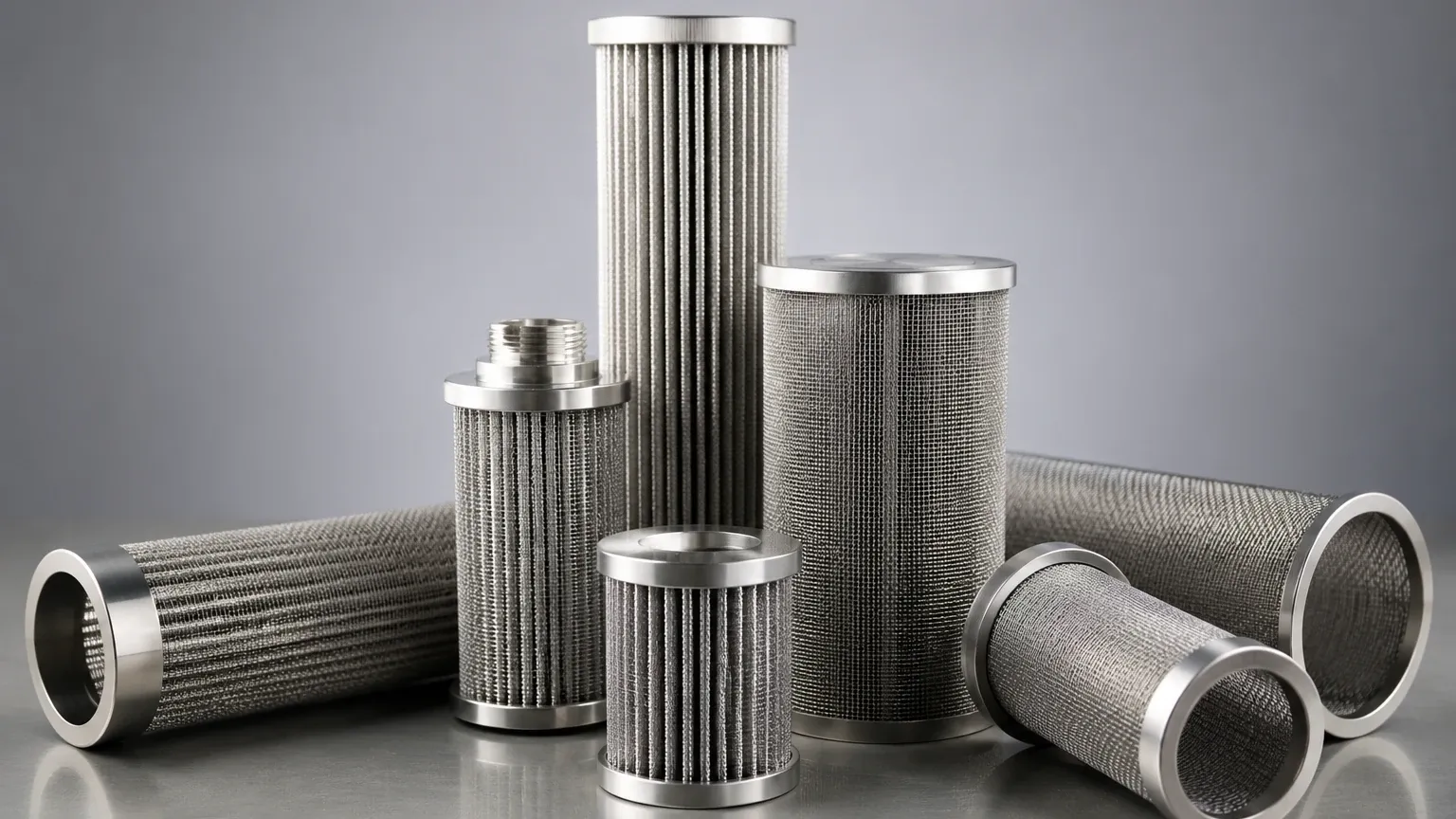
The physical configuration of the filter is as important as the mesh itself. Wire Mesh Filter Cylinders & Tubes are the most common geometries used in industrial housings. These structures are engineered to maximize surface area while fitting within the constraints of existing machinery.
Structural Integrity and Reinforcement
In high-pressure oil systems, the filter element must withstand the force of the fluid flow. Cylindrical filters are often designed with a perforated metal core or an external support cage. This reinforcement prevents the mesh from collapsing or bursting during pressure spikes (such as during cold starts when oil viscosity is high). For applications involving high-velocity flow, the longitudinal seams of the tubes are typically plasma-welded or resistance-welded to ensure a permanent, leak-proof bond that exceeds the strength of the mesh itself.
Pleated vs. Smooth Cylinders
Engineers must choose between smooth cylindrical tubes and pleated designs. A smooth tube is easier to clean and is suitable for applications with lower contaminant loads. Conversely, pleating the wire mesh significantly increases the effective filtration area within the same footprint. This results in a lower face velocity across the mesh, a lower pressure drop, and a higher dirt-holding capacity, which extends the interval between maintenance cycles.
Material Selection and Weave Patterns
The performance of a steel mesh oil filter is dictated by the alloy and the weave type used in its construction. Kaifil utilizes high-grade stainless steel to ensure longevity in corrosive or high-temperature environments.
Stainless Steel Grades
* AISI 304: The standard grade for most industrial oil applications. It offers excellent strength and good corrosion resistance for general lubrication systems.
* AISI 316/316L: Contains molybdenum, providing superior resistance to corrosion and pitting. This is the preferred choice for synthetic oils, fluids with acidic additives, or environments exposed to marine or chemical influences.
Weave Types and Filtration Accuracy
* Plain Weave: A simple over-under pattern that provides a high open area. It is ideal for coarse filtration and high-flow suction strainers.
* Twill Weave: Allows for thicker wires and is used for finer filtration requirements where increased mechanical strength is necessary.
* Dutch Weave (Plain or Twill): Features a dense, compact weave that provides the highest filtration precision. Dutch weave mesh can achieve absolute micron ratings as low as 5–10 microns, making it suitable for high-precision hydraulic systems.
Selection Criteria for Engineers
When specifying a steel mesh oil filter, several technical parameters must be evaluated to ensure system compatibility and performance.
Micron Rating: Nominal vs. Absolute
It is essential to distinguish between nominal and absolute micron ratings. A nominal rating indicates the filter's ability to retain a majority of particles of a certain size, whereas an absolute rating specifies the particle size at which the filter is 99% or 100% efficient. For critical oil systems, absolute-rated Wire Mesh Filter Cylinders & Tubes are recommended to prevent "bypass" of damaging particles.
Viscosity and Pressure Drop ($ΔP$)
Oil viscosity varies significantly with temperature. A filter that performs well at operating temperature may cause a significant pressure drop during a cold start. Engineers must calculate the maximum allowable $ΔP$ and ensure the mesh surface area is sufficient to handle the required flow rate even when the oil is at its highest viscosity.
Chemical Compatibility
While stainless steel is generally inert, certain oil additives or cleaning chemicals used during maintenance can react with specific alloys. Confirming the compatibility of the mesh, weld material, and end-cap adhesives (if used) is vital for long-term reliability.
Installation and Maintenance Considerations
One of the primary advantages of a steel mesh oil filter is its reusability. Unlike disposable elements, stainless steel filters can be cleaned and returned to service, reducing the total cost of ownership and environmental impact.
Cleaning Methods
* Backwashing: Reversing the flow of clean fluid through the filter to dislodge particles trapped on the surface.
* Ultrasonic Cleaning: Using high-frequency sound waves in a cleaning solvent to remove fine particulates embedded within the mesh pores. This is the most effective method for Dutch weave filters.
* Chemical Cleaning: Using specialized solvents to dissolve varnishes or oxidized oil deposits that have adhered to the wire mesh.
Replacement Cycles
While reusable, wire mesh filters are not infinite. Over many cleaning cycles, the mesh may experience work hardening or fatigue. Regular inspection for "blinded" (permanently clogged) areas or physical damage like pinholes and broken wires is necessary. If the pressure drop remains high even after cleaning, the element should be replaced.
Application Risks and Mitigation
Implementing a steel mesh oil filter requires awareness of potential failure modes. Improper installation can lead to bypass leakage, where unfiltered oil bypasses the mesh through gaps in the end caps or seals. Ensuring that the filter tube is properly seated and that gaskets are compatible with the oil type is essential.
Another risk is mesh migration, where fragments of the wire mesh break off and enter the downstream flow. This is usually caused by excessive vibration or pressure surges. Selecting reinforced Wire Mesh Filter Cylinders & Tubes and ensuring proper system dampening can mitigate this risk.
International Buyer Checklist: Procurement and Quality Assurance
For international buyers and OEM manufacturers, sourcing high-quality filtration components requires clear communication of technical requirements. When ordering a steel mesh oil filter, confirm the following with the manufacturer:
1. Material Certification: Request mill test reports (MTRs) to verify the stainless steel grade (e.g., 304 vs. 316L).
2. Filtration Efficiency Testing: Ask for data regarding the bubble point test or multipass test results to verify the micron rating.
3. Dimensional Tolerances: Ensure that the outer diameter (OD), inner diameter (ID), and length meet the precise tolerances of the housing.
4. Welding Standards: Verify that the longitudinal and end-cap welds are performed using methods that maintain the corrosion resistance of the base metal.
5. Customization Requirements: Specify if the application requires unique end-cap configurations, such as threaded fittings, flanges, or specialized gaskets.
By focusing on these technical boundaries, engineers can ensure that their oil filtration systems provide reliable protection for critical industrial assets. Kaifil’s expertise in manufacturing customized Wire Mesh Filter Cylinders & Tubes allows for the development of solutions tailored to specific flow rates, pressure requirements, and contaminant profiles, ensuring optimal performance in any industrial oil application.
