


Tube Mesh Filter
In industrial filtration, the tube mesh filter represents a fundamental component for liquid and gas separation. Often referred to as wire mesh filter cylinders or tubes, these components are engineered to provide precise particulate retention while maintaining structural integrity under varying pressure conditions. For engineers and procurement teams, selecting the correct filtration medium involves a deep understanding of material science, fluid dynamics, and mechanical design. This guide examines the technical specifications, application-specific considerations, and engineering trade-offs associated with stainless steel tube mesh filters.
Engineering Fundamentals of Tube Mesh Filters
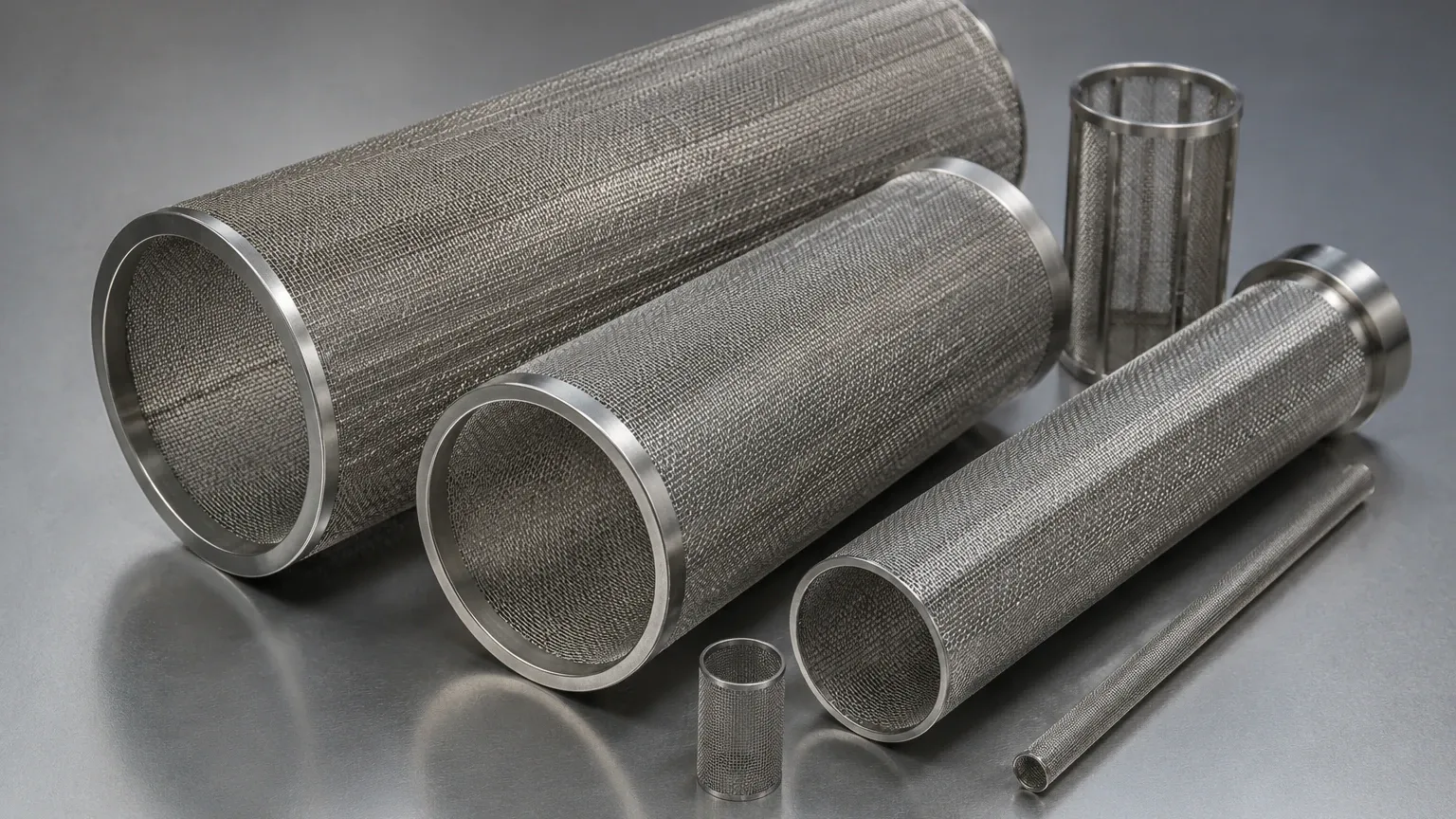
A tube mesh filter is typically constructed from woven wire cloth, which is formed into a cylindrical shape and joined via longitudinal welding. The performance of the filter is dictated by the weave pattern, the wire diameter, and the number of layers utilized in the construction. Unlike disposable polymer filters, stainless steel Wire Mesh Filter Cylinders & Tubes offer high thermal stability and chemical resistance, making them suitable for aggressive industrial environments.
Weave Types and Filtration Characteristics
The geometry of the aperture in a tube mesh filter is determined by the weaving technique. Common patterns include:
* Plain Weave: The simplest form where wires cross over and under each other. It provides a high open area and low pressure drop, suitable for coarse filtration.
* Dutch Weave: This pattern uses heavier warp wires and finer shute wires driven closely together. This creates a dense, strong mesh with small, curved openings that provide excellent surface filtration and high pressure resistance.
* Twill Weave: Each shute wire passes over and under two warp wires, allowing for a heavier wire diameter for a given mesh count. This is often used for finer filtration requirements where mechanical strength is critical.
Structural Reinforcement
For applications involving high differential pressure, a single layer of mesh may lack the necessary hoop strength. In such cases, the tube mesh filter is reinforced with a perforated metal core or an external support cage. This multi-layer approach ensures that the mesh remains dimensionally stable and does not collapse or burst during pressure surges or backwashing cycles.
Material Selection for Industrial Environments
Material compatibility is the primary factor in determining the service life of a tube mesh filter. Kaifil specializes in stainless steel alloys, which are the industry standard for durability and hygiene.
Stainless Steel 304 vs. 316L
* Grade 304: This is the most common stainless steel used in filtration. It offers good corrosion resistance and is cost-effective for general industrial water treatment, hydraulic oils, and food processing where high acidity is not a factor.
* Grade 316L: The "L" stands for low carbon, which improves weldability and prevents sensitization. Grade 316 contains molybdenum, which significantly enhances resistance to chlorides and pitting. This is the preferred material for pharmaceutical, marine, and chemical processing applications where the filter is exposed to corrosive cleaning agents or harsh process fluids.
Specialized Alloys
In extreme cases involving high-temperature oxidation or highly acidic environments, alloys such as Hastelloy, Monel, or Inconel may be used. These materials ensure that the tube mesh filter maintains its micron rating and structural properties at temperatures exceeding 500°C (932°F).
Performance Evaluation: Micron Rating and Flow Rate
When specifying a tube mesh filter, engineers must balance filtration efficiency with system throughput. The two most critical metrics are the micron rating and the clean pressure drop.
Nominal vs. Absolute Filtration
* Nominal Rating: This indicates the ability of the filter to retain a majority of particles (typically 60% to 90%) of a specific size. It is often used for pre-filtration stages.
* Absolute Rating: This refers to the diameter of the largest spherical particle that can pass through the mesh under laboratory conditions. For critical pharmaceutical or hydraulic applications, an absolute rating is required to ensure system protection.
Managing Pressure Drop (Delta P)
The "clean pressure drop" is the resistance the filter offers to fluid flow when it is first installed. As the tube mesh filter captures contaminants, the effective open area decreases, and the pressure drop increases. Engineers must calculate the total surface area required to keep the initial Delta P within acceptable limits for the pump and piping system. Increasing the length or diameter of the tube mesh filter effectively increases the filtration area, thereby extending the time between cleaning cycles.
Customization and Design Configurations
Industrial filtration systems rarely use standard off-the-shelf components. Customization of the tube mesh filter is often necessary to fit existing housings or to meet specific process requirements. Key design variables include:
* End Fittings: Depending on the housing, filters may require threaded connectors (NPT/BSP), flange mounts, O-ring seals (such as 222 or 226 configurations), or simple flat end caps. Proper sealing is vital to prevent fluid bypass.
* Pleated vs. Cylindrical: While a simple cylinder is easier to clean, a pleated tube mesh filter significantly increases the surface area within the same footprint. This is ideal for high-flow applications with low dirt-holding capacity.
* Sintered Mesh Tubes: For the most demanding applications, multiple layers of wire mesh are sintered together—bonded using heat and pressure without the use of adhesives. This creates a monolithic structure that is exceptionally strong and provides precise pore size control.
Industry-Specific Applications for Tube Mesh Filters
The versatility of the tube mesh filter allows it to be integrated into various stages of production across multiple sectors.
Chemical and Petrochemical Processing
In chemical plants, filters must withstand aggressive solvents and high temperatures. Tube mesh filters are used to protect downstream equipment like valves and meters from pipe scale and catalyst fines. Their ability to be cleaned and reused makes them a sustainable alternative to disposable cartridges in hazardous waste streams.
Food and Beverage Production
Hygiene is the priority in food processing. Stainless steel tube mesh filters are used for straining syrups, juices, and dairy products. The smooth surface of the wire mesh prevents bacterial growth and allows for Clean-in-Place (CIP) procedures using steam or caustic chemicals.
Hydraulic and Lubrication Systems
Hydraulic fluids must be kept free of metallic particles to prevent wear on pumps and actuators. A tube mesh filter is often used as a suction strainer or a return-line filter. Because these systems operate under high pressure, the mechanical strength of the stainless steel mesh is a critical safety feature.
Maintenance, Cleaning, and Total Cost of Ownership
One of the primary advantages of a stainless steel tube mesh filter over synthetic media is its cleanability. Understanding the maintenance requirements is essential for calculating the total cost of ownership (TCO).
Cleaning Methodologies
* Backwashing: Reversing the flow of the fluid to dislodge particles from the surface of the mesh. This is effective for surface-loading mesh types.
* Ultrasonic Cleaning: Using high-frequency sound waves in a cleaning solution to create cavitation bubbles that remove deeply embedded contaminants. This is the most effective method for restoring the original flow characteristics of a tube mesh filter.
* Chemical Cleaning: Soaking the filter in solvents or acids to dissolve organic or mineral deposits. This requires careful selection of cleaning agents to avoid damaging the stainless steel passivated layer.
1.
Replacement Cycles
While permanent, a tube mesh filter is not infinite. Over hundreds of cleaning cycles, the mesh may experience work hardening or mechanical fatigue, especially in high-vibration environments. Regular inspection for wire breaks or seam separation is necessary to ensure the integrity of the filtration process.
Critical Information to Confirm Before Purchasing
To ensure the successful integration of a tube mesh filter into an industrial process, engineers should confirm the following technical details with the manufacturer:
1. Fluid Characteristics: What is the viscosity, pH level, and temperature of the medium? High-viscosity fluids require a larger surface area to maintain flow.
2. Contaminant Profile: What is the nature of the solids being removed? Are they hard, abrasive particles or soft, deformable organic matter?
3. Maximum Differential Pressure: What is the highest pressure the filter will encounter before it is cleaned? This determines if a support core is necessary.
4. Housing Compatibility: Are the dimensions (OD, ID, and length) and end-cap styles precisely matched to the existing filter housing to prevent bypass?
By addressing these factors, purchasing teams can secure filtration solutions that optimize performance and minimize downtime. Kaifil provides comprehensive OEM support to develop customized Wire Mesh Filter Cylinders & Tubes tailored to these specific engineering requirements, ensuring reliable operation in the most demanding industrial environments.
