


Engineering Guide to Wire Mesh Disk Filters: Selection, Performance, and Industrial Application
In industrial filtration, the selection of a filter medium is dictated by the chemical environment, thermal conditions, and the specific particle size distribution of the process stream. The wire mesh disk filter serves as a fundamental component in many pressurized systems, providing a precise, surface-based filtration barrier. Unlike depth filters, which trap contaminants within a thick matrix, wire mesh disks utilize a geometric pore structure to intercept particles on a single plane, allowing for predictable performance and, in many cases, effective cleaning and reuse.
For engineers and procurement specialists, understanding the nuances of mesh weaves, material metallurgy, and structural reinforcement is essential to ensuring system longevity and process purity. This guide examines the technical specifications and engineering considerations required to integrate wire mesh disk filters into industrial workflows.
1. Operating Principles of Wire Mesh Disk Filters
The primary function of a wire mesh disk filter is to provide a mechanical barrier that allows fluid or gas to pass while retaining solids larger than the mesh opening. This is categorized as surface filtration.
Surface Filtration Dynamics
In a wire mesh disk, the filtration occurs at the interface of the mesh. As fluid flows through the apertures, particles exceeding the pore size are captured. Over time, these particles form a "filter cake," which can actually increase filtration efficiency but also leads to a rise in differential pressure (ΔP). Because the media is typically made of stainless steel, it offers high mechanical strength, resisting deformation under the pressure of the accumulating cake until a cleaning cycle is initiated.
Flow Distribution and Turbulence
The geometry of a disk filter is particularly suited for inline applications where space is limited. However, the flow profile must be considered. In high-velocity systems, the center of the disk often experiences higher impingement than the edges. Engineers must ensure that the housing design promotes even flow distribution to prevent premature blinding of the center mesh pores.
2. Material Selection and Chemical Compatibility
The durability of a wire mesh disk filter is heavily dependent on its metallurgy. While stainless steel is the industry standard, the specific grade must be matched to the process fluid.
* AISI 304 Stainless Steel: Suitable for general industrial applications, water filtration, and environments where corrosion risk is moderate. It provides excellent mechanical strength at a lower cost point.
* AISI 316L Stainless Steel: The preferred choice for the pharmaceutical, food and beverage, and chemical processing industries. The addition of molybdenum and a lower carbon content provides superior resistance to pitting and crevice corrosion, especially in chloride-rich environments.
* Exotic Alloys: In extreme cases involving highly acidic or high-temperature gas filtration, materials such as Monel, Inconel, or Hastelloy may be required. These alloys maintain their structural integrity at temperatures where standard stainless steels would undergo oxidation or mechanical softening.
When selecting materials, engineers must also consider the potential for galvanic corrosion if the filter disk is in contact with a different metal housing in an electrolytic fluid.
3. Mesh Weave Types and Micron Ratings
The performance of a wire mesh disk filter is defined by its weave. The weave determines the pore shape, mechanical stability, and the "open area" percentage, which directly impacts flow rate.
Plain Weave and Twill Weave
Plain weave is the most common, featuring a simple over-under pattern. It provides a high open area and is easy to clean. Twill weave, where wires cross over two and under two, allows for the use of heavier wires in a given mesh count, increasing the strength of the disk for high-pressure applications.
Dutch Weave (Plain and Twill)
Dutch weaves utilize different diameters for the warp and shute wires. This creates a much denser, more complex pore structure. Dutch weave disks are used for fine filtration (down to 5-10 microns) where high mechanical strength is required. They are less prone to "media migration" compared to fiber-based filters.
Absolute vs. Nominal Micron Ratings
It is critical to distinguish between these two ratings during procurement.
* Absolute Rating: The diameter of the largest hard spherical particle that will pass through the filter. For wire mesh, this is determined by the physical geometry of the weave.
* Nominal Rating: An arbitrary value indicating the filter's ability to retain a percentage of particles of a certain size.
For precision industrial processes, specifying an absolute rating is generally recommended to ensure consistent output quality.
4. Structural Variations: Single Layer vs. Multi-Layer Sintered
A wire mesh disk filter can be manufactured in several configurations depending on the mechanical stress of the application.
Single-Layer Disks
These are simple cutouts from a single sheet of wire cloth. They are often used as "last chance" filters or in low-pressure gas applications. The primary risk with single-layer disks is the potential for wire fraying at the edges or deformation under high differential pressure.
Multi-Layer and Sintered Disks
To increase strength and filtration depth, multiple layers of mesh are often stacked. These can be spot-welded at the edges or, more effectively, sintered. Sintering involves heating the stacked mesh layers in a vacuum furnace until the contact points of the wires fuse together.
Sintered disks offer several advantages:
1. Structural Integrity: The layers cannot shift, ensuring the pore size remains constant under pressure.
2. No Media Migration: The fusion of wires prevents individual strands from breaking off and entering the process stream.
3. Backwash Capability: The rigid structure allows for high-pressure backwashing or ultrasonic cleaning without damaging the filter media.
5. Installation Constraints and Sealing Mechanisms
Proper installation is as important as the filter media itself. If a disk is not sealed correctly within its housing, "bypass" occurs, where the fluid takes the path of least resistance around the edges of the filter, rendering the filtration process ineffective.
Edging and Rim Options
To facilitate a proper seal and prevent edge fraying, many industrial disk filters feature a rim or "binding." Common options include:
* Aluminum or Stainless Steel Rims: A metal U-channel is pressed around the circumference of the disk.
* Rubber or PTFE Gaskets: For applications requiring a soft seal against a flange.
* Welded Edges: For sintered disks, the edges can be plasma-welded to create a solid, leak-proof border.
Mechanical Integration
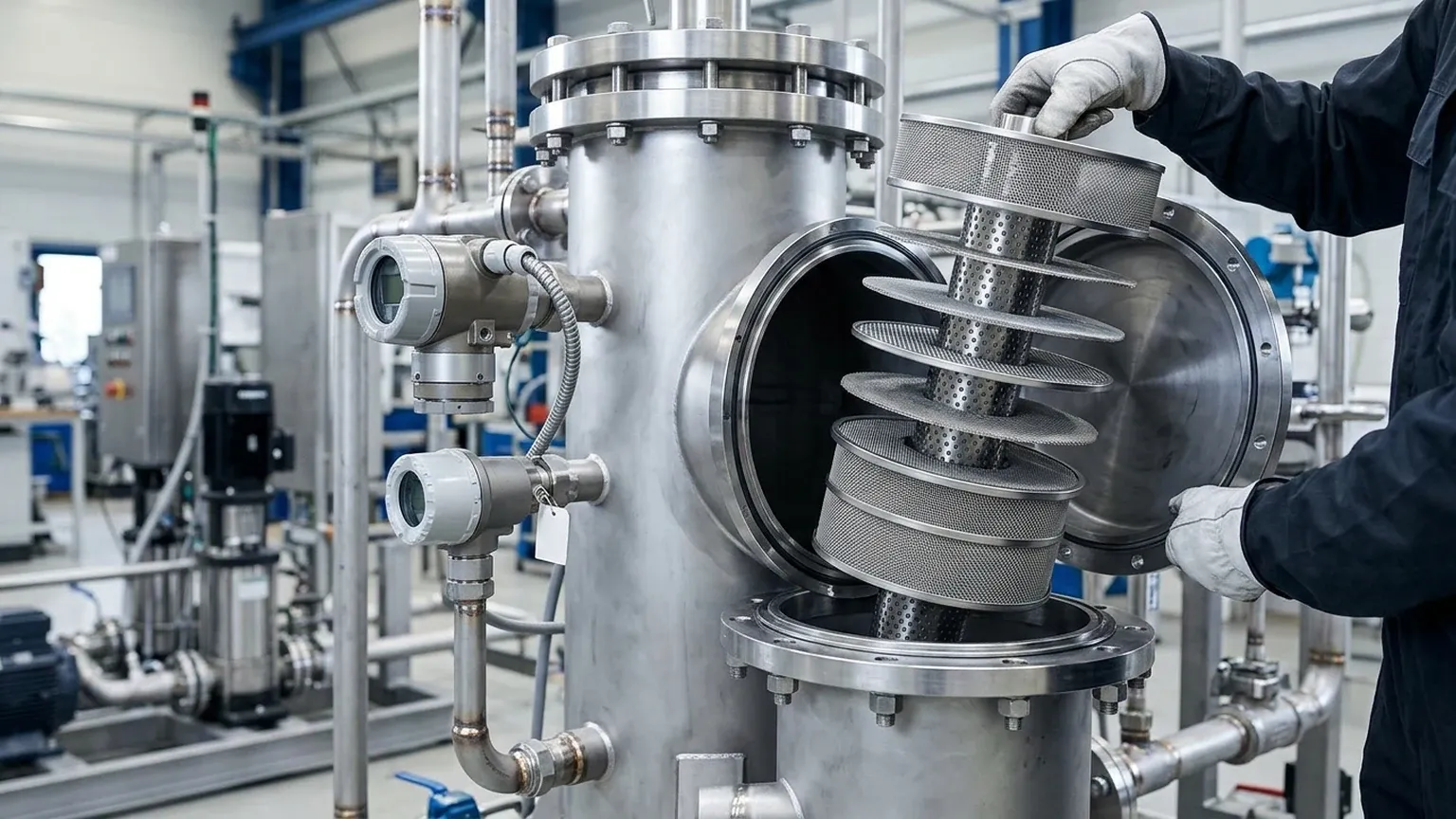
When designing a system, engineers must account for the thickness of the disk and any associated gaskets. In high-pressure hydraulic systems, the disk must be supported by a perforated plate or a coarser mesh layer to prevent the "bowing" or bursting of the fine filtration layer. For applications requiring significantly higher surface area within a compact footprint, engineers may consider Wire Mesh Filter Cylinders & Tubes as an alternative to flat disks.
6. Maintenance, Cleaning, and Replacement Cycles
One of the primary B2B advantages of stainless steel wire mesh is its cleanability, which reduces the Total Cost of Ownership (TCO) compared to disposable polymer cartridges.
Cleaning Methods
1. Backwashing: Reversing the flow of the process fluid to dislodge the filter cake. This is most effective with plain weave or sintered meshes.
2. Ultrasonic Cleaning: Using high-frequency sound waves in a cleaning solvent to remove fine particulates trapped deep within Dutch weave structures.
3. Chemical Cleaning: Utilizing acids or alkalis to dissolve organic or mineral scaling, provided the mesh material (e.g., 316L) is compatible with the cleaning agent.
Determining Replacement Cycles
While cleanable, wire mesh disks eventually reach a point of "permanent blinding" where the residual pressure drop after cleaning is too high. Monitoring the ΔP (differential pressure) across the filter is the standard method for determining when a disk needs cleaning or replacement. A sudden drop in ΔP may indicate a mechanical failure or a breach in the mesh, requiring immediate inspection.
7. Procurement Guide: Information for International Buyers
When sourcing custom filtration components from a manufacturer like Kaifil, providing precise technical data is necessary to ensure the component performs as expected. Before finalizing a purchase order for a wire mesh disk filter, confirm the following parameters:
* Dimensions: Exact Outside Diameter (OD) and, if applicable, Inside Diameter (ID) for donut-shaped disks. Include tolerances (e.g., +/- 0.1mm).
* Layer Configuration: Specify the number of layers and the mesh count/micron rating for each layer (e.g., a 100-mesh support layer with a 20-micron filtration layer).
* Joining Method: Specify if the disk should be spot-welded, sintered, or rim-bound.
* Material Certification: Request Mill Test Reports (MTRs) to verify the grade of stainless steel, especially for regulated industries like pharmaceuticals or aerospace.
* Operating Conditions: Provide the maximum operating pressure, temperature, and the chemical composition of the process fluid to allow the manufacturer to verify material suitability.
Conclusion
The wire mesh disk filter is a versatile and robust solution for precision industrial filtration. By carefully selecting the weave type, material grade, and structural configuration, engineers can achieve highly efficient particle separation with a component designed for long-term service. Whether used in a simple strainer application or a complex multi-layer sintered assembly, these components provide the mechanical reliability required for demanding B2B industrial environments. For applications where the flat surface of a disk provides insufficient filtration area, exploring Wire Mesh Filter Cylinders & Tubes can offer a viable path toward optimizing system performance and throughput.
