


Wire Mesh Filtration
In industrial processing, the efficiency of a system often depends on the precision of its filtration components. Wire mesh filtration serves as a critical mechanical separation process used to remove solid contaminants from liquids and gases. For engineers and procurement professionals, selecting the right filtration media—specifically components like Wire Mesh Filter Cylinders & Tubes—requires a deep understanding of material properties, structural integrity, and the fluid dynamics of the specific application.
This guide provides a technical overview of wire mesh filtration, focusing on engineering considerations, selection criteria, and the operational factors that influence the performance of stainless steel filter elements.
Understanding the Fundamentals of Wire Mesh Filtration
Wire mesh filtration operates primarily on the principle of surface filtration. Unlike depth media, which traps particles within a thick matrix of fibers, wire mesh captures particles on the surface of the screen. This is achieved through a precise weave of metallic wires, typically made from stainless steel, which creates uniform openings.
Mechanical Sieving and Pore Geometry
The primary mechanism is mechanical sieving. The size and shape of the mesh openings determine the "cut point" of the filter. In industrial applications, these openings are categorized by their micron rating. It is essential to distinguish between nominal and absolute filtration ratings:
* Nominal Rating: Refers to the ability of the mesh to retain a majority percentage (usually 60% to 90%) of particles of a specific size.
* Absolute Rating: Refers to the diameter of the largest hard spherical particle that will pass through the filter under specified test conditions. For critical applications in the pharmaceutical or chemical sectors, absolute ratings are often mandatory to ensure process safety.
Weave Types and Their Impact
The geometry of the weave significantly affects the flow characteristics and strength of the filter. Common weaves include:
1. Plain Weave: The simplest pattern, where wires cross over and under each other. It offers high flow rates but lower mechanical strength for very fine filtration.
2. Twilled Weave: Allows for heavier wires in a given mesh count, providing greater strength and better resistance to pressure.
3. Dutch Weave (Plain and Twilled): These weaves use different wire diameters in the warp and shute directions, resulting in a dense, strong mesh with high filtration precision. Dutch weaves are the standard for high-pressure Wire Mesh Filter Cylinders & Tubes used in hydraulic and fuel systems.
Material Selection and Chemical Compatibility
The choice of material is perhaps the most critical factor in ensuring the longevity of a wire mesh filter. Since these components are often exposed to corrosive fluids, high temperatures, and high pressures, stainless steel is the industry standard.
Stainless Steel Grades
* AISI 304: The most common grade, offering good corrosion resistance and excellent forming properties. It is suitable for food and beverage applications and general industrial water treatment.
* AISI 316L: Contains molybdenum, which provides superior resistance to chlorides and acids. This grade is preferred in marine environments, chemical processing, and pharmaceutical manufacturing where "L" (low carbon) prevents sensitization during welding.
* Specialty Alloys: For extreme environments, materials like Hastelloy, Inconel, or Monel may be used to withstand highly acidic or high-temperature conditions exceeding 400°C.
Environmental Factors
Engineers must evaluate the pH levels, the presence of oxidizing agents, and the operating temperature. Even high-grade stainless steel can suffer from pitting or stress corrosion cracking if the fluid chemistry is not properly matched to the alloy. Furthermore, the thermal expansion coefficients of the mesh and the housing must be compatible to prevent mechanical failure during thermal cycling.
Structural Design of Wire Mesh Filter Cylinders & Tubes
While the mesh provides the filtration, the structural design of the filter element ensures it can withstand the rigors of the process. Wire mesh filtration components are rarely used as standalone cloth; they are typically engineered into rigid cylinders or tubes.
Support and Reinforcement
Fine wire mesh is inherently flexible and can collapse under high differential pressure. To prevent this, Wire Mesh Filter Cylinders & Tubes are often constructed with multiple layers:
* Control Layer: The fine mesh that determines the filtration accuracy.
* Support Layers: Coarser mesh layers that provide mechanical stability to the control layer.
* Perforated Core: A central tube made of heavy-duty perforated metal that acts as the backbone of the filter, allowing it to withstand high collapse pressures.
* Outer Guard: An optional perforated or coarse mesh outer layer that protects the fine mesh from physical damage during handling or installation.
Sintered vs. Non-Sintered Mesh
For high-pressure applications, "sintering" is a common process. Sintered wire mesh involves bonding multiple layers of mesh together through heat and pressure without the use of binders. This creates a monolithic structure where the wires cannot shift, ensuring a permanent pore size and significantly higher mechanical strength compared to single-layer or traditionally welded tubes.
Evaluating Process Conditions and Performance Metrics
To specify a wire mesh filter correctly, several process variables must be calculated. Relying on a "one size fits all" approach often leads to premature blinding or system failure.
Flow Rate and Viscosity
The viscosity of the fluid dictates the resistance it will encounter when passing through the mesh. High-viscosity fluids (like heavy oils or polymers) require larger surface areas or coarser meshes to maintain acceptable flow rates. Engineers use the Darcy-Weisbach equation or manufacturer-provided flow-vs-pressure drop curves to determine the appropriate sizing.
Pressure Drop (ΔP)
There are two critical pressure drop values to monitor:
1. Clean Pressure Drop: The resistance of the filter when it is new or freshly cleaned. Ideally, this should be as low as possible (typically under 2-5 psi for liquid systems).
2. Terminal Pressure Drop: The point at which the filter is considered "dirty" and must be cleaned or replaced. Exceeding this limit can result in mesh deformation, bypass, or damage to upstream pumps.
Particle Loading Capacity
Wire mesh filtration is a surface-based process, meaning it has a lower dirt-holding capacity than depth filters. If the process fluid has a high concentration of solids, a pleated design may be required. Pleating the mesh increases the effective surface area of the cylinder within the same footprint, thereby extending the time between cleaning cycles.
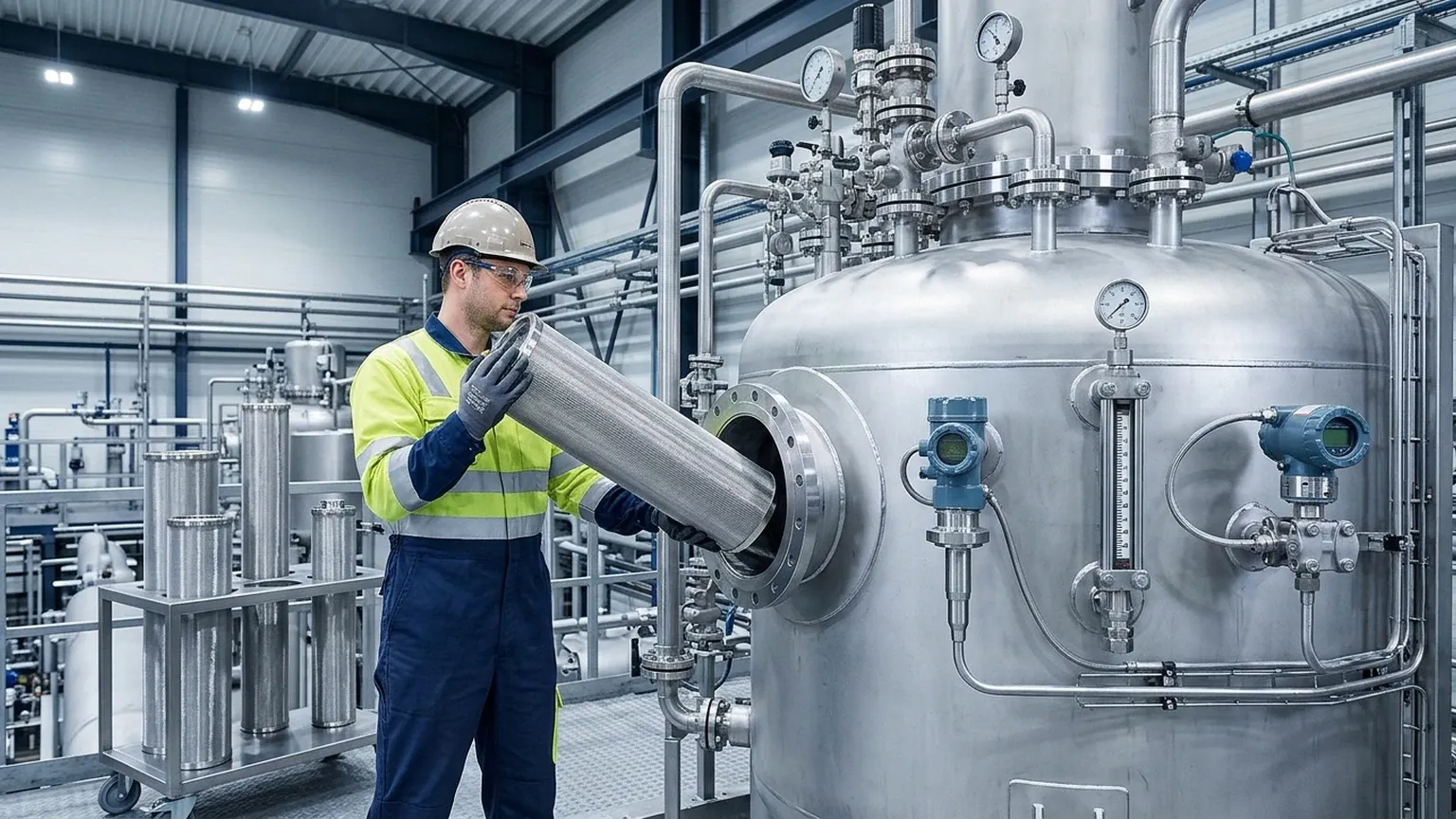
Installation Requirements and Sealing Integrity
A high-precision filter is useless if the fluid can bypass the media. Proper installation and sealing are paramount for effective wire mesh filtration.
Sealing Methods
The ends of wire mesh tubes must be sealed to the housing. Common methods include:
* O-Rings and Gaskets: Using elastomers like EPDM, Viton, or PTFE. The choice of gasket must match the chemical and thermal profile of the fluid.
* Metal-to-Metal Seals: Used in high-temperature or high-purity applications where elastomers might degrade or outgas.
* Welded End Caps: For permanent installations or where the filter is part of a larger welded assembly.
Flow Direction
Most cylindrical filters are designed for "outside-to-in" flow, where contaminants are trapped on the exterior surface, making them easier to inspect and clean. However, some systems require "inside-to-out" flow, particularly when the filter acts as a basket to collect large debris. Reversing the designed flow direction without consulting the manufacturer can lead to the structural collapse of the mesh.
Maintenance, Cleaning, and Replacement Cycles
One of the primary advantages of wire mesh filtration is that the elements are often cleanable and reusable, which lowers the total cost of ownership compared to disposable cartridges.
Cleaning Techniques
* Backwashing: Reversing the flow of clean fluid through the filter to dislodge surface contaminants. This is often automated in continuous process systems.
* Ultrasonic Cleaning: Placing the filter in an ultrasonic bath. The high-frequency sound waves create cavitation bubbles that remove fine particles lodged deep within the mesh pores.
* Chemical Cleaning: Using solvents or acids to dissolve organic or mineral scaling. It is vital to ensure the cleaning agent does not attack the stainless steel or the brazing/welding materials.
Determining Replacement Cycles
While reusable, wire mesh filters do have a finite lifespan. Repeated cleaning cycles can eventually lead to "work hardening" of the wires, causing them to become brittle and crack. Signs that a filter needs replacement include:
* Permanent high pressure drop (blinding that cannot be cleaned).
* Visible gaps or tears in the mesh.
* Deformation of the support core.
Procurement Guide for Technical Buyers
When sourcing Wire Mesh Filter Cylinders & Tubes from international manufacturers, technical buyers should confirm specific details to ensure the product meets engineering standards.
Technical Checklist for Buyers
1. Micron Rating Verification: Does the manufacturer provide a bubble point test report or a glass bead test to verify the absolute micron rating?
2. Material Certification: Request Mill Test Reports (MTRs) to confirm the grade of stainless steel (e.g., verifying 316L vs. 304).
3. Dimensional Tolerances: For custom tubes, specify tolerances for length, outer diameter (OD), and inner diameter (ID). Even a 1mm deviation can prevent a proper seal in the housing.
4. Weld Quality: Inquire about the welding method (TIG, Plasma, or Resistance welding). Smooth, burr-free welds are essential to prevent fluid turbulence and potential points of corrosion.
5. Compliance: Ensure the filters meet industry-specific standards, such as FDA compliance for food contact or ISO 9001 for general manufacturing quality.
Conclusion
Wire mesh filtration is a robust and versatile solution for industrial separation needs. By selecting the appropriate material, weave, and structural design, engineers can achieve precise filtration with long-term reliability. Whether the application involves protecting sensitive hydraulic valves or ensuring the purity of a chemical batch, the performance of Wire Mesh Filter Cylinders & Tubes is a fundamental component of system integrity. Understanding the balance between flow rate, pressure drop, and cleaning requirements allows for an optimized filtration strategy that minimizes downtime and maximizes process efficiency.
