


Wire Mesh Pre Filter
In industrial fluid processing, the reliability of downstream equipment—such as high-pressure pumps, fine membrane filters, and precision nozzles—depends heavily on the effectiveness of the initial filtration stage. A wire mesh pre filter serves as this critical first line of defense, removing large particulate matter, debris, and scale that could otherwise cause mechanical wear or premature clogging of more expensive components.
For engineers and procurement professionals, selecting the correct Wire Mesh Filter Cylinders & Tubes requires a technical understanding of fluid dynamics, material science, and mechanical structural integrity. This guide examines the engineering principles, selection criteria, and operational considerations necessary to optimize pre-filtration performance in demanding B2B environments.
The Role of a Wire Mesh Pre Filter in Industrial Systems
Pre-filtration is defined by its position in the process flow. Its primary objective is "coarse" filtration, typically targeting particles ranging from 50 to 500 microns, though finer applications exist. By capturing these larger solids, the wire mesh pre filter reduces the solids loading on secondary and tertiary filtration stages.
From a Total Cost of Ownership (TCO) perspective, an effective pre-filter is a sacrificial yet cleanable component. While secondary filters (such as melt-blown cartridges or membranes) are often disposable and costly, stainless steel wire mesh components can be cleaned and reused multiple times. This significantly lowers the operational expenditure (OPEX) of the entire filtration system.
Key Functions:
* Equipment Protection: Preventing large particles from entering pumps where they can cause cavitation or impeller erosion.
* Process Stability: Reducing the frequency of unplanned shutdowns caused by the sudden clogging of fine filters.
* Resource Recovery: In some chemical processes, the pre-filter captures valuable catalyst or raw material particles for recycling.
Engineering Fundamentals: How Wire Mesh Filter Cylinders & Tubes Function
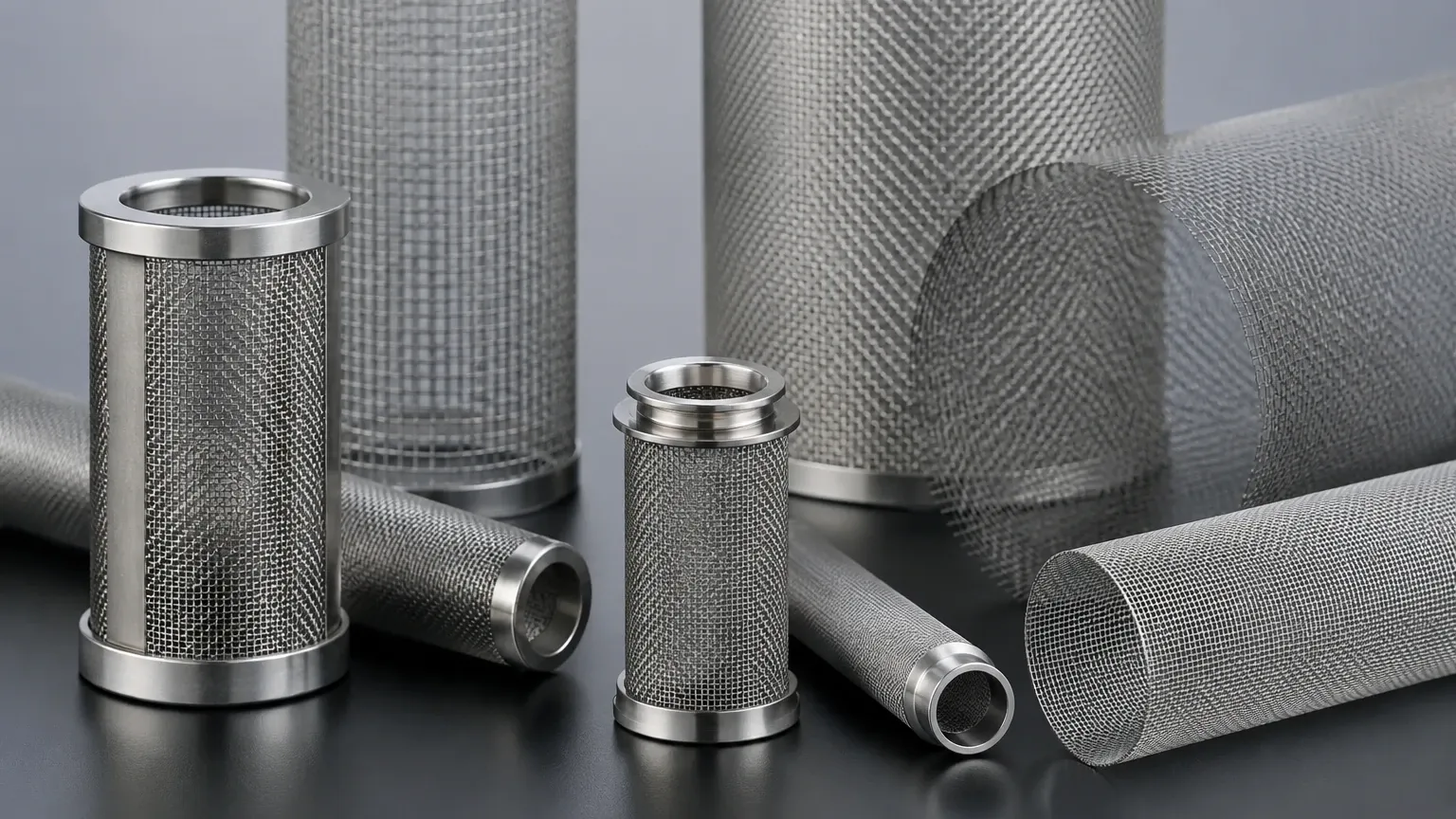
The performance of a pre-filter is governed by its geometry and the weave of the mesh. Most industrial pre-filters are constructed as Wire Mesh Filter Cylinders & Tubes to provide a high surface-area-to-volume ratio and to withstand radial pressure differentials.
Surface Filtration vs. Depth Filtration
Unlike sand filters or thick felt bags, wire mesh operates on the principle of surface filtration. Particles larger than the mesh opening are trapped on the upstream surface. This allows for predictable performance and easier cleaning.
Weave Types and Their Impact
1. Plain Weave: The most common and cost-effective. It offers high flow rates and low pressure drop, making it ideal for general-purpose pre-filtration.
2. Dutch Weave: This weave uses heavier wires in one direction and finer wires in the other, creating a dense, strong mesh. It is preferred for applications requiring higher mechanical strength and finer filtration than plain weave can offer.
3. Twilled Weave: Used when heavier wires are required for a specific mesh count, providing increased durability for high-viscosity fluids.
Material Selection and Structural Integrity
In industrial engineering, material compatibility is non-negotiable. Most wire mesh pre filter components are manufactured from stainless steel due to its resistance to corrosion and temperature extremes.
Stainless Steel Grades
* AISI 304: Suitable for general industrial water, food and beverage applications, and mild chemical environments.
* AISI 316L: The "L" denotes low carbon, which improves weldability and resistance to intergranular corrosion. This is the standard for pharmaceutical, marine, and highly acidic chemical processing.
* Specialty Alloys: For extreme environments, alloys like Monel or Inconel may be utilized, though 316L satisfies the majority of industrial requirements.
Structural Reinforcement
In high-pressure systems, the mesh itself may not have the structural rigidity to resist collapsing or bursting. Engineers often specify Wire Mesh Filter Cylinders & Tubes that incorporate a perforated metal core or an external support cage. This "sandwich" construction allows the fine mesh to perform the filtration while the perforated plate handles the mechanical load.
Critical Selection Criteria for Engineers
When specifying a wire mesh pre filter, several variables must be balanced to ensure the component does not become a bottleneck in the system.
1. Micron Rating and Open Area
The micron rating defines the largest spherical particle that can pass through the mesh. However, engineers must also consider the "percentage of open area." A higher open area results in a lower initial pressure drop ($Δ$P) and longer run times between cleanings. If the open area is too low, the fluid velocity through the pores increases, which can force deformable particles through the mesh.
2. Flow Rate and Velocity
The flow velocity should be kept within limits that prevent turbulence and excessive shear stress on the mesh. For water-like viscosities, a common engineering rule of thumb is to keep the velocity through the filter housing below 3 meters per second, though the specific flux (flow per unit area of mesh) is the more critical metric for the filter element itself.
3. Clean Pressure Drop (ΔP)
Every filter introduces a pressure drop. A well-designed pre-filter should have a clean $Δ$P of less than 2-3 psi (0.14-0.21 bar). If the initial pressure drop is higher, it indicates the filter is undersized for the application, which will lead to a very short service life.
Installation Constraints and Configuration Options
The integration of Wire Mesh Filter Cylinders & Tubes into an existing pipeline requires careful attention to the mechanical interface. Standard configurations include:
* Single-Layer Cylinders: Best for low-pressure, high-flow applications where easy cleaning is the priority.
* Multi-Layer Sintered Tubes: Multiple layers of mesh are bonded together using heat and pressure. This creates a robust, rigid structure that does not require a separate support core and offers excellent backwashing characteristics.
* Pleated Elements: By pleating the mesh, the surface area can be increased by 2 to 4 times compared to a smooth cylinder of the same dimensions. This is ideal for systems with high solids loading but limited space for a large filter housing.
Sealing Mechanisms
Bypass is the enemy of filtration. If the fluid can go around the filter rather than through it, the pre-filter is useless. Engineers must specify the correct sealing method, such as:
* Double Open End (DOE): Uses flat gaskets at both ends.
* Single Open End (SOE): Often features a 222 or 226 O-ring configuration with a locking fin to ensure a leak-proof mechanical seal.
Maintenance, Cleaning, and Replacement Cycles
One of the primary advantages of a stainless steel wire mesh pre filter is its cleanability. However, the cleaning method must be matched to the contaminant.
1. Backwashing: Reversing the flow of fluid to dislodge particles. This is most effective for non-fibrous, hard particulates.
2. Ultrasonic Cleaning: Using high-frequency sound waves in a solvent bath to remove fine particles trapped deep within the mesh pores. This is the gold standard for restoring pleated or multi-layer sintered filters.
3. Chemical Cleaning: Using acids or alkalis to dissolve organic buildup or mineral scale. Material compatibility between the cleaning agent and the stainless steel grade must be verified.
When to replace? While reusable, wire mesh eventually suffers from mechanical fatigue or "blinding" (permanent clogging). If the pressure drop after cleaning is significantly higher than the original clean $Δ$P, or if there is visible deformation of the mesh, the element must be replaced to prevent downstream contamination.
Application Risks and Mitigation
Engineers should be aware of specific risks that can compromise pre-filtration:
* Pressure Spikes: Rapidly opening or closing valves can create water hammer, which may burst the mesh. Installing a pressure snubber or choosing a reinforced cylinder design can mitigate this.
* Viscosity Changes: If the process fluid thickens (e.g., due to temperature drops), the pressure drop across the mesh will rise exponentially. In such cases, heated filter jackets or coarser mesh may be required.
* Abrasive Wear: In mining or slurry applications, high-velocity particles can physically erode the wire mesh. Using thicker wire diameters or specialized hardened coatings can extend service life.
Procurement Checklist for International Buyers
Before finalizing a purchase order for Wire Mesh Filter Cylinders & Tubes, international buyers should confirm the following technical specifications with the manufacturer:
1. Exact Dimensions: Outer diameter (OD), inner diameter (ID), and overall length (OAL) including end caps.
2. Mesh Specification: Mesh count (wires per inch) or absolute micron rating.
3. Material Certification: Request MTRs (Material Test Reports) to verify the grade of stainless steel.
4. Pressure Rating: Maximum allowable differential pressure ($Δ$P) the element can withstand before deformation.
5. End Cap Style: Ensure compatibility with existing filter housings (e.g., NPT threaded, flanged, or O-ring plug).
By following these engineering guidelines, industrial facilities can ensure that their wire mesh pre filter provides reliable, long-term protection for their process equipment, maintaining high throughput and minimizing costly downtime.
